


How a 25-Acre Vegetable Farm Keeps Its Employees Year-Round
 October 6, 2026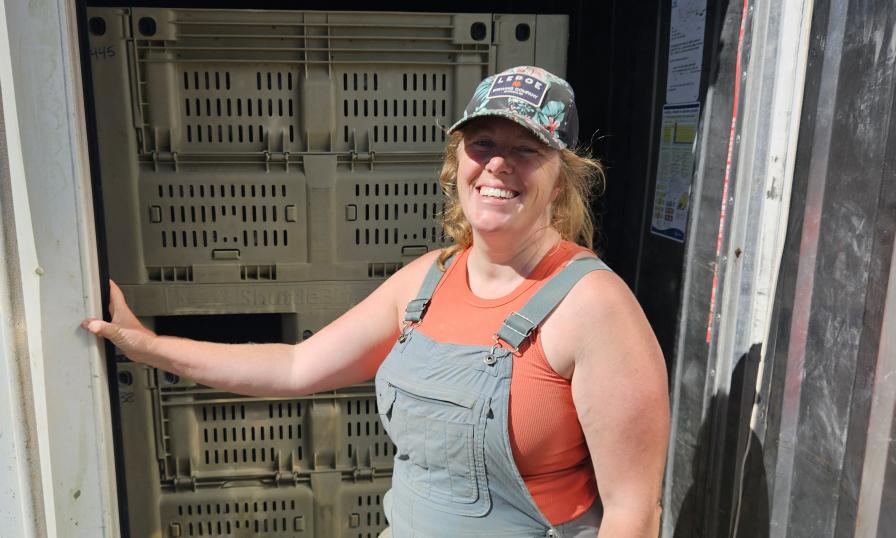
Bethany Allen of Harvest Tide Organics knows crop planning and labor planning go hand in hand, helping the farm retain a year-round team.
Photo: Carol Miller
For a small vegetable farm, keeping good employees is tough enough during the growing season. Keeping them through a Maine winter requires a different approach. At Harvest Tide Organics, Co-owners Bethany Allen and Eric Ferguson grow about 25 acres of vegetables. Several years ago, employees told Allen that the promise of year-round work made it easier to commit to the farm, and more likely they would return for another season.
Harvest Tide began restructuring its labor model around that idea. Today, every position the farm hires locally is a year-round job.
Hours drop during the winter, when employees typically work about 32 hours rather than 40. During the busy season, Harvest Tide supplements its local team with seasonal H-2A workers.
That combination lets the farm increase its workforce when labor needs peak without treating its local employees as seasonal workers.
“We’ve also found that trying to be as competitive as possible with the wages that we offer and offering a lot of side benefits [are] really critical,” Allen says.
The goal is to attract people who want farming to be their profession, even if owning a farm isn’t their ambition.
That has helped Harvest Tide retain employees for three, four, and five years. The payoff, Allen says, becomes especially apparent when spring arrives.
Experienced employees already know the farm, its systems, and what needs to happen. A successful spring sets the operation up for a successful summer.
People Before Equipment
How does a 25-acre farm afford year-round employees?
“It’s really touch and go,” Allen says.
Harvest Tide makes a conscious tradeoff: Labor gets priority over some equipment and other capital investments. That means the farm buys fewer pieces of equipment and makes fewer large asset purchases than the owners might otherwise like — or sometimes need.
“We’d rather spend our money on our awesome team that we like to be around, that can help take care of the farm when we’re not here,” she says.
The farm’s marketing model helps make the labor strategy possible, too.
Most Harvest Tide produce is sold directly to consumers through a customizable CSA. That allows the farm to receive retail value for its crops while giving customers flexibility in what they receive.
Just as importantly, customers commit in advance. Allen says roughly 60% of the farm’s cash flow is predetermined on a rotating basis three to four months ahead. That gives Harvest Tide Organics greater ability to anticipate revenue and plan labor expenses.
“It’s not a perfect system,” she says. “But we’ve found that it helps us keep really committed people on the farm longer.”
Benefits That Fit the Farm
Harvest Tide also looks beyond hourly wages when competing for employees.
Each employee receives a CSA share — not simply access to seconds or surplus produce. Besides being worth about $30 a week, the benefit gives employees firsthand experience with the same CSA system the farm’s customers use.
The farm provides a technology stipend to help cover phones used for work and gives year-round employees a $100 PPE stipend twice a year for boots, coats, and other workwear.
Harvest Tide also offers a SIMPLE IRA with an employer match of up to 3%, along with earned paid time off and scheduled paid breaks. SIMPLE stands for Savings Incentive Match Plan for Employees, a retirement plan designed for small businesses.
That includes the week between Christmas and New Year’s. This year, Allen and Ferguson decided to experiment with something harder to provide on a vegetable farm: meaningful time off during Maine’s short summer.
They scheduled a one-week CSA break and arranged staffing so employees could receive several consecutive days off, creating five-day summer weekends without leaving the farm unattended.
The approach continues to evolve.
“We’re always trying new things,” Allen says. “It works one year at a time.”
Markets change. The economy changes. What works today may need adjusting tomorrow.
But for Harvest Tide, investing in people has created something difficult to put on a balance sheet: an experienced team whose members know the operation, take their jobs seriously, and want to come back.
“And they’re happier, and it just makes us happier,” Allen says. “We have people around that we really like and respect, and that take it really seriously. We’re super grateful.”
Subscribe Today For
