



Stock Up On Alternative Crops
 June 25, 2012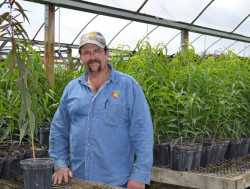
There has always been a buzz around “alternative” crops, as growers seek the next big thing in specialty crop production. With today’s challenges like HLB in citrus and tight margins in other more traditional crops, perhaps the search for alternatives is more intense than ever.
For growers in search of these new and emerging crops, Hopkins Nursery has just about any alternative crop one can imagine. The nursery’s tagline — “Where the exotic becomes reality” — is fitting considering there are about 60 different species of fruit plants in cultivation there on the 10-acre operation in Immokalee.
The operation is a family affair with a passion for growing tropical fruit. The nursery is managed by Billy Hopkins, his mother Barbara, and his wife Rachel. Billy and Rachel’s daughter Hannah Joye is five and already in command of many of the plants grown at the nursery.
Picking Peaches
Hopkins is now selling peach liners and he has some advice for growers considering planting the crop. “I have heard some people comment that peaches are replacing citrus,” says Billy Hopkins. “This is simply not true. Look at peaches as an addition to your income. Peaches begin fruiting after Valencias are finished, so they are a way to extend your season and cash flow.”
He adds that growers should start with a solid rootstock selection. There are some peaches going in older rootstock technology from Tennessee, which is not the proper selection. Flordaguard is the current rootstock developed by and recommended from UF/IFAS.
“Verify that peach trees you purchase are fresh,” says Hopkins. “Trees grown on speculation may have been sitting and have become stagnant or have circling roots and are root bound. Make sure the trees are actively growing, unless they are purchased in winter while they are dormant.”
Hopkins also advises that prospective or existing peach growers visit different nurseries to inspect the quality and appearance of trees. “Pull a few plants out of their containers and look at the roots,” he says.
“We recommend contract growing the peach trees to ensure you have the freshest trees possible. It is not like the good old days of field grown citrus nurseries. Peaches don’t care for the old deep citrus pots.”
Currently, Hopkins is testing different containers that will produce a good tree with a healthy root system. Experimentation with new crops and new production techniques is emblematic of how Hopkins Nursery has been successful over the years.
Ancient Crops Comeback
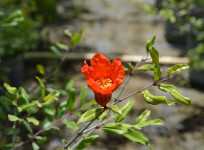
While peaches have garnered much of the current alternative crop attention, pomegranates and olives also are getting noticed as having potential in Florida. These crops date back to biblical times, but have been in demand throughout history. Recent news on both plants’ health benefits are bringing increasing interest from consumers in pomegranates and olives.
During the All Florida Ag Show in April, Dr. Bill Castle, UF/IFAS, announced the formation of the Florida Pomegranate Association to support the fledgling interest in the new crop in the state. “Dr. Castle is researching the crop’s viability here,” says Hopkins. “At this time, there is not a fresh fruit market here, however efforts are being made to develop a pomegranate industry in Florida. It does appear to make a good processed fruit crop.”
Hopkins sells five primary pomegranate varieties at the nursery. He says he and others are still trying to determine which varieties work best in different locations.
Stock Up On Alternative Crops ctd.
Growers in North Florida, Georgia, and South Texas have had commercial success with olives, so it is being eyed as a new crop with potential in Florida. “Olives are a hit from the Orlando area northward,” says Hopkins. “In addition, the Arbequina variety is fruiting on a regular basis south of Orlando, so it might be a good crop for Central Florida as far south as Sebring.”
A Veritable Cornucopia
While Hopkins Nursery sells the much discussed alternative crops like peaches, blueberries, pomegranates, and olives, there’s plenty more types of plants for growers seeking alternatives to choose from.
“Plums and nectarines are a new area to watch,” says Hopkins. “These new varieties developed by UF/IFAS have potential and have not yet been planted extensively, so it leaves space with a crop without a lot of competition right now. Plums and nectarines are a good fit for smaller farmers who can tap into the buy local interest from consumers.”
Avocados also are a big part of the operation’s business. In May, the nursery was busting at the seams with avocado plants being prepped for large customer orders. More than 20,000 plants shipped. Hopkins says five varieties have potential outside of South Florida. These five are ready to harvest from July to September.
“Cold hardy avocados will grow in Central Florida and warmer parts of North Florida,” he says. “They are pure Mexican varieties like the Haas. South Florida growers don’t want to get involved with smaller fruit like a Haas and the existing competition. I think the Haas market has opened the door for the smaller avocados and we should walk through it.”
Dragon fruit is another crop that Hopkins says is easy to grow with low pest and disease pressures and low fertilizer requirements. In addition, it is more cold hardy than some people think. “Dragon fruit has a lot of promise and will take a considerable amount of cold,” says Hopkins. “I’ve seen a planting in eastern Punta Gorda that froze two years ago. It was the December freeze that dropped down to 24°F and colder. Those plants fruited in the spring.
Guava also is available from Hopkins Nursery. “Guava is a desirable fruit for many ethnic groups who live in the U.S., so it enjoys high sales,” say Hopkins. “The drawback for some folks is that it needs to be grown in a relatively warm area. Guavas are being shipped into the U.S., so I say growers should take advantage of this demand and grow and market them here. We can grow and deliver a superior product to the market.”
Papaya is a good crop for a quick turnaround. “If you time it right, you can plant papaya and harvest a crop before winter kills the trees,” Hopkins says. “In a good year/winter, it might be possible to get a couple years out of a tree, or in warmer areas possibly three years.”
Other crops that Hopkins suggests growers give a look include lemon grass, passion fruit, and blackberries. “Lemon grass is a clumping grass with high demand in Asian cooking and has been used throughout the Caribbean,” says Hopkins. “It is being used more and more in American dishes, so expect demand only to grow. Passion fruit needs to be planted in warmer areas of Florida, but it will fetch a good price in the market. And, blackberries are beginning to look better as a crop in northern parts of South Florida and Central Florida because of new variety selections.”