



CRISPR Technology at Heart of Potential Apple Industry Game Changer
 September 9, 2025
 Apple production is labor-intensive due to manual orchard operation tasks, such as tree pruning and fruit harvesting. Unfortunately, the scarcity of agricultural workers is frequently getting worse. Such supply shortage has driven labor costs for apple production nearly double over the past 10 years. As a result, the U.S. apple industry has been increasingly threatened by the rising costs in fruit production. To effectively address the threats, Neal Carter, CEO and Co-Founder of Okanagan Specialty Fruit (OSF), argues that a key for sustaining the apple industry is to make apple trees bear fruit on green shoots that develop after breaking dormancy each spring using the CRISPR gene editing technology.
The argument is detailed in his white paper, “Traits and Tech: Designing the orchard of the future,” published April 30.
Below are my comments on Carter’s argument, with some additional information provided:
How do apple trees produce fruit in the current production system?
The current apple production system is largely established on how apple fruits are produced naturally from reproductive (flower and fruit) buds. However, all apple buds are initially vegetative buds for leaves and shoots. Among the vegetative buds, some will naturally develop into flower buds. It would be useful to first understand this developmental process.
For most apple cultivars, the development from vegetative to reproductive buds, a process called flower induction, occurs during a period from early summer through early fall. When the growing season ends, all components are made available as miniatures. These miniatures will continue to develop slowly over the winter and become fully developed in spring. After budbreak, a cluster of six individual flowers usually appears. Overall, the entire process takes about 10 months, explaining why apples usually set fruit on at least two-year-old wood.
Depending upon their location on shoots and spurs (short shoots), flower buds are grouped into terminal flower buds and lateral flower buds (SEE PHOTOS BELOW). Differences exist among apple cultivars in their preference of flower bud locations. Some cultivars, such as ‘Gala’ and ‘Golden Delicious’, frequently flower on lateral buds on shoots in addition to terminal buds on spurs and shoots, while others mostly do so on terminal buds on shoots (‘Granny Smith’ and ‘Rome Beauty’) or on terminal buds of spurs (‘McIntosh,’ ‘Delicious’). Consequently, the locality of apple fruit is nearly random in canopy.
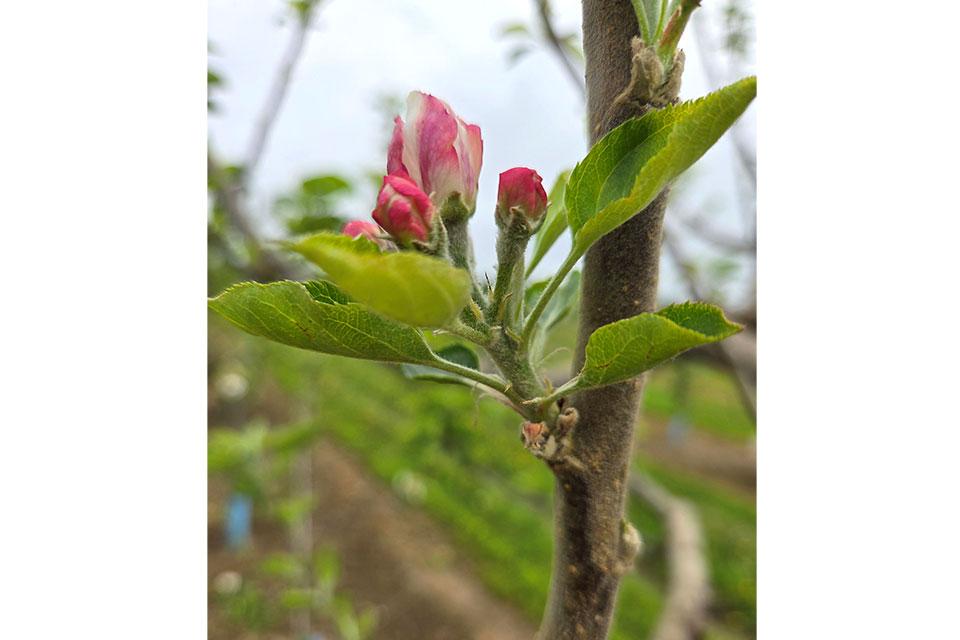
A lateral fruit bud-derived flower cluster shortly before bloom.
Photo by Kenong Xu
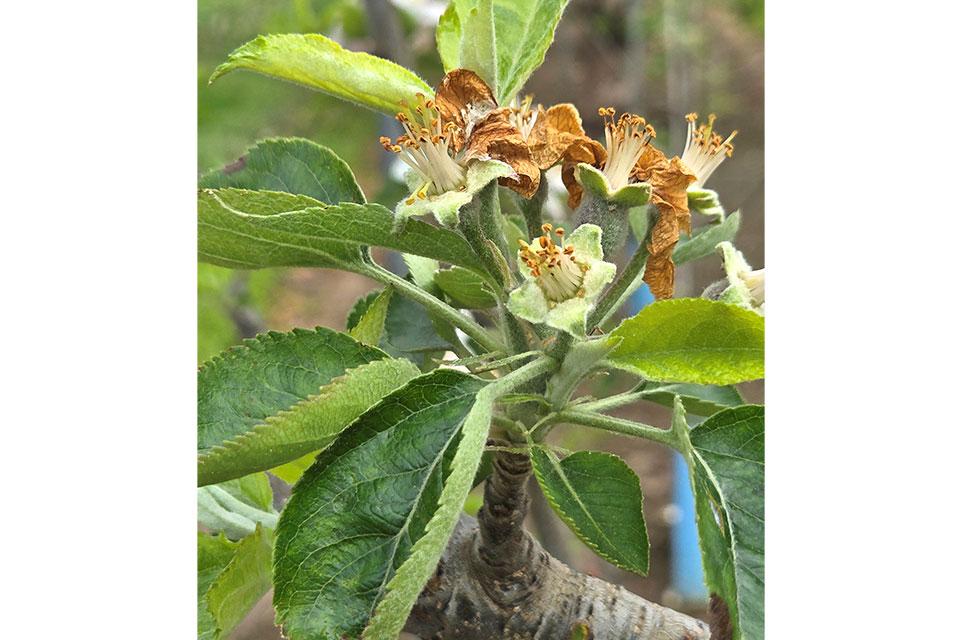
A spur terminal bud-derived flower cluster soon after pedal fall.
Photo by Kenong Xu
Why is the natural apple fruit producing method a major constraint for industry?
It has long been understood that orchard automation is the key for industry’s profitability and sustainability. As part of endeavors for orchard automation, multiple robotic apple fruit harvesting systems were developed, such as those by FFRobotics, Advanced Farm Technology, and Abundant Robotics. However, none of them was adopted by the industry.
A major challenge has been the high costs in building and implementing these robotic systems due to the complexity in picking fruit rapidly, which is directly stemmed from the natural apple fruit producing method. This is particularly true when the large tree size and the vulnerability of fruit to physical damage are considered. Thus, tree pruning and fruit harvesting remains to be conducted by workers.
These unsuccessful efforts in orchard automation call for alternative methods for producing apple fruit.
Why could bearing fruit on green shoots be a game changer for the apple industry?
Based on Carter’s white paper, OSF scientists have identified a gene that can make apple trees set flowers and produce fruit from the current year (green) shoots, like grapevine.
This paves a road for OSF to edit this gene in commercial apple cultivars using the CRISPR gene editing technology to convert them into a green shoot fruit bearer.
Such gene edited apple cultivars can be grown like grapevine, instantly enabling automation for tree pruning and fruit harvesting.
According to the white paper, the estimate cost savings could be $8,000 to $10,000 per acre over the current production costs of $14,000 to $16,000 per acre.
This certainly would be a game changer for the apple industry if successful.
However, it is unclear on how much the flowering time would be delayed in such green shoot fruit bearers, which may cause issues in pollination and restrictions for late-season apple cultivars, such as ‘Granny Smith’ and ‘Pink Lady’.
Subscribe Today For
