


Watching for Potential Preharvest Remedy to Postharvest Problem in Pome Fruit
 March 24, 2026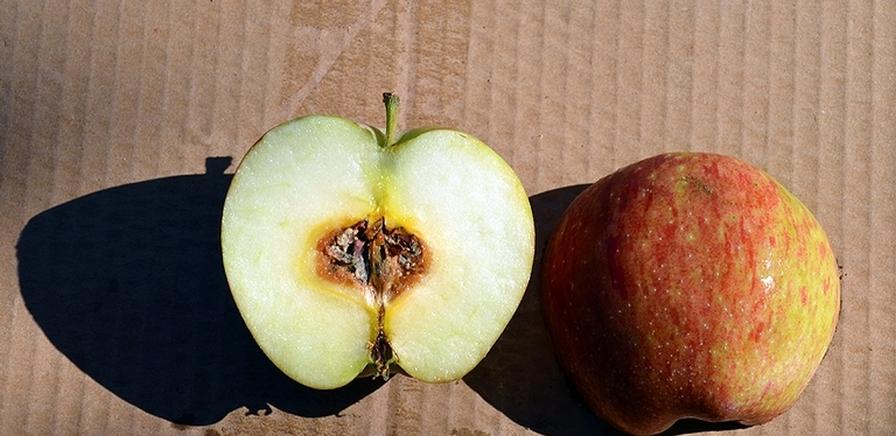
This apple is showing symptoms of Alternaria rot (Alternaria alternata (Fr.) Keissl).
Photo: Karen Levy, Bugwood.org
Four fungicides — triflumizole, flutriafol, cyprodinil, and fluazinam — may be effective as preharvest controls against postharvest nemesis Alternaria rot, according to Penn State University in vitro research presented at the Mid-Atlantic Fruit and Vegetable Convention in January.
Alternaria rot is considered the “most notorious” postharvest rot in the Mid-Atlantic, Kristen Pierce, Research Project Manager at Penn State’s Fruit Research and Extension Center, said at the Mid-Atlantic Fruit and Vegetable Convention. The fungus, which infects numerous hosts while thriving in diverse ecological niches, has low sensitivity to fungicides across multiple Fungicide Resistance Action Committee (FRAC) groups.
In fact, the only effective postharvest fungicide to be identified to date is FRAC 12 fludioxonil (Scholar, Syngenta), Pierce said.
TAKING IT TO THE FIELD
Despite its reputation as a postharvest pathogen, Alternaria does infect pome fruit in the field. Researchers have known the pathogen causes Alternaria leaf blotch in apple, and 2024 research out of China links the pathogen to apple tree cankers.
Currently, the most effective preharvest fungicide against Alternaria rot, at an average efficacy of 64.9% (fair), is FRAC 3 difenoconazole. Also rated fair, at 49%, is FRAC 7 fluopyram. Four other fungicides — FRAC 7 fluxapyroxad, FRAC 11 pyraclostrobin and trifloxystrobin, and FRAC 1 thiophanate-methyl — are rated “poor” against the disease.
“So, there is a need for greater depth of fungicide exploration,” Pierce said.
FRAC 3 RELIABILITY
Pierce and former Penn State doctoral student Johanny Castro, under Kari Peter, Associate Research Professor of Tree Fruit Pathology, tested seven fungicides in fungicide-amended agar media in concentrations of 1, 10, 100, and 1,000 parts per million (ppm) of active ingredient against 40 Alternaria isolates.
Consistent with previous results, two FRAC 3 fungicides fared best, according to Pierce. Both triflumizole (Procure, UPL) and flutriafol (Rhyme, FMC) inhibited the growth of 75% of the Alternaria isolates at both 100 ppm and 1,000 ppm, which is encouraging since the field rate equivalent (FRE) for each is 527 ppm and 53 ppm, respectively.
Of note, FRAC 9 cyprodinil (Vangard, Syngenta) inhibited the growth of the majority of the isolates by more than 50% at just 1 ppm, which is “quite impressive,” Pierce said, given that its FRE is 235 ppm.
RELATED CONTENT: Crop Protection Tools To Fight Blight in Peach Crops
FRAC 29 fluazinam (Omega, Syngenta) landed in the middle of the seven fungicides. While it was unable to inhibit the growth of more than 50% of the isolates at 1,000 ppm, it did decrease the average colony diameter by more than 75% at 100 ppm (FRE is 431 ppm).
Also consistent with previous results, FRAC 7 and FRAC 11 fungicides — in this case penthiopyrad and kresoxim-methyl, respectively — did not inhibit any of the Alternaria isolates’ growth. Another FRAC 7, benzovindiflupyr, could not be tested at 1,000 ppm but at the same time it did not perform well at 1, 10, or 100 ppm.
Subscribe Today For
