



Berry Good Recognition for a True Postharvest Powerhouse
 April 3, 2025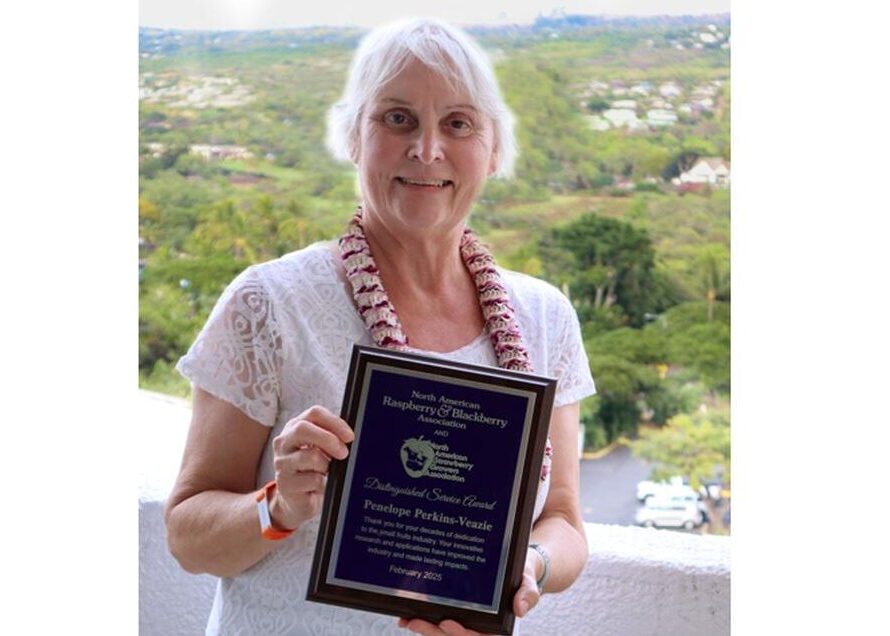
Congratulations to NARBA and NASGA Distinguished Service Award winner Penny Perkins-Veazie.
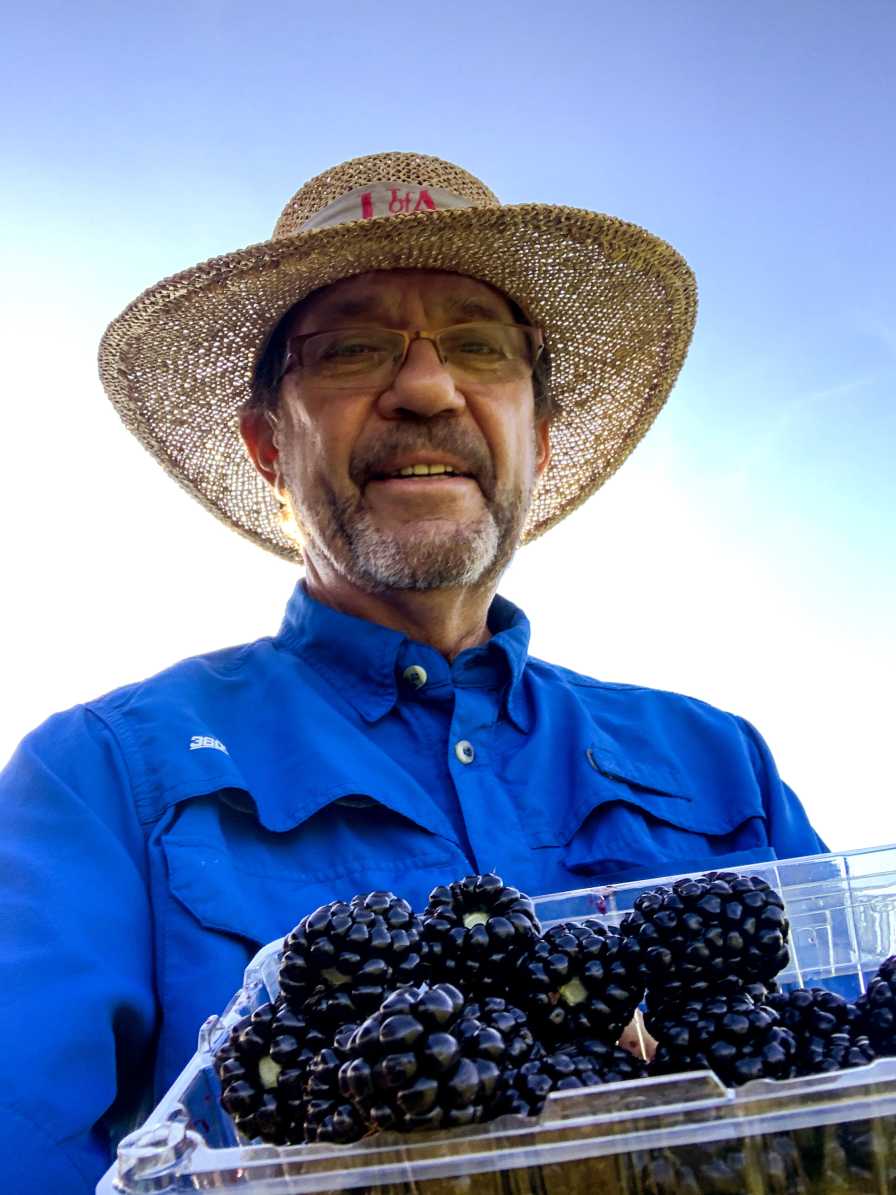
Photo courtesy of John R. Clark
One of the highlights of my research career has been cooperating with exceptional scientists at other institutions. Penny Perkins-Veazie is one of the most special. She was recently presented the Distinguished Service Award by the North American Raspberry and Blackberry Growers Association (NARBA) and North American Strawberry Growers Association (NASGA) at their annual meeting in Hawaii in February. That she was recognized for her career-long work in postharvest physiology was great to see.
The native of Maine — she and David Cain, the creator of ‘Cotton Candy’ grapes, are two Mainers special to me! — attained her BS from the University of Maine-Orono in 1981 and her MS and PhD degrees from the University of Florida in 1985 and 1988, respectively. Her first professional position was with the USDA-ARS in Lane, OK, starting in 1988. She later moved to North Carolina State University in 2008 and has been based at the North Carolina Research Campus in Kannapolis, NC.
For her career, Perkins-Veazie has advanced knowledge of fruit composition and shelf-life extension of small fruits in conjunction with breeding programs. More recently, she has been exploring the anthocyanins contributing to the visual color of strawberries, raspberries, elderberries, muscadines, and blueberries as the importance of anthocyanins for human health increases.
‘EYE-OPENING RESEARCH’
My first job was based at the University of Arkansas Fruit Research Station, Clarksville, as resident director of the station while also researching small fruits, both cultural management and breeding collaboration. Jim Moore and I released ‘Navaho’ blackberry in 1989, and I noticed it had far superior storage potential compared to the other Arkansas varieties at the time. In the early 1990s I began some elementary storage trials of ‘Navaho’ compared to other varieties and advanced selections and could tell there was a lot of difference between ‘Navaho’ and other varieties in the amount of leakage, mold, and retention of black color in berries stored for four to seven days.
At this time blackberries were not routinely found in grocery stores but were a local-market and pick-your-own berry. As best I can remember, Penny and I had lunch one day in Ft. Smith, AR, in the early 1990s, when she was attending a meeting of the Arkansas State Horticultural Society. I told her of the potential to research postharvest storage of blackberries, and that I thought there was substantial opportunity to identify differences in ‘Navaho’, existing older varieties, and advanced selections in the Arkansas blackberry breeding program.
This was the beginning of very important research that she led while focusing on blackberry postharvest. She published her first paper on this research, “Changes in blackberry fruit quality during storage,” in 1993. And, wow, did the research productivity grow from that point forward! In her research she was able to verify the storage potential of ‘Navaho’, and in 1997 published a paper explaining the storage potential of ‘Navaho’ fruit shipped to Europe. This was eye-opening research since no one thought blackberries could be shipped for any distance (this was before the large Mexican blackberry shipping industry developed).
Of extreme importance was her development of a postharvest protocol used in the Arkansas breeding program to differentiate storage potential of new developments. Her input on the storage potential of the 2003-released ‘Ouachita’ was extremely important, as soon after its release, the eastern U.S. shipping blackberry industry developed, with ‘Ouachita’ a key component. The protocol she developed is still a cornerstone of evaluations of Arkansas blackberry developments.
MAKING A DIFFERENCE
Penny went on to expand her work in other fruits as her career continued at NC State. Her cooperation with Gina Fernandez and Jim Ballington led to the release of ‘Von’ blackberry. Her work in anthocyanins and their benefits in human health have been noteworthy, particularly on blueberries, strawberries, raspberries, and muscadine grapes. Penny has been a prolific publisher of research papers and been an excellent speaker at hundreds of conferences, both research and grower oriented. Prior to her recent recognition by NARBA and NASGA, she was named a Fellow of the American Society for Horticultural Science (ASHS) as well as receiving the ASHS Research Award. She also received the prestigious Chad Finn Ambassador Award from the American Pomological Society (APS).
Penny Perkins-Veazie has been a difference maker in our berry world. She has the intelligence, persistence, follow-through, and constant interest of growers in her approach to research. I was lucky enough to spend years working with her in our little blackberry postharvest world, starting 30-plus years ago. That world is a lot bigger today, with a big part of this due to her efforts.
Let the berry good times roll!
Subscribe Today For
