



How To Scout For Bois Noir
 June 1, 2007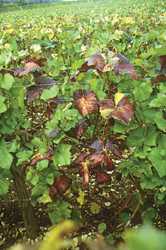
Growers scouting for Bois noir should look for leafrolling and scorching of leaves, as well as leaf yellowing in white wine grapes and purpling in red wine grape leaves, such as Pinot Noir.
The Canadian Food Inspection Agency has discovered a mysterious grapevine yellow disease caused by phytoplasma in a vineyard in British Columbia. The contaminated vines have been traced back to an order received from a nursery in France, where Bois noir is much more common. Pathologists don’t yet know how big a threat the disease represents in North America, says Ken Eastwell a Washington State University plant pathologist.
“What’s different about this is it’s a different phytoplasma than we’ve seen in North America, so we don’t know how it will behave,” says Eastwell. “That’s always a question when you get a new pathogen in a new environment.”
Growers should look for leafrolling and scorching of leaves, and it can also be accompanied by berry shrivel. However, because a lot of phytoplasma diseases, as well as such viral diseases as grape leafroll disease, exhibit such symptoms, the only way to accurately detect the presence of Bois noir is through a molecular assay performed in a lab. Other symptoms of Bois noir include leaf yellowing in white wine grapes, and red wine grape leaves may show purpling.
Climate-Dependent Disease
The disease is also cultivar- and climate-dependent. Exceptionally sensitive varieties include Chardonnay, Sauvignon Blanc, Pinot Noir, and Cabernet Sauvignon. But the disease is tricky, says Eastwell, because infected vines won’t necessarily exhibit symptoms every year. Phytoplasmas can be found in other crops as well. In almonds, a different phytoplasma causes a disease termed almond shrivel, and in potatoes a disease known as purple top.
In all crops, the disease is vectored by leafhoppers. The leafhopper that vectors Bois noir is Hyalesthes obfoletus, a leafhopper that is common in Europe, but is not found in North America. Pathologists remain concerned however, because other leafhoppers may spread the disease. For example, different phytoplasmas can be vectored by 14 different types of leafhoppers. But it’s important to note, says Eastwell, only those leafhoppers that feed on the phloem and transmit phytoplasma could be carriers.
What most concerns pathologists is that the disease is spreading so quickly in Europe. It was first observed in 1960 and until just a decade ago, Bois noir was confined to southern France, northern Italy, and northern Spain. It has since mushroomed throughout Europe and into the Middle East, and has been confirmed in 13 countries. Pathologists don’t know exactly why it spread so quickly, though it is climate-related. “It’s definitely associated with warmer winters,” says Eastwell, “It’s strictly a climate-dependent thing.”
Hot Water Treatment Recommended
Bois noir proliferated so rapidly through Europe that many nurseries that were formerly certified to be clean have become infected. Because of that, growers should be careful about where they source their vines. The recommended procedure to prevent the spread of Bois noir is a hot water treatment of all plant propagation material. This procedure is recognized internationally as the best way to halt the spread of the disease.
While pathologists remain quite concerned about the disease because it’s new and has extended so quickly in other areas, growers who are careful about where they get their rootstocks do not need to worry. Bois noir is obviously a threat to yields and quality, and can even cause quite a bit of winter dieback, particularly in young vines. But by scouting for symptoms of the disease in the summer, as they should be doing for other problems in the vineyards, growers should be able to avoid potential problems, says Eastwell. “They don’t need to be panicking,” he notes, “but they do need to be observant.”
Subscribe Today For
