



Time For A Check-Up
 December 29, 2010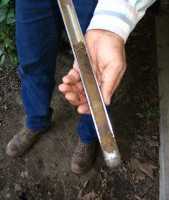
Winter is a common time to perform soil analysis in California orchards and vineyards because the growing season has recently concluded. It is not critical exactly when the samples are taken, but if salts have been accumulating during the growing season, they should become evident by early winter. It is wise to conduct soil analysis every two to three years to alert you to any chemical problems that are developing.
With orchards and vineyards, we rely on tissue (leaves, petioles, or hulls) analysis and on visual assessments for making decisions about the nutritional status of the plant. We do not typically rely on soil analysis to develop fertilizer recommendations for trees and vines in California. The soil analysis is essential to finding out if you are developing a chemical problem of some sort. Tree and vine crops are usually more sensitive to the effects of salinity and toxic elements than most field crops and even some vegetable crops.
The laboratory that performs the analysis will often include some interpretive information to assist you in reading it. You can also call the lab, ask your pest control advisor, or call a University of California farm advisor for more explanation. Most of our Cooperative Extension production manuals have a discussion on nutrition, lab analysis, and recommendations. However, it is wise to have a basic understanding of the terms used in interpreting soil analysis. What follows is a list of such terms.
– pH — This is the measure of how acidic or basic the soil is. Generally we want to be near 7.0 which is neutral, or slightly acidic (6.5 to 7.0). This range is where you have the best overall nutrient availability and no pH related problems.
– EC — An abbreviation for “electrical conductivity,” this is a general measurement of how salty the soil is. With orchards and vineyards we are trying to stay below 1.0 if at all possible. As the soil becomes saltier, you begin to have reduced availability of some nutrients, toxicity symptoms, and water infiltration problems. A full discussion can be found in Agricultural Salinity and Drainage — University of California Agriculture and Natural Resources Publication #3375, available from most Cooperative Extension offices.
– B — Boron is of interest to growers in some areas of the state where B can be high enough to cause toxicity in sensitive crops. In the Central Valley for example, B toxicity is more commonly found on the west side of the Valley — especially along Interstate 5. We hope to have values less than 1.0 ppm (parts per million).
– Cl — Chloride can be toxic to plants in high quantities but it is easy to leach out if there is good, deep percolation. A value of less than 5.0 milliequivalents (meq)/liter is desirable (which is equivalent to 175 mg/liter).
– SAR — The Sodium Adsorption Ratio is used to determine the potential sodium hazard of irrigation water.
– ESP — The Exchangeable Sodium Percentage represents what percentage of the soil exchange sites are taken up by sodium. To avoid water infiltration problems we want a value that is less than 10, but for sensitive crops the value should be less than 5.
– CEC — Cation Exchange Capacity is a measurement of the capacity of the soil to hold onto positively charged nutrient cations, such as magnesium (Mg), potassium (K), and calcium (Ca). Mineral soils with higher CEC are typically more fertile because they have less loss of nutrients due to leaching.
– Base Saturation — This represents how much of the CEC is taken up by cations that are of interest such as calcium, magnesium, potassium, hydrogen or sodium. Typical ratios would be 20% to 80% for Ca, 10% to 40% for Mg and 1% to 5% for K.
– Organic Matter — Sometimes referred to as “OM,” in the hot, arid, West, it is typically very low — especially under irrigated conditions. For practical purposes, in the Central Valley, this value has little impact on our decisions.
– Saturation Percentage (SP) — This is simply a laboratory method of determining the soil texture: Clay, clay loam, sandy loam, etc. You probably already know that or can look it up in the soil survey so there is little value in having it determined again.
– Bicarbonates & Carbonates — These are determined as part of the process in determining the ESP. Waters that are high in these can lead to plugging of the drippers or micro jets.
Subscribe Today For
