



Stemilt is In It for the Long Haul
 March 1, 2008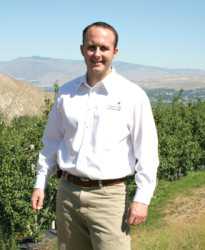
One of the hottest buzzwords in agriculture in the last few years has to be “sustainability.” Look over any conference agenda and you’re likely to find a seminar or panel discussion on the topic. Washington State University recently announced that graduate students working toward their degree in any discipline can now earn a graduate certificate in Sustainable Agriculture. The buzz brings a smile to the face of West Mathison, the president of Stemilt Growers Inc., one of the largest tree fruit growers in North America. “It’s interesting to see how the message is resonating with a lot of people,” says Mathison, “because sustainability has been driving us since 1989.”
That was the year Stemilt adopted the ladybug as its mascot. The mascot seemed appropriate for a company that wanted to highlight its sustainable efforts, because the ladybug is a great pest predator, a beneficial insect to growers. Mathison also liked it because the 31-year-old was still a kid at the time, and the symbol still brings back memories. “My most fun job was taking out 2-gallon refrigerated jugs of ladybugs on a warm day and spreading them around,” he recalled.
But the ladybug was just a symbol of a conscious change at the company that began with the airing of a television show. That was the year of the infamous Alar broadcast, when the CBS TV show 60 Minutes aired a report stating that consuming apples from trees treated with the plant growth regulator can cause cancer. People threw out apples and dumped apple juice. Subsequent tests by the National Cancer Institute and the Environmental Protection Agency failed to show that Alar caused cancer, but the damage was done. Change was in the wind, and West’s grandfather, Tom Mathison, who was then president of Stemilt, could feel it.
“At that point he realized that we need to grow fruit not only to meet consumers’ expectations for quality, but their perception of food safety,” says West, who took over as president from his grandfather in 2005. “He said ‘People’s perceptions are realities, and we have to deal with those realities.'”
Responsible Choice
Along with adopting the ladybug logo, that same year Stemilt adopted — and later trademarked — the slogan “Responsible Choice.” The program’s goal was simple, said Mathison, noting the company’s official stance on its Web site goes beyond the environment: “When consumers see the ladybug or the Responsible Choice mark on the label of the fruit they buy, it is another reminder of Stemilt’s commitment not only to the environment, but also to sustainability, high-quality products, and respect for employees.”
In other words, Responsible Choice, like the sustainability movement, means more than just reducing chemical applications or growing organic fruit. (However, Stemilt did begin the transition to organic farming at the same time it began the Responsible Choice program, and has ambitious plans in that area. See sidebar, “Going All-Organic.”) Sustainability requires a more holistic approach. At Stemilt, they are guided by the following definition: “Development that meets the needs of the present generation without compromising the ability of future generations to meet their own needs.”
However, all the noble concepts in the world don’t mean anything unless they are translated to programs that get real results. In addition to its organic and integrated pest management programs, here are a few of the ways that Stemilt has become more sustainable in recent years.
– Composting: All leaves and stems, a total of 3.5 million pounds in 2007, were taken to a composting facility owned by Kyle Mathison, West’s dad. The cost savings over taking it to a landfill was $25,000. Of the company’s 4.1 million pounds of rotten fruit, half goes to cattle feed and half goes to compost for a cost savings of $32,000 versus taking it to a landfill.
– Electric Forklifts:” Changing from propane to electric forklifts is making a big difference. So far, 89, or just over half of the company’s 174 forklifts, have been changed over to electric. Mathison says that because they have inexpensive hydroelectric power from the Columbia River, it’s a huge cost savings, so they are converting over as fast as they can. Annual savings just for those that have been converted so far is nearly $200,000. However, he notes that a huge initial investment in a battery room was required. “But now that we’ve made the investment,” he says, “it’s really paying off.”
– Energy Conservation — This can range from pursuing a change in lighting systems at the company’s original packing plant, Olds Station, which may save $32,000 a year, to installing automatic bi-fold doors on the cold rooms. Not only do they save $2,920 per door in electrical savings, but 75% of the cost of the doors was paid for by their utility company. Mathison says they have learned to work closely with utilities. They try to use more power at night, which reduces the peak load on the grid. For example, Stemilt works with the utility to turn off cold rooms on winter mornings to minimize pressure on the community’s peak grid usage.
– Biodiesel Trucks: Their goal is to make 20% of their trucks run on biodiesel this year. But this is proving to be difficult, as there aren’t enough biodiesel facilities in Washington yet to make it pencil out.
– Recycling: Stemilt recycled nearly 1.9 million pounds of cardboard last year. At 3¢ a pound, that amounted to a savings of $61,400. They also recycled eight dumpster loads of plastic and 25 dumpster loads of strap. They would have cost $800 a dumpster, or $26,400, if they went into a landfill. Instead, the recycling revenue from 190,000 pounds of plastic at 25¢ a pound equalled $4,700.
The savings are great, and it’s nice to see Stemilt is making a concrete difference, says Mathison. But it’s also nice to see that they’re making an impression on the people with which they do business. One of Stemilt’s growers (the company grows about 60% of the 14 million boxes of fruit it packs each year) recently showed Mathison his new business card. On the card, the grower printed his company’s mission statement: “Striving to grow the planet’s best Rainier cherries through sustainable practices for the environment, our employees, and our customers.”
Subscribe Today For
