


Out of Adversity Grows Hope in Cherry Capital of the World
 July 1, 2025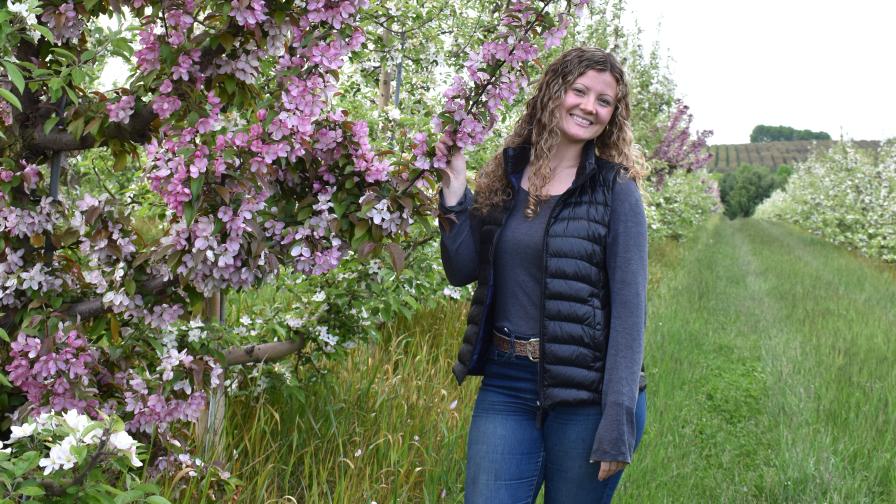
At just 25, Emma Grant grew quickly into the role of Orchard Manager at Cherry Bay Orchards in Traverse City, MI. She has a fresh perspective on the challenges and opportunities facing the cherry industry today.
Photo by Emily Schneider
When it comes to adversity in agriculture, the tart cherry industry in northwest Michigan has “been there done that” the last decade. Now, with so many other farmers across the country running against the wind in pursuit of a profit, who better to offer words of encouragement than a rising star from the never-say-die Cherry Capital of the World?
Emma Grant grew up in Suttons Bay, MI. Just 25, she is in some ways still growing up in Suttons Bay. Yet she is already in her third season as the Orchard Manager at Cherry Bay Orchards, responsible for growing its tart cherries (1,800 acres), sweet cherries (250), and apples (230).
Her ascent since graduating from Michigan State University in 2022 with degrees in horticulture and crop and soil science has been as stark as a Lake Michigan sand dune.
“My goal was always to come back to Suttons Bay,” Grant says. “My parents weren’t cherry growers, but I grew up in the Cherry Capital. Everybody is kind of involved in the industry in some way.”
Cherry Bay hired Grant as an orchard operator that summer of 2022. Then, the operation’s orchard manager, whose duties had included spraying, orchard maintenance, labor contracting, and food safety, resigned in the fall.
“Everybody just kind of looked at me,” Grant says. “I was, like, ‘I’m 22. Who am I?’”
THE RELAY OF LIFE
If nothing else, Grant — one of 515 respondents to American Fruit Grower’s 2025 State of the Industry survey — is an eternal optimist despite the decline of northwest Michigan’s tart cherry industry and the current state of U.S. agriculture.
“They tell me that’s because I’m still young. I haven’t had 20 cherry seasons beat down on me yet,” she laughs.
Seriously, though, agriculture is “just different,” Grant counters. “We’re in this relay of something that people have been doing for thousands of years and will continue to do. People will always have to eat. There will always be agriculture. I’ve been given this land to take care of for now, and we’re going to do it to the best of our ability.”
A combination of factors, including rising input costs, labor shortages, market instability, erratic weather, and, in the end, land sales, has made that difficult for Michigan’s tart cherry industry. Meanwhile, many of those same issues have now carried over to the average U.S. farmer.
“I think the current state of northwest Michigan agriculture is everybody is just trying to hold on and hoping there will be a swing. Nobody wants to throw it away before we’ve really seen the end,” Grant says. “But it seems like the last decade has been a tipping point, especially for tart cherries. In the past five years alone there’s been a large number of growers that have called it quits just because you can’t be in the red year after year after year. How do you keep going?”
For starters, keep battling, Grant answers.
“A lot of people will refer to tart cherries as a dying industry, and I just think that’s such a disservice to the growers who have been fighting through this for years and are fighting to keep going,” she says. “There is a lot of life in this industry, and it’s in the people that have been doing this for generations and continue to love this crop and want to keep going.”
Next, stay true to your roots.
“This region is special because not only have we grown the volume of cherries that we grow, but it’s just such a part of this area,” Grant says. “Fifty years ago, when there were packhouses and plants up and down the county, everybody had a connection to the industry in some way or form. It’s just something that’s ingrained here. And you want to keep that.”
Finally, stand together.
“It’s a really nice community up here,” Grant says. “I have great relationships with other growers. All of them are just so kind to me. I feel really lucky to have grown up in the world of cherries.”
Stay tuned for more insights from the 2025 State of the Fruit and Nut Industry report in the coming weeks.
Subscribe Today For
