



USApple Projects Record 2025–26 Crop at Nearly 279 Million Bushels
 August 15, 2025
Chris Gerlach, Vice President of Insights & Analytics with USApple, presents the 2025 Industry Outlook Report at the organization’s 130th annual Outlook Conference in Chicago.
The U.S. apple industry is on track for another high-performing year, with production expected to reach nearly 279 million bushels for the 2025-2026 crop year. That was the reported outlook from Chris Gerlach, Vice President of Insights & Analytics at the U.S. Apple Association (USApple), who presented the latest Industry Outlook Report at the organization’s 130th annual Outlook Conference this week in Chicago.
Gerlach’s presentation, part of Outlook 2025, which drew a record attendance of approximately 370 growers and industry professionals with representation from 40 countries, painted a picture of both opportunity and challenge for U.S. apple producers. “The U.S. grows the best apples in the world, and this year we will certainly have plenty for domestic and global consumption,” Gerlach told attendees. “That said, growers carefully select what comes off the tree to ensure only the highest quality fruit makes it to the store. And with skyrocketing labor costs, growers are having to be even more disciplined in their harvest decisions.”
U.S. Crop Climbs as Apple Mix Evolves
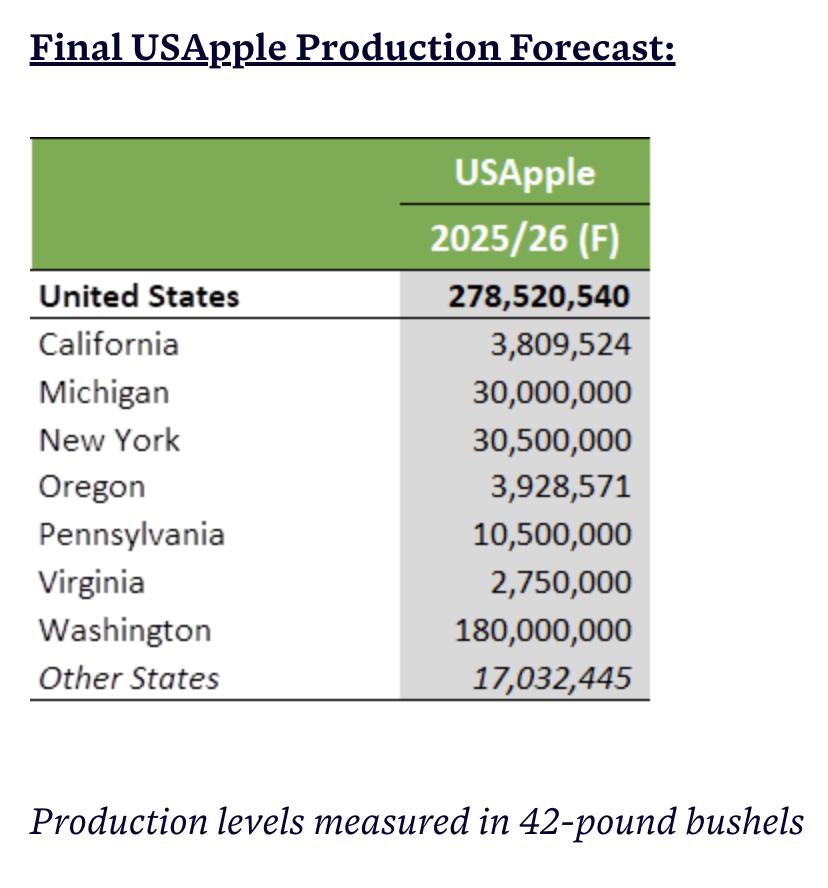
2025 USApple Production Forecast
According to USApple’s analysis, total U.S. apple production for 2025/2026 is forecast at 11.7 billion pounds, or 278.5 million bushels. That’s up 1.3% from last year and 3.6% above the five-year average. Unlike the United States Department of Agriculture (USDA)’s figures, which focus on the top seven apple-producing states, USApple’s report incorporates data from additional states and direct feedback from growers, providing a more comprehensive snapshot of the industry.
Gala remains the top variety, with nearly 47 million bushels expected this year—about 16% of total U.S. production. Rounding out the top five are:
- Red Delicious (39 million)
- Honeycrisp (34 million)
- Granny Smith (32 million)
- Fuji (25 million)
Gerlach noted that ‘Honeycrisp’,’ Granny Smith’, ‘Cosmic Crisp’, and ‘Pink Lady/Cripps Pink’ are all on the rise, while ‘Gala’, ‘Fuji’, and ‘Rome’ are trending down.
“Retailers are responding with aggressive promotions, especially for Honeycrisp, which has become the most heavily promoted variety nationwide,” Gerlach said. He also pointed out that the industry is seeing a shift in varietal mix, with newer varieties gaining ground and some traditional favorites losing share.
Exports Strong, Markets Expanding
On the trade front, the U.S. maintained a strong position in 2024-2025, exporting 44 million bushels and importing less than 5 million. Net exports were valued at approximately $900 million, despite a 5% decline in fresh apple exports year-over-year. “With another large crop on the way, maintaining and expanding exports is essential,” Gerlach emphasized. “We’re exploring all avenues to strengthen our presence in established markets like Taiwan, Thailand, and India, while pushing to open new high-value markets such as South Korea and Japan.”
From Washington to Virginia: A Varied Harvest
As Gerlach delved into the outlook for the 2025-2026 apple crop, he emphasized that understanding the national forecast requires a closer look at the state-by-state dynamics driving overall production. Each major apple-producing state faces its own unique set of challenges and opportunities, and the numbers reflect a complex interplay of weather, market forces, and local expertise. Gerlach walked attendees through the latest USDA estimates and his own analysis, highlighting notable year-over-year changes and the nuances behind the figures. Here’s how the production outlook breaks down across the country:
- State-level production figures show Washington continuing its dominance, with a record crop forecast of over 180 million bushels valued at nearly $2.3 billion;
- New York holds the No. 2 spot at 30.5 million bushels;
- Michigan is up 10% to about 30 million;
- Pennsylvania is up 2% at 10.5 million bushels;
- Virginia is down 50% to 2.75 million; and
- Oregon is up 40% to 3.9 million.
Worldwide Production Shifts
As the U.S. apple industry looks to maintain its competitive edge, understanding the global production landscape is more important than ever. Gerlach highlighted how shifts in output from major players like China and Turkey can open new opportunities — or present fresh challenges — for American growers. With China producing apples on a scale 10 times that of the U.S., and Turkey’s crop fluctuations influencing key export markets such as India, the international stage is constantly evolving. Against this backdrop, Gerlach provided a closer look at how global apple production is shaping up this season:
- Globally, the U.S. remains the second-largest apple producer, accounting for just over 5% of worldwide supply.
- China continues to lead by a wide margin, producing 51% of the world’s apples.
- Turkey accounts for 4.7% of global apple production, making it the world’s third-largest producer after China and the United States, and a key supplier to major export markets such as India and Europe.
- Poland produces 4% of the world’s apples, ranking as the fourth-largest global producer and the leading apple supplier within the European Union.
- India contributes 3% of global apple production, making it the fifth-largest producer worldwide and a major player in the Asian apple market.
“With China down 100 million bushels and Turkey’s crop off by 40%, the U.S. has a real opportunity,” Gerlach said. “Given Turkey’s role as a major supplier to India, this could open the door for us to regain market share there.”
Navigating a Shifting Marketplace
Despite the positive production outlook, Gerlach cautioned that growers face significant headwinds. “Many of these prices are below the cost of production, which is not sustainable for the long term,” he said, citing rising labor costs and supply-demand imbalances. “Expanding existing markets and opening new ones may provide significant opportunities, but uncertainty around tariffs and global trade remains a challenge.”
As the industry looks ahead, the data and insights from USApple’s Outlook Report will be essential reading for growers and marketers navigating a complex and rapidly evolving marketplace. For more detailed data and analysis, the full Outlook Report is available from USApple. (https://usapple.org/news-resources/2025-26-apple-crop-outlook)
Subscribe Today For
