



Scientists Gain Ground In Effort To Prevent Pistachio Hull Split
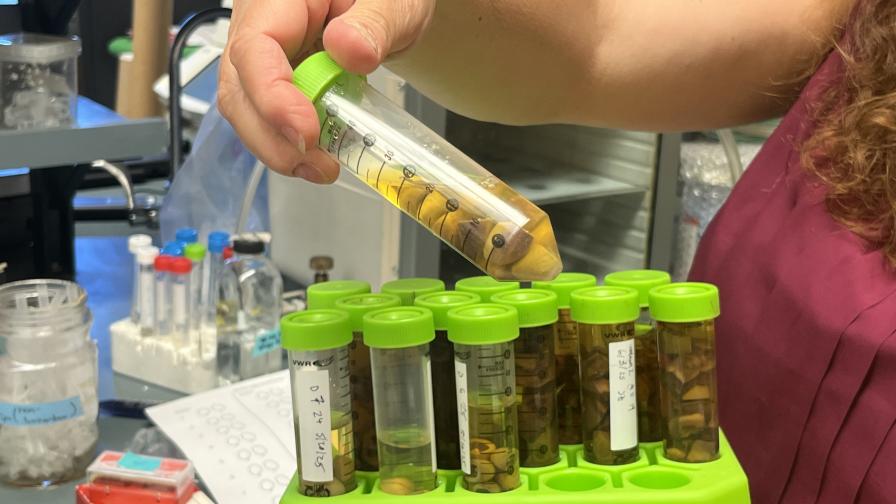
Professor Georgia Drakakaki studies pistachios in the lab at UC Davis. These experiments are helping gain ground on pistachio hull split.
Photo: Trina Kleist/UC Davis
When pistachio hulls split before the nuts are harvested, insects and fungi can get inside, damaging the nut, costing farmers money and contaminating the nuts. About 4% of the overall crop experiences hull split, but some cultivars can split as much as 40% under certain conditions. Now, for the first time, scientists at the University of California, Davis, are seeking solutions for California’s $2-billion-a-year pistachio industry. New research reveals how the hull is built and how cell walls in certain layers break down, along with the genes and corresponding mechanisms that spark and control those changes.
Pectin, a component of cell walls, makes fruit skin strong in part by keeping cells hitched to each other. In pistachio hulls, the composition of pectin changes as the hull ripens, causing the cells to come unhitched. This leads to cracks and tears in the hull.
In the Journal of Experimental Botany, recent Ph.D. graduate Shuxiao “Susan” Zhang, a student in the lab of Department of Plant Sciences Professor Georgia Drakakaki, identified genes that control how cell walls change as the fruit ripens, leading to the hull breaking down. The research will help breeders select for traits that will make the hulls less vulnerable to tearing and cracking.
“This is the first time anyone has studied the pistachio hull at the anatomical and cellular level while also looking at gene expression and physiological data,” Drakakaki says. “Susan really got into the details of how the hull is built with different layers and how the cells in those layers are of different sizes. The layers respond differently to changes in pectin, and that causes the hull to split in different ways.”
RELATED CONTENT: American Pistachio Growers Get $1 Million for Pest Management Collaboration
Zhang built on the work of two more scientists in the department and their teams. Grey Monroe, an assistant professor, and Barbara Blanco-Ulate, an associate professor, assembled a reference genome of Pistacia vera ‘Kerman,’ the leading female pistachio cultivar in California. They also defined the stages of the nut’s growth and the characteristics at each stage. Their work was published last year.
For more, continue reading at caes.ucdavis.edu.
Subscribe Today For
