



What’s the Current State of Spraying in Almond Crops?
 December 2, 2024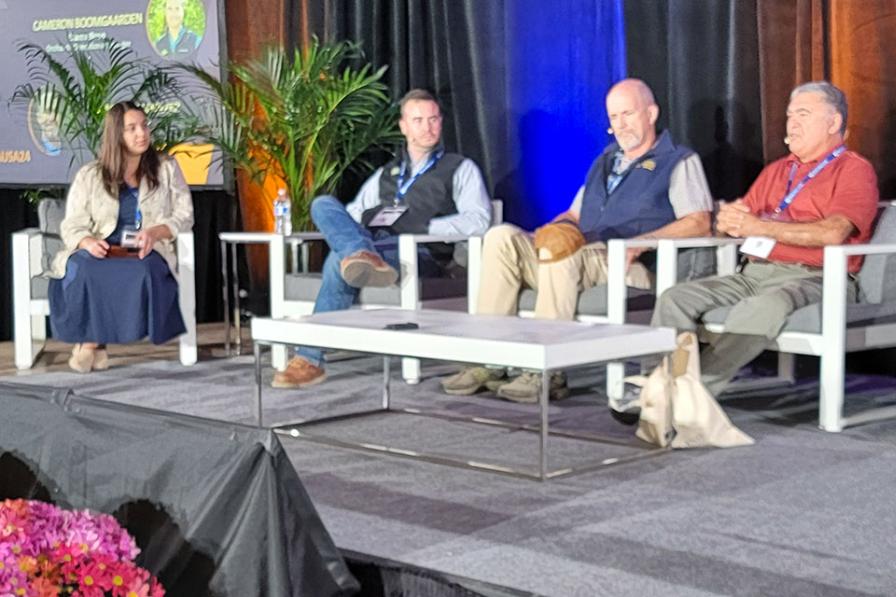
Lauren Fann, Almond Board of California, Cameron Boomgaarden, Vann Bros, Franz Niederholzer, UC-Davis, and Birat Bisabri, grower and crop protection industry veteran, participate in a FIRA USA panel discussion on reducing spray drift while improving coverage in tree nuts.
Photo by David Eddy

Franz Niederholzer, a University of California Cooperative Extension Farm Advisor, has researched sprayers for decades. So, during a panel discussion on autonomous solutions at the recent FIRA USA conference in Woodland, CA, listeners were eager to learn the key to evaluating a sprayer.
“Despite all the technological advancements in the field,” he said, “water-sensitive paper is still the best way to track spray coverage.”
Just goes to show the newest way is not necessarily the best. Cameron Boomgaarden, Orchards Operations Manager at Vann Bros of Williams, CA, immediately agreed with Niederholzer, who is an American Fruit Grower columnist.
“Besides accuracy, the paper is straightforward to use,” he said. “Simplicity is key for us. It makes it easier for more employees to do.”
Boomgaarden says he is open to any spray technology, but it has to work in his orchards.
“Adaptation to new technology is tough because of topography and other differences,” he said. “Orchard to orchard, block to block, it’s a challenge.”
One big problem, he said, is the difference in the available equipment is much less than the difference in the sizes of trees in a typical orchard.
The other grower on the panel, Birat Bisabri, who, in addition to farming almonds, worked in the crop protection industry for many years, agreed, noting there are further complications.
“In research, we work on younger trees because we often have to destroy the trees (after trials),” he said. “But growers don’t have all young trees, of course.”
INVASIVE PESTS
The panel moderator, Lauren Fann, Senior Specialist, Pest Management, Almond Board of California, noted that a recent focus for the industry is the carpophilus beetle. The invasive pest has done a lot of damage to the Australian almond industry in recent years.
Niederholzer noted that new developments in spray technology are critical in battling such invasive pests. He specifically noted the new See & Spray units from John Deere because nothing is wasted, saving the grower money and reducing both worker and environmental exposure to pesticides.
Bisabri says the return on investment in such technology is easy to document because of the sharp reduction in inputs.
“But the equipment, the initial investment is huge,” he said. “I hope almond prices go up so we can make these investments.”
Boomgaarden agreed that the equipment is getting more expensive — and complicated.
“I don’t even work on our automated sprayers — we have a specialist — so it’s tough to put that in some worker’s hands,” he said.
Niederholzer agreed.
“It’s a big deal to have a layer of technology that is challenging to the crew,” he said. “It’s a big ask.”
Boomgaarden agreed, saying there is a disconnect between those buying the equipment and those operating the equipment.
“Teaching them how to operate it is the easiest part,” he said. “But how do you handle it when things go wrong? Also, the training period is time lost at certain key times of the year, such as hull split.”
Then there is the fact that not only is every farm different but every farm within each block is different.
“We train in a perfect environment, but that’s practice, not reality,” he said. “I thought one person could operate (his newest spray rig), but you almost definitely need two when things go wrong”
WHITHER DRONES?
Niederholzer said he was in a research plot this past fall where he saw a drone spraying crops. It was most impressive, although he emphasized the application was being done by the company, not by the grower.
“It’s not a silver bullet,” he said. “But there’s a lot of potential for profit.”
Boomgaarden is keenly interested in drones for that very reason but sees some real pitfalls regarding payloads.
“Drones have tremendous potential, especially on our large almond blocks,” he says. “But we’d have to stop and fill the tank nearly every other row.”
Bisabri agreed, saying the technology is extraordinarily appealing for large-acreage growers such as himself, but the fuel capacity makes them currently impractical.
“The biggest problem they have is spray volume — only 20 gallons or something, which is about 2 acres,” he said. “I also grow citrus. What if I need (to spray) 500 acres for red mite? I have to get that in.”
Subscribe Today For
