


Building Better Orchards From the Ground Up
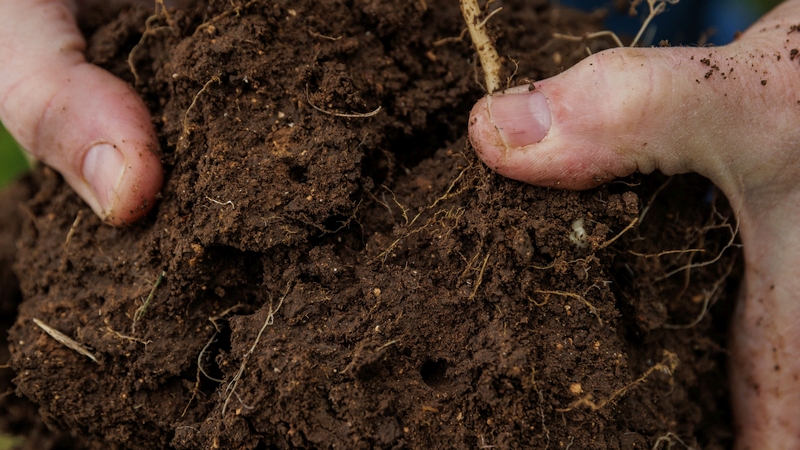
When orchard managers talk about productivity, they often focus on fertilizer rates, irrigation schedules, and pest control. Charles Rohla believes the real conversation should start beneath the surface. As a senior regenerative ranching advisor at Noble Research Institute, Rohla works with growers across the country to rebuild soil function and reduce dependence on costly inputs. His message is straightforward. Healthy soil is not a luxury. It is the foundation of long-term orchard success.
“Soil health is the foundation of our orchards,” Rohla explains. “We have neglected it for so long. Once input costs start getting greater than our revenue, we have to look at how to mitigate those costs.”
The soil health framework he teaches is built on six core principles. These principles guide decisions without locking growers into a rigid recipe. They emphasize working with natural processes rather than fighting them.
Know Your Context
Every orchard exists within its own ecological and management realities. Rainfall, native vegetation, temperature swings, soil type, harvest method, and operational goals all shape what is possible.
“Your context is different than your neighbor,” Rohla says. That perspective helps growers avoid copying practices that may not suit their environment and operational goals.
Keep Soil Covered
Soil left bare heats quickly, loses moisture, and weakens microbial life. Rohla has observed dramatic differences in temperature between the air and the soil when ground cover is absent. “I have been in orchards when it is 80 degrees outside, and the bare soil temperature is 140 degrees. We have cooked all our microbes, and the soil is pretty much sterile.”
Cooling the soil and reducing evaporation improves microbial activity, root health, and overall resilience.
Minimize Unnatural Disturbances
Tillage, herbicides used to maintain bare ground, heavy fertilizer use, and repeated machinery passes all stress soil biology. Rohla distinguishes between disturbances that occur in nature and
those that do not.
“Chemicals, fertilizers, metal in the ground. Those are all unnatural. They do not naturally occur.”
The goal is not to eliminate all inputs. It is to be intentional, reduce their frequency, and let natural systems perform the work whenever possible.
Build Diversity Above and Below Ground
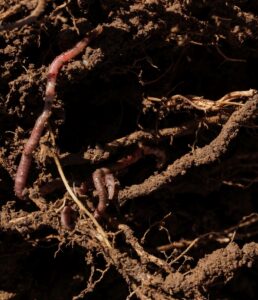
Monoculture tree rows do not have to mean monoculture ground cover. Diverse forages under orchard canopies help capture more sunlight, extend periods of biological activity, support beneficial
insects, and reduce reliance on imported pollinators.
“The driver of soil health is capturing as much sunlight as possible,” Rohla says. Different plant shapes and growth periods allow orchards to harness more of that energy throughout the year.
Maintain Continuous Living Roots
Perennial trees provide year-round root systems, but Rohla encourages growers to expand that living network through plant diversity. Living roots feed soil microbes, stabilize soil structure, and improve water infiltration. Even in orchards harvested from the ground, temporary adjustments are possible without reverting to bare-soil management.
Integrate Livestock When Feasible
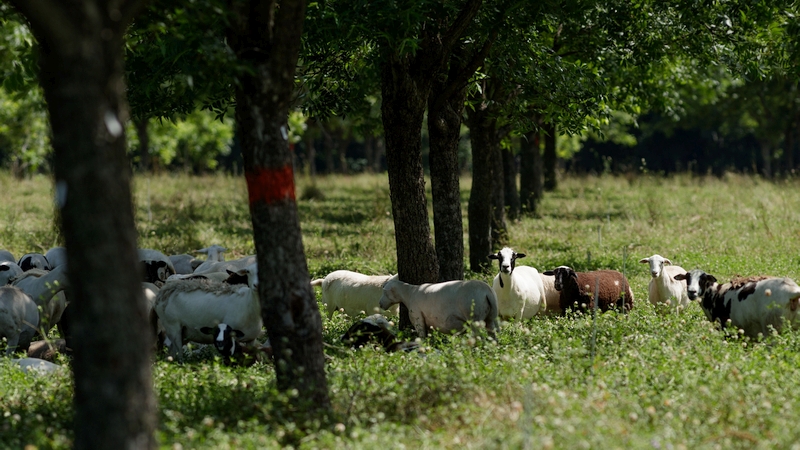
Livestock provide natural disturbance with clear benefits. Hoof action improves infiltration, stimulates root growth and supports beneficial microbes.
“Livestock is a natural disturbance that can create a positive impact,” Rohla notes.
Start Small and Watch Closely
When growers ask how to adopt these principles, Rohla keeps the recommendation simple. Pick one area and start experimenting.
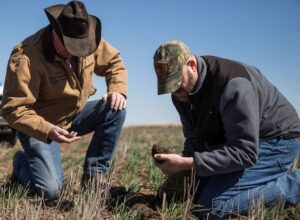
“Try something small and learn from the mistakes that may occur,” he says. “The greatest learning opportunity comes from failures.”
Observation is a skill he emphasizes repeatedly. Seeing the orchard differently leads to practical changes. One of the easiest, he notes, is reconsidering mowing.
Most orchards maintain a manicured, golf-course aesthetic. Rohla challenges that. Taller ground cover improves water capture, reduces evaporation, strengthens root systems, and lowers management costs. Many growers who once mowed five times a year eventually cut back to a single mow after seeing the benefits.
Profit Follows Function
Healthy soil does not magically increase production. It increases profit by reducing dependence on expensive inputs.
“We over-fertilize and over-water because we think we have to,” Rohla says. By relying more on biological processes, growers can cut costs, reduce irrigation cycles, and improve water-holding capacity. Increasing soil organic matter by just one percent means storing more than 20,000 gallons of water per acre.
Some growers also gain value through transparency. As soil health improves, many choose to market the ecological story behind their products.
“People want to know what you are doing to their food,” Rohla explains. He has seen a grower increase product value by nearly 40 percent without certifications simply by telling his story clearly.
Want to Apply These Principles?
Walk your orchard and identify a single block where you can test one change: skip a mowing, reduce a pass, or seed a small test strip. Document the outcome and adjust based on what you see.