



Smart Tech
Bridging the Smart Tech Adoption Gap in Vegetable Farming
 September 22, 2025
Eye-catching videos of robotic weeders and crop thinners, drone sprayers, and other technologies — paired with headlines touting artificial intelligence and automation in agriculture — highlight the rapid evolution of smart tech and the transformation in farming it promises.
These tools aim to improve farming efficiency and help offset rising input costs and labor shortages. While growers have already begun adopting many of these new technologies, several hurdles must be addressed before robots, drones, and other advanced tech on every farm.
As part of American Vegetable Grower’s State of the Industry survey, growers were asked about their current use of ag tech, whether they plan to adopt it, and what factors influence their decisions. Importantly, responses were grouped by farm size, from under 25 acres to 2,500 acres and up.
Why Growers Say Yes to Smart Tech
Among those who have already implemented ag tech, the reasons were diverse, indicating that growers see potential for these tools in a wide range of applications. Still, one drive rose to the top: increased efficiency.
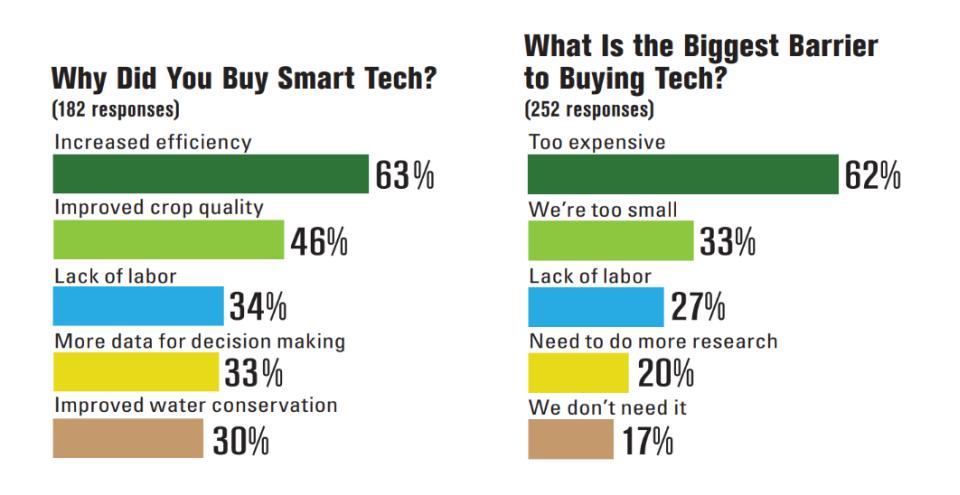
Other motivators varied. Improving crop quality and addressing labor shortages ranked high. For the largest farms in particular, reducing inputs was a notable goal. Together, these responses suggest that growers are taking a strategic approach to tech adoption.
What’s Slowing Adoption?
Despite that optimism, financial concerns remain the most consistent and significant barrier. More than half of respondents, regardless of farm size, identified expense as the primary obstacle.
Given the tight margins already familiar to farmers, economic uncertainty, and the sticker shock associated with some of these new technologies, it’s no surprise that many growers are hesitant to make such significant investments.
ROI concerns were another major factor. Among farms with more than 1,000 acres, growers roughly split on whether they believed investment would pay off. Interestingly, ROI skepticism was lower for small and mid-sized farms. Fewer than 20% of the smallest growers (25 acres or less) questioned the potential return.
Even with the promises of reducing operational expenses, the price of entry with novel technology remains a hard pill to swallow. Especially for smaller growers that struggle to secure capital for equipment purchases.
Proposed legislation, such as the recently reintroduced Precision Agriculture Loan (PAL) and other Acts, may ease that pressure by opening funding programs to smaller growers wanting to invest in high-ticket ag tech.
But adoption isn’t just about cost or ROI. Growers also consider the companies behind the machine. After seeing several ag tech startups rise and fall, farmers want assurances: will the product work reliably day and night? Will parts be available when needed? Will customer service be fast and knowledgeable?
Arguably, tech developers partnering with dealerships or through acquisitions by OEMs can make or break a buying decision. These relationships give credence to the technology itself assures long-term support.
On the other hand, some developers will want to stay independent to preserve creative control in hopes of carving out a larger stake in the future market.
For the industry to mature, case studies and third-party reviews will be crucial. Just as ag-chemical companies work with universities and research partners to validate performance, ag tech developers likewise need trusted third parties, especially from a financial perspective.
To that end, general transparency and real-world case studies that clearly demonstrate ROI will benefit the industry. Groups like Western Growers have begun publishing these kinds of studies, and the more of this we see across the industry, the more confidence will grow.
Finally, simplicity will be a key element in helping ag tech to mature. Technology must be easy to adopt, intuitive to operate, and capable of turning complex data into real-time decisions for farm managers.
To borrow an old cliché: what’s good for the goose is good for the gander.
Editor’s note: This article launches our new column, “Smart Tech in Vegetables,” where experts explore real-world applications, challenges, and opportunities in technology.

For more Smart Tech topics, click here.
Subscribe Today For
