


When It Comes to Quality and Quantity, There’s No Second Chances in Squash
 April 11, 2026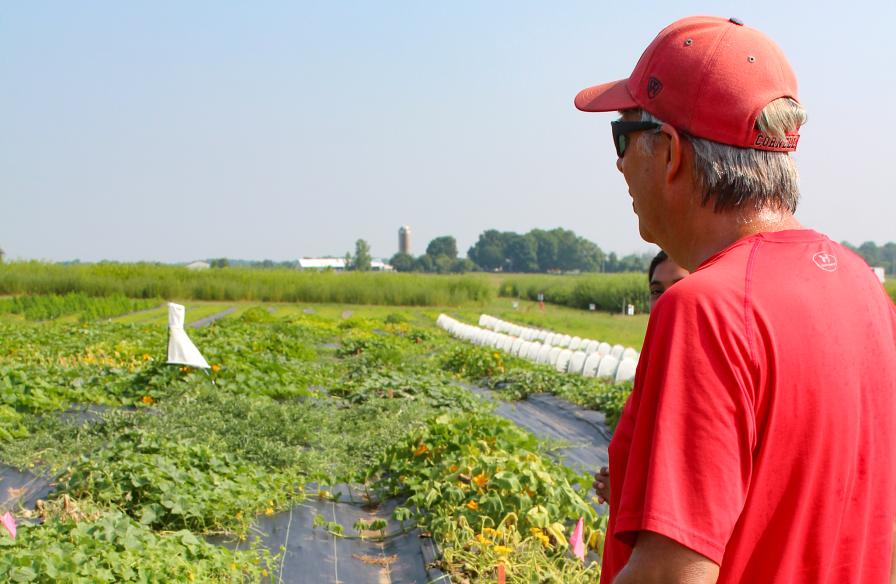
Cornell University’s Brian Nault evaluates squash bug pressure and control strategies in field trials. Early detection and timely intervention are critical, as it’s easier to control nymphs than adults.
Photo: Carol Miller
Summer squash and zucchini remain one of the most widely grown vegetable crops in the U.S. About 68% of growers reported producing summer squash or zucchini, according to the 2026 State of the Vegetable Industry survey, placing it among the top crops across all regions.
Squash, however, is not a crop that allows for midseason recovery. Profitability is determined early and reinforced through precise management.
Once a plant is infected with a virus, there is no cure, according to University of Florida Extension guidance on cucurbit production, a point most Extension programs echo when discussing squash management.
The First Few Weeks Set the Season
The first decision growers make — beginning with variety selection — directly affects both yield and risk.
North Carolina State University trials show that squash cultivars vary widely in productivity and in their response to disease pressure and environmental stress. Many of the most damaging issues in squash, including virus transmission by insects, cannot be corrected once established.
Choosing a variety is not just about yield potential or market preference. It sets the crop’s risk profile. Check with local trial leaders to learn which varieties are showing resilience to your most common issues.
Early-season pest management reinforces that risk profile.
Squash vine borer must be controlled at egg hatch or very early larval stages, before larvae enter the stem. By the time wilting appears, control options are limited. Virginia Tech’s Thomas Kuhar emphasized that timing is critical for effective control.
The same is true for squash bugs. Nymphs are far more susceptible to insecticides than adults, making early detection and treatment critical, Kuhar says in Extension guidance.
Disease pressure follows a similar pattern. Cucurbit scab spreads rapidly under favorable conditions, and once lesions are established, protecting new growth becomes the priority.
Across pests and diseases, the pattern is consistent: Intervene early or manage consequences all season.
Managing Pressure Means Reading the Field
As the season progresses, the challenge shifts from early prevention to staying aligned with field conditions.
Extension programs increasingly emphasize that pest and disease management should be based on field conditions and thresholds, not calendar-based spray schedules. Cornell’s vegetable disease resources stress monitoring weather, crop stage, and disease risk before making application decisions.
A practical example is powdery mildew management in cucurbits. Rather than beginning fungicide programs on a fixed schedule, many recommendations call for initiating sprays when disease is first detected in the region or when conditions favor development.
Similarly, insect pressure builds in waves tied to temperature and crop stage, requiring growers to adjust timing rather than follow preset intervals.
For experienced growers, these are not new concepts. But in squash, where pressure can escalate quickly, the difference between a condition-based decision and a scheduled one can show up directly in yield and marketable quality.
Efficiency Drives Profitability
These same principles apply across both conventional and organic production systems.
A long-term systems comparison published in Renewable Agriculture and Food Systems found that organic and conventional vegetable systems can produce comparable yields but differ significantly in input use, labor, and cost structure.
That reinforces a key point for squash growers: Profitability is shaped less by maximum yield than by how efficient inputs are used.
Preventative management plays a role here as well. Extension guidance across multiple crops shows that timely, preventative treatments are often more cost-effective than reacting to established pest or disease outbreaks, which can require more intensive inputs and still result in yield loss.
In squash, where early-season issues carry through the crop cycle, that dynamic is especially pronounced.
Balanced fertility, consistent irrigation, and maintaining plant health are well understood fundamentals — but their impact is magnified in a crop with limited opportunity for recovery.
A Crop That Rewards Discipline
For all its familiarity, squash is not a casual crop.
Growers tend to stay with it and often expand production incrementally because it fits well within diversified systems and delivers reliable returns when managed carefully.
But that reliability depends on discipline.
From variety selection through early-season pest control and in-season management, squash rewards growers who stay ahead of problems — and offers few second chances to those who don’t.
Squash by the Numbers
- 68% of growers produce summer squash or zucchini
- About 1 in 5 growers increase production each year
- Most growers maintain current acreage year to year
- Very few add or drop the crop entirely
Source: 2026 State of the Vegetable Industry
Subscribe Today For
