



Scientists Sharpening the Focus on Strawberry Leak
 June 23, 2026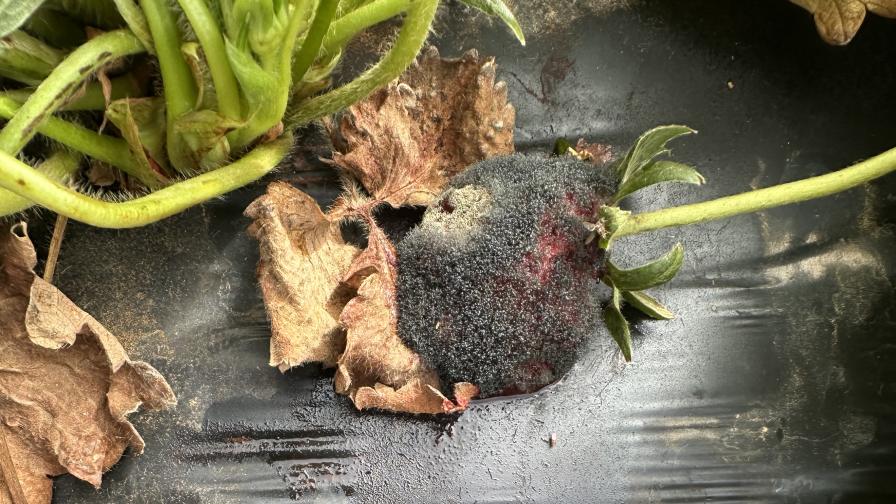
Fruit showing symptoms of strawberry leak.
Photo: Gerald Holmes
Strawberry leak has exacted a large but unmeasured toll on California’s warm weather strawberry crop for many years. The disease, caused by the Rhizopus rot fungus, makes berries liquify and run down the side of the plastic mulch.
Late spring and summer are peak times for leak in the most productive strawberry regions near Salinas and Watsonville.
“Leak rot usually starts to show up in Santa Cruz and Monterey counties in late May and then gets worse as the season goes on, with a lot around in August and September,” Mark Bolda, University of California Cooperative Extension farm advisor based in Watsonville, says. “It is the dominant fruit rot through the summer months to be sure on the Central Coast.”
Growers who end their harvest before it gets warm do not have problems with leak.
“It is in Santa Maria in quantity as well but far less common in the Ventura-Oxnard area, and this I feel is a function of their growing season, which basically winds down at the end of May,” Bolda says. “This dynamic also unfortunately colors research funding since Southern California growers see it as a non-issue for which little funding is committed, while we in the North are losing really significant amounts of fruit to this disease.”
Until recently, growers put the infected berries on the discard pile and made little effort to examine the extent or cause of the loss.
RESEARCH SHINES A LIGHT ON HIDDEN LOSSES
Researchers at the Strawberry Center on the California State University, San Luis Obispo campus began the first serious study of leak a few years ago.
They have already uncovered information that will give California Central Coast region strawberry growers tools for identifying and managing the spread of this fungus that destroys warm season berries.
“It’s a significant economic disease, but it’s overlooked,” Gerald Holmes, Director of the Strawberry Center, says. “This thing has been around forever. We think it is more important than the industry thinks; and we think we can do something about it.”
SANITATION AND COOLING KEY TO CONTROL
Recent research at the San Luis Obispo center has already shown the importance of rigorous sanitation to limit the spread of leak by moving infected berries far from healthy plants.
“Remove any fruit with disease from the field, and don’t leave it in the furrows,” says Gabriela Torres Gonzalez, who is earning a master’s degree with her research on leak. “The disease is airborne from the furrow if there is wind, or it can be carried on the workers’ hands.”
Gonzalez, who hopes to have a career in plant pathology after earning her doctorate, received first place when she presented her research at the Pacific Division of the American Phytopathological Society Conference in Pullman, WA, and will present again this August at the society’s national conference in Rhode Island.
Another management tool is to move berries harvested in warm weather to the cooler as quickly as possible.
“It’s important to get them cooled as soon as possible,” Holmes advises.
According to the University of California Pest Management Guidelines, “Fruit decays can be kept to a minimum by using raised beds, plastic mulch to keep fruit from touching the soil, and drip or furrow irrigation to keep water off the foliage and fruit. Most important is to make sure plants are spaced far enough apart that there is good air circulation around the fruit. Dense plantings make a damp environment that favors fruit decay.”
Although there are no degree models to predict strawberry leak, the disease is known to become a problem as the weather warms up.
In San Luis Obispo and Santa Barbara Counties, leak is usually an issue in May or June, according to Gonzalez, but the disease can strike earlier if it is warm enough.
“You can get it in March if it gets hot,” Holmes says. “Leak can break out when the temperature gets to the high 70s or 80s.”
NEW FUNGICIDE TOOLS AND BETTER DIAGNOSIS
In addition to field sanitation and moving berries quickly to the cooler, growers should also soon be able to slow the spread of leak with preventive fungicides.
“Nothing reduces it by 90% but maybe 50%,” Holmes says.
The promising materials in fungicide trials are Switch and Miravis Prime, which both have the active ingredient fludioxinil.
A fungicide program will be more effective as growers learn to quickly tell the difference in the field between Rhizopus, which causes leak, and Mucor.
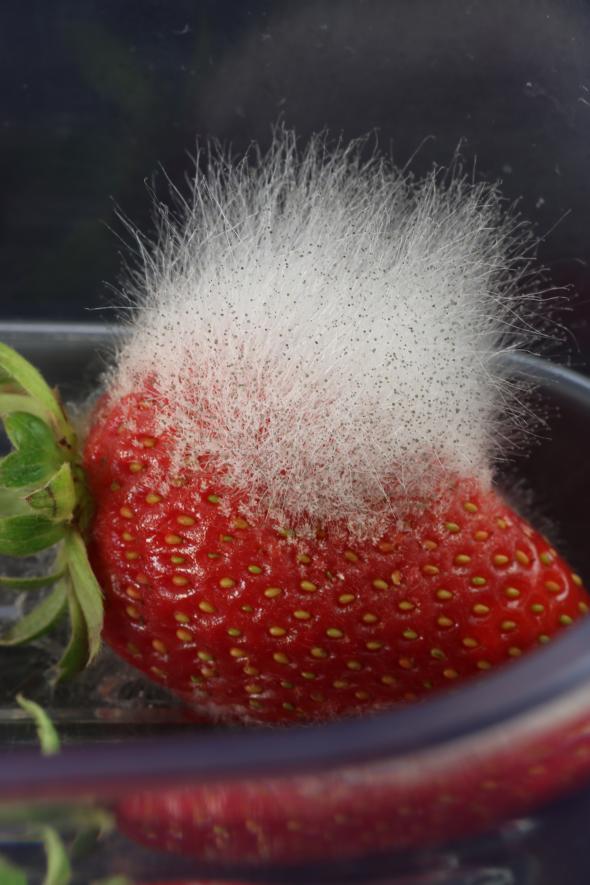
Symptoms of Mucor on strawberry.
Photo: Gabriela Torres Gonzales, California State University, San Luis Obispo
“We are distinguishing Mucor from Rhizopus,” Holmes says. “Until now people have been lumping leak with Rhizopus and Mucor.”
Gonzalez has examined 82 samples from throughout the state and found 76 of them had Rhizopus and only six had Mucor. She plans to take an additional 200 samples this year.
“I think Rhizopus has drier spores, while Mucor glistens in the sun,” Gonzalez says. “There is also the difference between leaking and not leaking.”
Even the most effective program, however, will not help berries that have already started to leak. “If it’s leaking there’s nothing you can do about it,” Gonzalez says.
Growers will also not be able to benefit from planting resistant or tolerant varieties. “We have not yet found anything that is tolerant,” Gonzales says. “They all look susceptible.”
Subscribe Today For
