


Public Ag Research Continues To Break New Ground for Growers
 April 30, 2025
 How many times have you ridden in a trailer at a university field day? As the tractor pulls you along from field to field, you hear the latest updates. One researcher may talk about a study on different methods to access nitrogen in the soil and how much fertilizer you can cut back on without impacting yield. Another shows the results of multiple treatments for a new pest to your area, sharing application details to help you succeed if the pest shows up on your farm.
Field days, a decades long lifeline for farmers, are just one aspect of land grant universities and the research they do on behalf of the public. The Morrill Act of 1862 created the land grant system, providing practical education and research, especially in agriculture. The three core missions of the system are teaching, research, and Extension.
Ongoing funding cuts have shut down many of these research projects midstream. And future funding is in question for a large portion of studies with grant applications in review that would normally already be approved.
One project that currently still has its funding is worth a deeper look, since it illustrates the far-reaching impact public research can have.
A Closer Look at One Project
Most research projects start with issues growers raise. Take onion growers in winter growing areas.
Short-day onions have a disadvantage over their long-day counterparts. They’re softer, which makes mechanical harvesting problematic. If you uproot the onions and automatically place them on a conveyor to fill a truck, too many will be damaged for it to make sense economically.
But the current method is labor intensive.
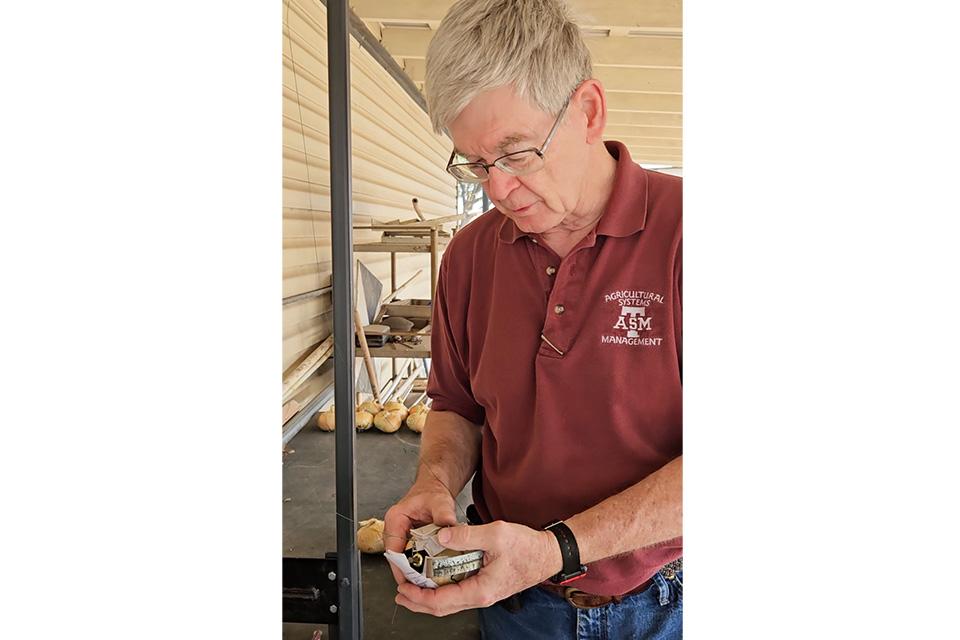
Dr. Stephen Searcy heads up the engineering team for the “Ensuring Future Economic Viability of U.S. Short-Day Onion Production Through Mechanical Harvesting.”
Photo by Carol Miller
“[Growers] have people clipping the onions, and then they’ll dump them into bins in the field. Then all those bins get collected and taken to the shed,” says Dr. Stephen Searcy, Professor Emeritus and former head of the Department of Biological and Agricultural Engineering, Texas A&M University.
Dr. Searcy met with the Secretary of The South Texas Onion Committee, Dante Galeazzi (currently the Executive Director of Texas International Produce Association), who expressed the interest its member onion growers had in developing mechanical harvesting.
“The growers are out in front of us in terms of trying to make it work,” says Dr. Juan Anciso, Professor and Extension Vegetable Specialist at Texas A&M University.
But those efforts can hit a wall, and that’s where researchers step in.
“[Growers’] don’t have the time to do the kinds of things we’re doing. What we’re doing is quite time and labor intensive and no grower will ever be able to do that. So this is where public research comes in,” Dr. Searcy says.
Importantly, trained researchers will do things in a more comprehensive and systematic way that allows them to share reliable results anyone can use.
The original goal was to simply evaluate harvesters. But the complexities of the issues were quickly evident, so over time the project’s goals expanded. And it would need significant funds to execute successfully.
The first funding application, to USDA Specialty Crops Research Initiative, fizzled.
“They came back and said it was an outstanding proposal, but not funded,” Dr. Searcy says. “The reviews suggested we add other short-day growing areas to the proposal, which we did in a second application. The second attempt was funded.”
With funds from USDA’s National Institute of Food and Agriculture [NIFA], Texas A&M, New Mexico State University, University of Georgia, and University of California are in its second year of working together on “Ensuring Future Economic Viability of U.S. Short-Day Onion Production Through Mechanical Harvesting.”
The problem is easy enough to describe. The solution, naturally, is a bit more complex.
The teams are examining all options in finding a mechanical harvest solution.
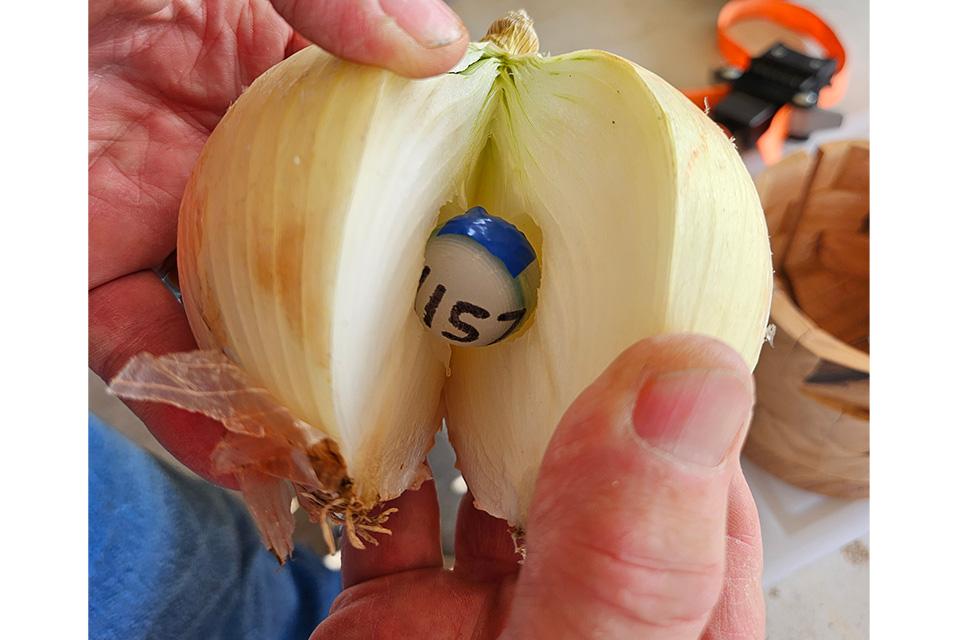
The research team embedded sensors into onions and sealed them with bright tape before burying the bulbs again so they can be mechanically harvested.
Photo by Carol Miller
Engineering. If onions get bruised during mechanical harvesting, you need to know when that damage takes place, how much damage occurs, and how much force causes bruising.
To that end, Dr. Searcy and his team cut onions, removed a small part of the middle, inserted sensors, and taped the onions shut. Then those onions went through an obstacle course of trials, from digging them up to dropping them in a truck.
To better understand how much force may cause damage, Dr. Searcy created a pendulum that allows an onion (and its sensor) to swing from different heights, imitating different drop heights. Then a team member examines each onion to document the damage.
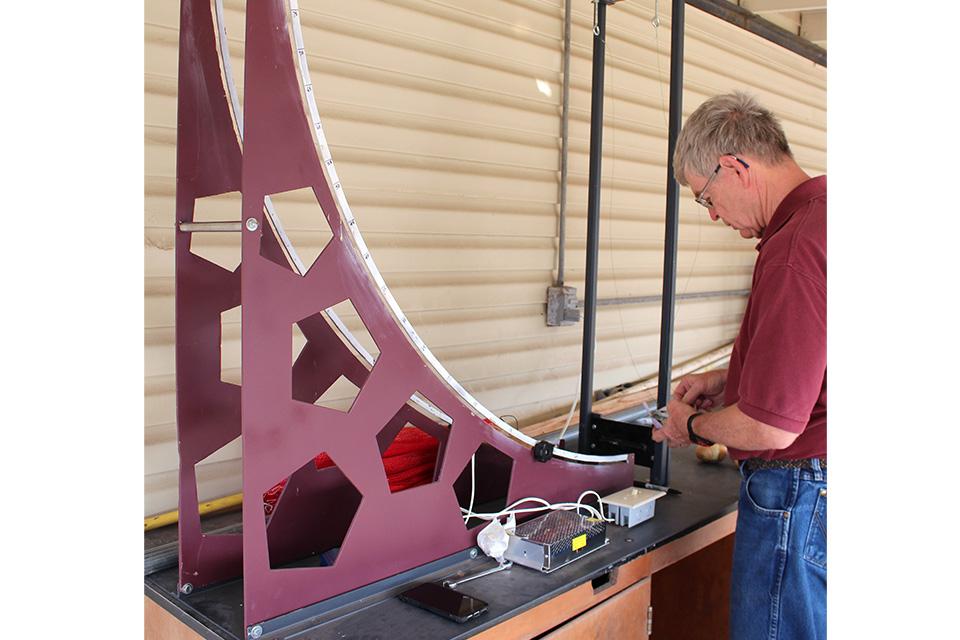
Dr. Searcy built a pendulum that swings onions from different heights to measure the force when hitting the bar. It’s designed to mimic falling into a truck from different heights.
Photo by Carol Miller
The project team is working with a few progressive growers who are using mechanical harvesting for a portion of their crop. One grower invested in trailers out of the U.K., Larrington Trailers, that have cloth bins that softens the impact of falling onions. Project data has shown no additional bulb damage occurs in bin filling with these trailers.
The engineering team is also looking at how curing newly dug onions on the field affects damage to the crop. The early results are promising. They are now zeroing in on harvest practices that minimize bulb damage.
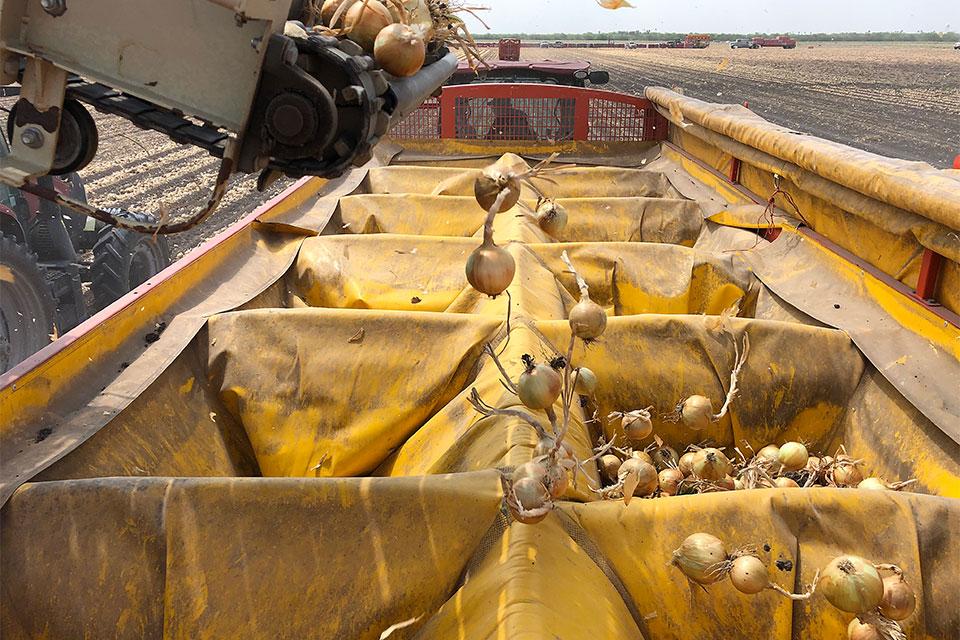
Soft bins in this Larrington Trailer minimizes bruising for falling onions.
Photo by Stephen Searcy
Genetics. Seed companies are sharing cultivars they think will fit in with a mechanical harvest system, says Dr. Subas Malla, Associate Professor of Vegetable Breeding, Texas A&M, and director for the research project.
Dr. Malla is assessing about 30 to 40 different cultivars from seed companies along with A&M’s own germplasm.
His team is looking at bulb shape and other characteristics that will better fit mechanical harvesting. The team is also assessing production methods like fertilizer rate that may affect their goals.
Another task is to field test a new tool from the engineering team.
“We’re using the information we gained from all this impact recording to assemble an instrument that breeders could use to assess the suitability of germplasm for mechanical harvesting,” Dr. Searcy says.
His team has created a prototype that Dr. Malla’s team can use in germplasm evaluations, he says. It still has a few problems to solve, but it’s early days yet.
As is typical of university projects like this one, private companies often participate. Universities are trusted, impartial third parties who will not only evaluate their products along with their competitors’, but they will also share the results with participating vendors.
Seed companies regularly work with land grant universities, especially on regional projects.
‘Carolina Strongback’, a leading rootstock in watermelon grafting, is a good example, says Clemson’s Dr. Anthony Keinath (and American Vegetable Grower columnist). It resulted from a North Carolina State University-led research project.
“[It] was instrumental in helping establish Tri-Hishtil in Asheville, NC, as a large commercial cucurbit and tomato grafting organization,” Keinath says.
Economics. Dr. Francisco Abello, Assistant Professor and AgriLife Extension Economist, is heading up the economic evaluation of the project. His team will evaluate the costs and sales involved with the current methods, from production to harvest to using dryers against the methods the teams’ research develops. Labor will be a major part of that assessment, but not the only aspect.
Working with Growers. Dr. Anciso has recruited area onion growers to work with the team to help them see the results of their methods in a true production operation.
Taking On Ag’s Biggest Problems
From Cornell to Oregon State to University of Florida and many more, land grant researchers have stepped in to address vital issues farmers face.
“When cucurbit downy mildew came into the U.S. in 2004,” says Michigan State’s Dr. Mary Hausbeck, “research was needed to determine how to control the disease and preserve the yield and quality of cucumbers, pumpkins, squash, and other cucurbits.”
In the past 20 years, the pathogen keeps mutating, making several fungicides ineffective, she says.
“A group of scientists collaborated through a USDA NIFA grant to develop an early detection system that warns growers when this airborne pathogen has entered their growing region.”
That early warning allows growers to apply fungicides in a timely manner.
University of California, Davis’ Dr. Michael Cahn helped develop an evapotranspiration software system to help California growers better time their irrigation, helping them cut down on over watering or underwatering. It’s now in the market under the brand name CropManage.
And several universities are trialing the new batch of artificial-intelligence-driven farm equipment so growers can assess when its time to jump on the emerging technology.
Public research offers growers a way through the thorniest issues they face.
How Does Funding Work?
The funding system has shifted some over the years, Dr. Searcy says.
“As a fresh, new assistant professor in 1980, my department had funds that were allocated to faculty for research,” he says.
But by the time he became department head from 2010 to 2020, there were no longer any departmental funds to allocate.
“What that means is that faculty are on their own to find research dollars,” Searcy says. “If faculty are going to be successful, they have to find some mode of funding their research. And, of course, the federal government is a major source.”
Big dollar amounts can be attached to a project, which at first glance can seem outrageous. But these large projects also tend to be over more than one year and involve several institutions working together. So a portion goes to each university involved.
From there, it’s broken down by paying salaries of all involved, from project leads to field workers to grad students making repetitive assessments.
Many researchers are attached to the main campus, where they teach classes. But research stations can be more remote, requiring travel. Equipment and facilities also eat up a portion of the budget.
Today’s faculty fund themselves from several different sources, from growers, to suppliers, from states to associations. The largest funder, however, is the U.S. government.
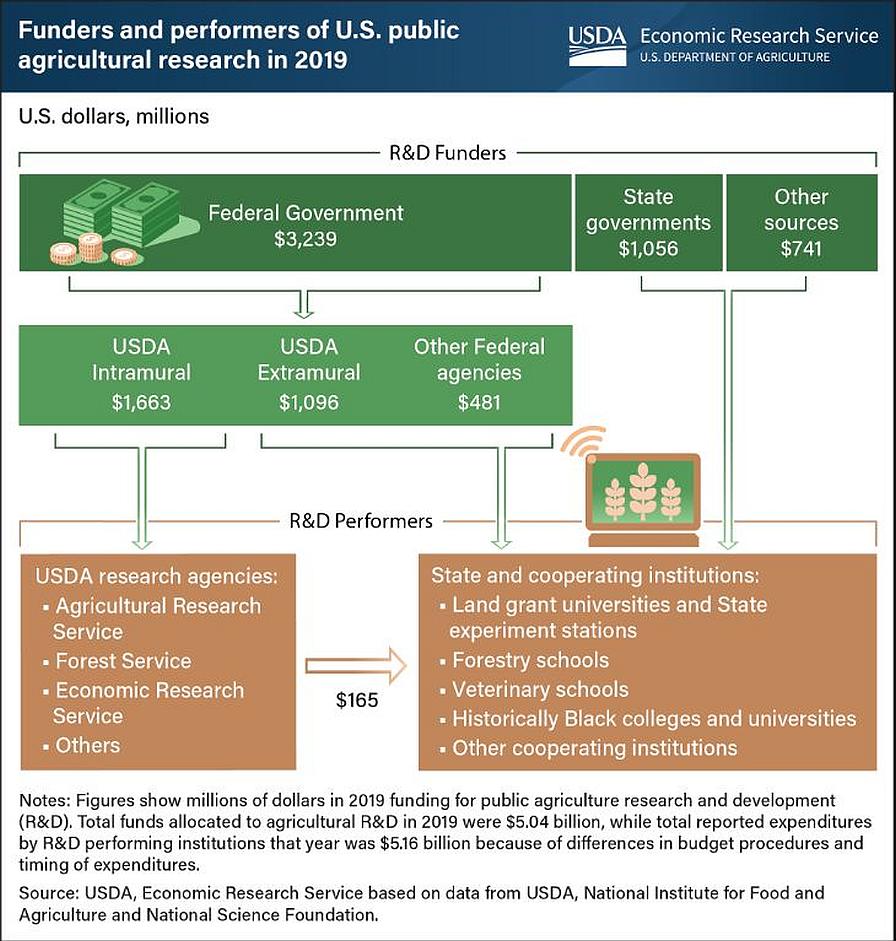
In this USDA chart from 2019, you can see the previous system of funding. Several deep cuts have already been made, but where funding will be in the next couple of years remains to be seen.
Training the Industry
Land grant universities currently provide a pipeline for most agricultural experts, and their research studies are a key way of training them.
“Most of the money is going to the manpower,” Dr. Anciso says.
Every step of research needs assessing, which translates to hiring undergrads, grad students, and post docs.
But our industry is getting much more than just future university scientists and Extension agents from their time working on public research projects.
“Just about everybody who works directly with growers or in important behind-the-scenes roles [come up through this system],” says Matthew Kleinhenz, Professor and Extension Specialist, The Ohio State University.
This includes people working at all types of ag companies, from equipment to food safety, he says. Crop advisors, government workers, association staff, and even growers themselves gain their skill sets through public research.
And don’t forget high school ag students, Clemson’s Keinath adds.
“Multiple members of the youngest generation of growers have come through programs and worked directly on projects of the sort we are describing as paid undergrad students, interns, etc.,” Kleinhenz says. “They return to their own farm, join another one, or take a different path. Regardless, they gain from the experience.”
Subscribe Today For
