


Worden Farm: Growing Food, Building Community
 March 1, 2008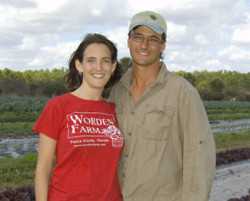
Those who observe agriculture can’t argue the fact that organic production is a growing market. At first glance, one might consider the organic movement a phenomenon growing out of an affluent society that can pay more for healthier foods that contribute to a more sustainable environment. But looking a little deeper, one sees another attraction of organics that is lost in modern, urban society — a connection to the land.
Community-Centered Ag
Eagerness to be connected back to the land and agriculture is a big part of Worden Farm’s success, according to the husband-wife team of Chris and Eva Worden. The 55-acre organic farm near Punta Gorda is the offshoot of the Wordens’ life-long dream to run their own farm in a way that is sustainable and ties back to their community.
“We have a farm membership program, which is based on community supported agriculture models,” says Eva. “We also sell to the general public through local farmers’ markets.”
Eva says their membership ranges from older folks, who have family connections and memories of farming, to young urban professionals looking to experience the natural world. But despite their diversity, they all get along in the shared experience of Worden Farm.
Many others who enjoy the Wordens’ diverse range of produce are looking for the health and environmental benefits of organics and the fact that it is very high-quality, fresh produce.
Creating Excitement
No matter the motivation of the Wordens’ customers, they need to know what’s happening on the farm to help develop the market and demand for the farm’s organic products.
According to the Wordens, community-oriented agriculture can’t reach its full business and social potential without community outreach. The Wordens accomplish this with tours, potluck dinners and newsletters for members, and even helping to develop educational tools for teachers. The farm also offers apprenticeships to students for college credit. Chris teaches organic gardening workshops on the farm as well to build interest in the organic approach.
“We do farm tours at least once a week and plan to build that up to become more frequent this year,” says Eva. “We have a program for teachers with pre-visit materials and post-visit materials, so they can build agriculture into their curriculum.”
It Can Be Done
With Florida’s climate and pest and disease pressure, some say organics can’t be done in the state. The Wordens argue that their farm and others prove that assertion wrong.
“If you were to only substitute conventional inputs with organic inputs in a traditional monoculture setting, it could be challenging,” says Eva.
To fight pests and disease, the Wordens employ an ecosystems approach, which adds diversity and breaks pest cycles. Their acreage looks more like little gardens of individual crops, which are harvested weekly, rather than large blocks of single crops. To do this, the Wordens have to be extremely organized, so they have developed a farm plan for each week of the year.
“Our production system includes high crop diversity, which limits pest populations,” says Eva.“In ecological terms, the farm is temporally and spatially diverse, meaning it is diverse both over time, throughout the growing season, and over space, throughout the fields.We use cover crops for breaking disease,insect, and weed population cycles, as well as for improving soil fertility and increasing soil organic matter.
“Some people think of organic farming in an industrial sense,” says Eva. “They try to plop down a biological system that doesn’t fit, so they are fighting nature the whole time. If we can look at the natural world and work with it, it is easier to grow organically.”
Certification Preparation
The Wordens’ farm is certified organic by USDA, which they say gives consumers a starting point and ease of mind when purchasing organic.
“Organic certification provides consumers with a standard of good growing practices we use that are verified by a third party,” says Chris. “It gives growers a guide for producing crops with ecological techniques to protect soil and water resources, wildlife, and human health.”
Chris says certification will run more smoothly when growers thoroughly prepare for the process.
“Review the organic certification regulations and Organic Materials Review Institute (OMRI) listings in detail, contact the certifier well in advance of the growing season to be certified, have a crop plan in place that is as detailed as possible, and keep excellent records,” he says.
More Than Just Produce
The Wordens say their farm is more than just a business — it is a way of life.
“This is very important to Chris and I personally because we want to provide people with more than just produce,” says Eva. “We believe agriculture can provide many more services to the public than just commodities, especially when done in an environmentally conscious way that creates a healthy place where people want to be. There is recreational and educational value in those kinds of places, which is what we want to create on our farm.”
Subscribe Today For
