



Unexpected Vegetable Disease Issues Can Lead to Unusual Findings
 November 6, 2024
 Yet another novel medical development is threatening people in some regions of the U.S. This concern is a Neisseria bacterium that is responsible for meningitis and bloodstream diseases. The “new” is a particular Neisseria strain that causes unusual, atypical symptoms. While regular meningitis has well known effects, this other strain causes different symptoms like painful joints, fatigue, vomiting, rapid breathing, purple rashes, and higher fatality rates. In addition, this strain often affects middle-aged persons, in contrast to the usual pattern of meningitis in young children and adolescents. Heath providers are therefore on alert for atypical symptoms as they diagnose possible cases. Our growers and field professionals also need to be aware of atypical symptoms and new developments in their crops.
While our ag professionals deal with a great number of regular, familiar issues, they must expect the unexpected and take note of anything unusual happening to their plantings.

Unusual sunken lesions on celery signaled a recent development of Impatiens necrotic spot virus on this crop in California.
Photo by Steven T. Koike
Do You See Unusual, Unfamiliar Disease Symptoms?
Growers and the consultants who advise them are quite familiar with the common, expected diseases for the commodities they grow. Recognizing typical symptoms allows the production team to implement established integrated pest management (IPM) measures to control the disease.
The crop might develop symptoms that are unfamiliar to field personnel, however.
A grower did not see large, oblong, dark lesions on celery petioles on his crop in California. It turns out thrips insects vectored the Impatiens necrotic spot virus from severely diseased lettuce onto nearby celery plantings.
The fungus Alternaria is a familiar leaf spot and head rot pathogen of broccoli and other crucifers. When agronomists and growers saw stem lesions and collapsing plants in fields, they first attributed the unfamiliar symptoms to transplanting damage or insect feeding.
Yet the problem was confirmed later to be caused by the same Alternaria behind leaf spot and head rot issues. We did not previously list stem disease as part of the Alternaria disease complex for crucifers.
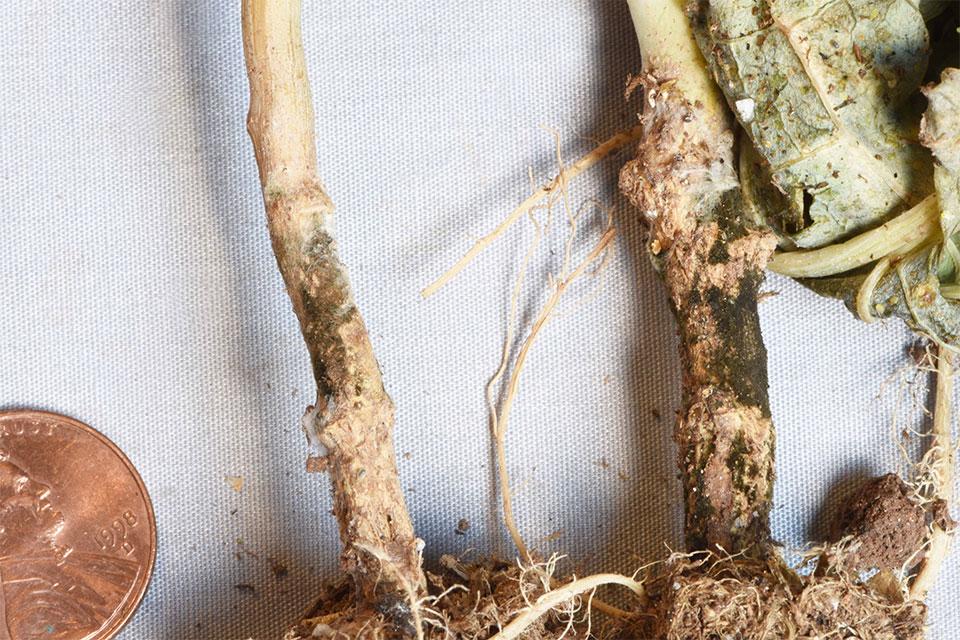
Alternaria is known to cause leaf spots and head rots on broccoli, but atypical stem infections indicated a new problem on this crop.
Photo by Steven T. Koike
Are There Unexpected Symptoms on Crops That Should Be Healthy?
Breeding and planting crop cultivars that are resistant to various pathogens is a powerful IPM tool. It enables growers to avoid reduced quality and yield.
Therefore, if a resistant variety begins to manifest that disease’s symptoms, it’s possible a new strain has overcome the plant’s resistance genes. You would not expect the resistant cultivar to show symptoms, so the development of disease is an unwelcome sign that something new is occurring.
Over the years, foliar diseases such as spinach and lettuce downy mildews have undergone the “boom-and-bust” cycle of plant resistance:
- Resistant cultivars become available and are planted in the field
- Excellent disease-free crops grow for a period of time
- Mutation and genetic recombination result in new pathogen races that overcome those resistance genes.
This breaking of resistance forces plant breeders back to work to create new resistant material.
Has a Previously Reliable Field Location Started to Experience Issues?
For most soilborne pathogens, the disease will generally only occur if the initial inoculum is in the soil prior to planting. If the pathogen is not already in the ground, then there will be no soilborne disease.
For this reason, fields free of the inoculum are reliable locations. Fields where you can grow crops consistently without being subject to those soilborne limitations.
If a field begins to show symptoms of a soilborne problem but has no previous history of such an issue, this would be an unexpected development. This change signals the possible introduction of the pathogen in question. Field personnel may at first be uncertain about the causal factor since no previous crop had such diseases.
What Investigative Process Should You Implement?
What is to be done if atypical disease symptoms begin to manifest? If unexpected disease occurs on resistant crops? Or if previously disease-free locations start to show symptoms of soilborne issues?
Without a doubt, you should employ extensive diagnostic efforts. A guiding principle applies to any such case: the best way to manage a problem is to first document and understand the cause of the issue.
Careful examination by the field professional should be followed by consultations with extension agents, university researchers, and industry experts. Laboratory-based diagnostic tests are usually needed for confirmation.
Following such efforts, an informed strategy for controlling the new issue can be fashioned.
Subscribe Today For
