



Niche Super Fruits Berry Growers Should Know
 May 3, 2025
 Farm profitability and sustainability are being challenged by many factors, such as high labor costs, inflation, climate change, diseases, insects, and pests. Adding niche super fruits to diversify farming operations is one way to help fruit growers boost their profitability and sustainability. Super fruits are those fruit crops that have high antioxidant content and health benefits. Blackberries, blueberries, and raspberries are some of the more common super fruits. Aronia berries, currants, elderberries, and gooseberries are niche crops that can also be considered super fruits.
Select fruit growers in Ohio and beyond have found success in growing and marketing some of these niche crops to help them boost their bottom lines.
CURRANTS/GOOSEBERRIES
Cathy Pullins, co-owner of Champaign Berry Farm in Urbana, OH, has been growing currants and gooseberries with her husband Mike for 20 years. Their farm is mostly a pick-your-own operation of blackberries, currants, gooseberries, and raspberries. Currants and gooseberries belong to the genus Ribes.
When asked about the types of consumers that like currants and gooseberries, Pullins says the customer base for currants is primarily those with roots in Britain, Russia, and Slavic countries. “Those customers also love gooseberries, along with customers who remember them from years past, growing on grandparents’ farms and in the wild,” she says. “We have customers traveling up to 4 hours one way to pick gooseberries.”
Pullins has a list of gooseberry customers, whom she contacts when the berries are ready to pick. They are picked clean within days. “We plant new gooseberry plants annually since they are so popular and take time to mature. It would be great if more growers planted gooseberries!” she says.
Currants and gooseberries are easy to grow and maintain, Pullins says, especially since Champaign Berry Farm grows them on fabric. Potential growers can refer to two Ohio State University (OSU) sheets #ANR-0162, “Growing Currants, Gooseberries, and Jostaberries in Ohio” and #ANR-0163, “Storing, Using, and Marketing Currants, Gooseberries, and Jostaberries in Ohio,” for more information.
ELDERBERRIES
Most prevalent in Missouri, elderberries are gaining popularity in Ohio. Taylor Clark of Boulder Berry Farms in Morrow, OH, grows 3 acres of USDA-certified organic elderberries. He also grows Aronia berries, Japanese Haskap, and Kiwi berries. When asked why Boulder Berry got into elderberry production, Clark says the berry immediately jumped out because it grows natively in every region of the U.S., is easily propagated, and new research is verifying its anti-viral and anti-inflammatory properties and effects on the human body. “Then, through many testimonials, our own usage, and prayer, we became believers and dove in,” he says.

Taylor and Alicia Clark with their children beside elderberry bushes.
Photo: Beth Luken Photography
Clark also saw a strong consumer demand for elderberries. “All we rely on is a farm website with in-depth information, social media, and word-of-mouth. With this, we have sold out all fresh/frozen berries before the end of harvest every year, as well as cuttings,” he says.
Clark calls ‘Bob Gordon’, ‘Adams’, and ‘Ranch’ his favorite varieties. “All have done so well for us, it is difficult to pinpoint which is better,” he says. “The differences in these varieties were actually more subtle than we originally thought. All are proven commercial varieties and tend to be more disease-resistant and produce large and more abundant fruit than what you can find off the side of the road.”
For more information on elderberry production and marketing, growers can refer to the OSU fact sheet #ANR-0110, “Elderberry Production in Ohio.”
ARONIA BERRY
Aronia berry or black chokeberry is a crop that is seeing significant acreage in Iowa. Aronia fruits are not typically consumed fresh, as they are extremely astringent due to high tannin levels. The fruit is more palatable when used in processed foods. Aronia has been used in dietary supplements, fruit desserts, teas, jams, jellies, juices, nectars, syrups, wines, and other products due to its wide array of health benefits.
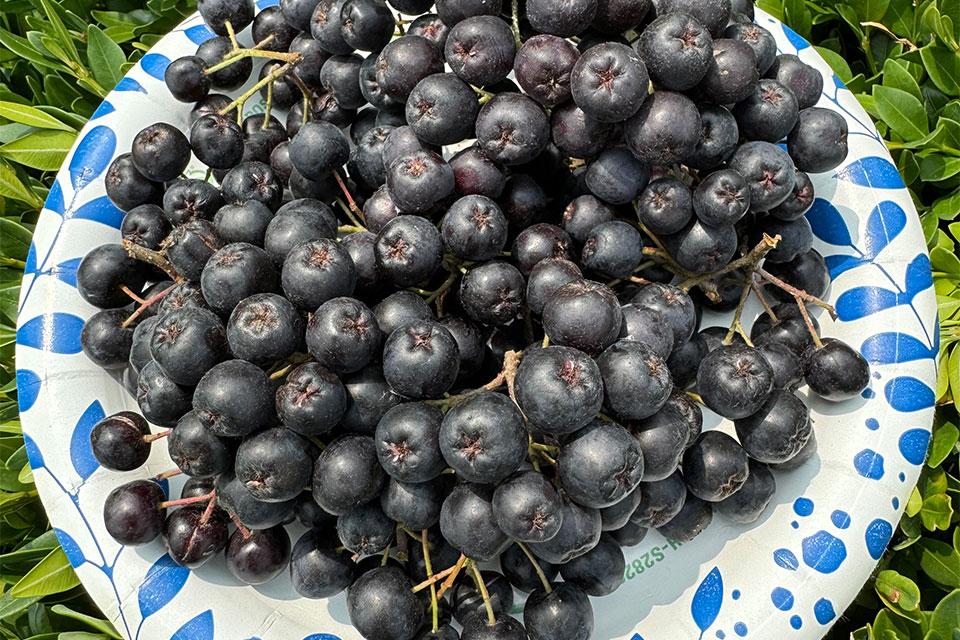
Plate of ‘Viking’ Aronia berries.
Photo: Gary Gao
Aronia is not hard to grow. Lace bug can be a serious pest on Aronia and can cause its leaves to lose color. An insecticide application to the underside of the leaves in spring can be quite effective in managing the pest. Interested growers can refer to the OSU fact sheet #ANR-0157, “Growing Aronia (Aronia melanocarpa) in Ohio,” for more information.
Despite all these rave reviews, growers should still do their own homework before committing to a large planting of any niche super fruit.
Subscribe Today For
