



How To Make Every Nutrient Count in Your Orchard
 June 15, 2026
 Accurate fertilization in fruit crops has never been more important. Mineral nutrients play essential roles in plant growth, yet their rising costs and limited availability of fertilizers are creating major challenges for fruit growers. These pressures make it critical to closely monitor nutrient status and apply the right fertilizer source at the right rate, time, and place. This is a good moment to revisit the basics of plant nutrition, especially the macronutrients required in the largest quantities.
Plants require 18 essential elements for growth and development, grouped into macronutrients and micronutrients. Macronutrients are needed in larger amounts and play major structural and physiological roles. According to nutrient management resources from Cornell University, structural nutrients include carbon (C), hydrogen (H), and oxygen (O). Primary macronutrients include nitrogen (N), phosphorus (P), and potassium (K) while secondary macronutrients include calcium (Ca), magnesium (Mg), and sulfur (S). Both primary and secondary macronutrients are commonly applied as fertilizers.
To understand how growers are adapting to fertilizer challenges, I spoke with several fruit producers, including Theresa Beyler, who took over a struggling blueberry farm in northern Ohio after retiring as a music teacher. Determined to restore the farm to full productivity, she has made precision fertilization one of her top priorities.
I also reached out to Brad Bergefurd, Regional Agronomist for the Eastern Corn Belt at BRANDT Discovery and Innovation and a former colleague at The Ohio State University. When asked about rising fertilizer costs and the importance of precision nutrient management, Bergefurd emphasizes that maximizing yield, quality, and profit requires optimizing nutrient availability at the right time. He stresses that growers must use key diagnostic tools, such as soil testing and plant tissue analysis to accurately assess the nutrient needs of fruit crops.
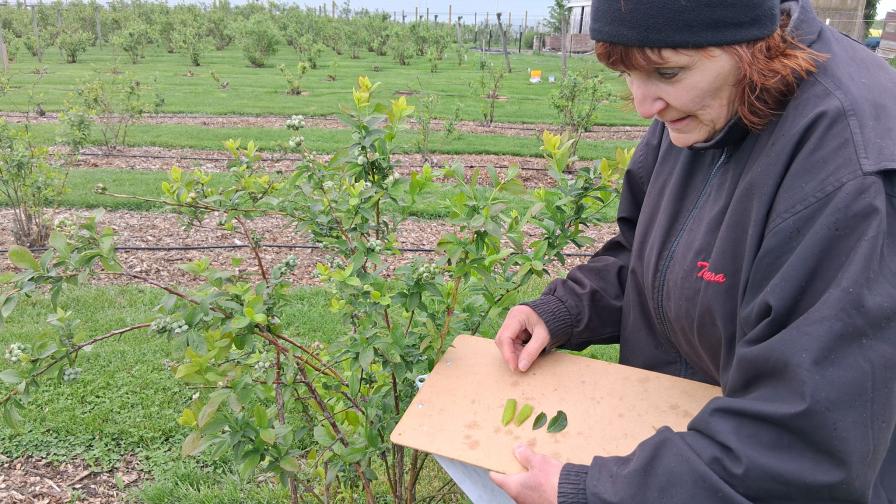
Theresa Beyler of Blue J. Farm in Spencer, OH, examines blueberry leaves for nutrient deficiencies.
Photo: Mark Wood of Blue J. Farms
SOIL AND TISSUE TESTS GUIDE FERTILITY DECISIONS
Beyler has already taken steps in this direction. Working with her county Extension educator, Ashley Kulhanek of Ohio State University Extension in Medina County, they collected soil samples last year and used the test results to guide her applications of N, P, K, and other nutrients. I also reminded her that blueberries prefer nitrogen in the ammonium (NH₄⁺) form, making urea and ammonium sulfate better choices than nitrate-based fertilizers. Split applications help reduce losses from nitrification and leaching.
This year I recommended plant tissue testing to her management routine. For fruit crops in Ohio and surrounding states, the recommended window for tissue sampling is mid-July through mid-August. While soil tests show what nutrients are present in the soil, tissue tests reveal what the plant is actually taking up at that moment, an equally important piece of the puzzle.
MATCHING NUTRIENTS TO CROP GROWTH STAGES
Understanding nutrient needs at different growth stages is also essential for efficient fertilization. Plants require specific nutrients at specific times, and deficiencies during critical periods can limit yield and quality.
Bergefurd notes that strawberries, for example, have sharply increased demand for potassium, nitrogen, and calcium when shifting from vegetative to reproductive growth. This demand often exceeds the soil’s natural mineralization rate, making supplemental fertigation or foliar feeding necessary.
ESSENTIAL ROLES OF MACROS AND MICROS
Each macronutrient plays unique roles in plant health. Phosphorus is essential for DNA and RNA synthesis and serves as an “energy currency” in plants. Although often associated with root growth, phosphorus is essential for many plant functions. Cornell University notes that phosphorus deficiency can cause purple or reddish leaf discoloration, poor root and shoot growth, reduced yield, early fruit drop, and delayed maturity.
Potassium is vital for water movement, carbohydrate transport, and overall nutrient flow within the plant. Often referred to as potash by growers and suppliers, potassium helps fruit crops tolerate water stress and enhances sugar accumulation in fruit, thus leading to sweeter harvests and more resilient plants.
Calcium is critical for strong cell walls, which contribute to firmer fruit and better shelf life. While adequate soil calcium is important, uptake depends heavily on water movement and can be slow. For this reason, foliar calcium sprays are widely used in apples, strawberries, and other fruit crops to ensure adequate levels during fruit development.
Micronutrients, even though needed in lesser amounts, are equally essential. Deficiencies in iron, zinc, boron, or other micronutrients can severely limit plant growth. Beyler, for example, is managing iron chlorosis in her blueberry bushes, a common issue in soils with higher-than-ideal pH levels.
To meet the nutritional needs of fruit crops efficiently and sustainably, growers must use every tool available. This includes soil testing, tissue analysis, knowledge of crop-specific nutrient demands, and careful selection of fertilizer sources and application methods. Successful nutrient management follows the 4Rs of nutrient stewardship: applying the right nutrient source at the right rate, at the right time, and in the right place.
Wishing everyone a bountiful and sweet harvest in 2026!
Subscribe Today For
