



Grow Bigger Berries Through Better Pollination
 December 16, 2025
 Wild bees don’t just help blueberry plants produce fruit — they help make the berries bigger. A new international study combining data from 260 blueberry fields across major production regions has shown that wild bee visits improve berry weight by increasing the number of seeds per berry. More seeds mean heavier, higher-quality blueberries. Although honey bees are the most common pollinator in blueberry fields, the research reveals that it is wild bees, like bumble bees and solitary bees, that make the greatest difference to fruit quality.
WILD BEES MAKE BETTER BERRIES
Blueberries are largely self-fertile, meaning pollen from the same flower, plant, or cultivar can lead to fruit formation. Regardless, insect pollination remains essential for pollen movement and achieving economically viable yields of fruits with marketable size. To better understand this relationship between insect pollinators and berry outcomes, a study was conducted that analyzed data from thirteen pollination experiments. The overall aim of the study was to examine how honey bees and wild bees influence fruit set (the proportion of flowers that develop into berries), seed set (the number of seeds per berry), and berry weight, which served as an indicator of fruit quality (Figure 1).
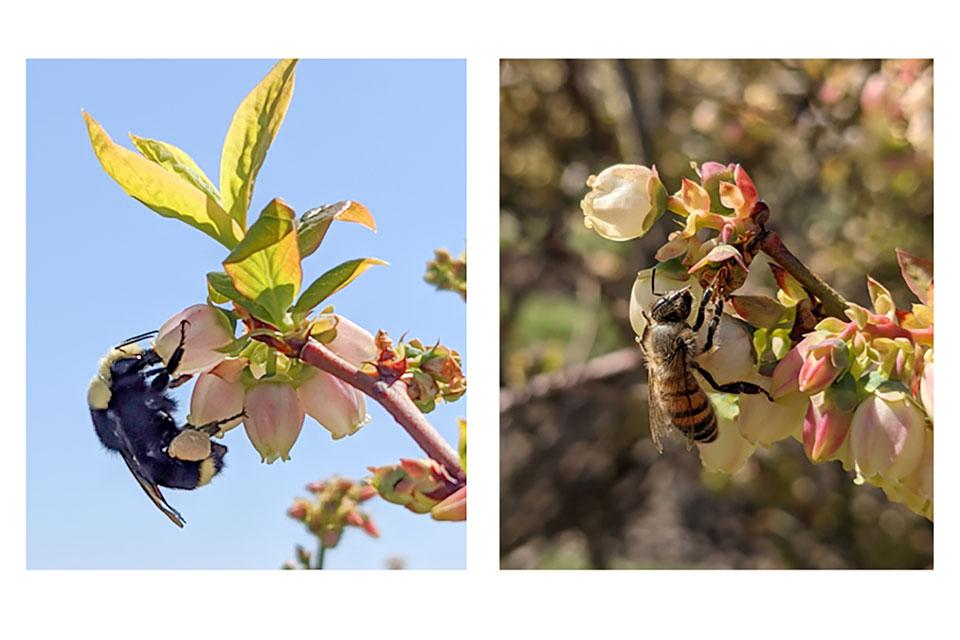
Figure 1: Bumble bee (left) and honeybee (right) visiting a blueberry flower.
Photos: Maxime Eeraerts
The results were clear: seed set was the strongest factor driving berry weight, and floral visitation by wild bees significantly increased seed set. In contrast, honey bee visitation and fruit set showed no clear link with berry weight. In other words, wild bees indirectly make blueberries bigger by improving seed formation — something honey bees did not achieve (Figure 2).
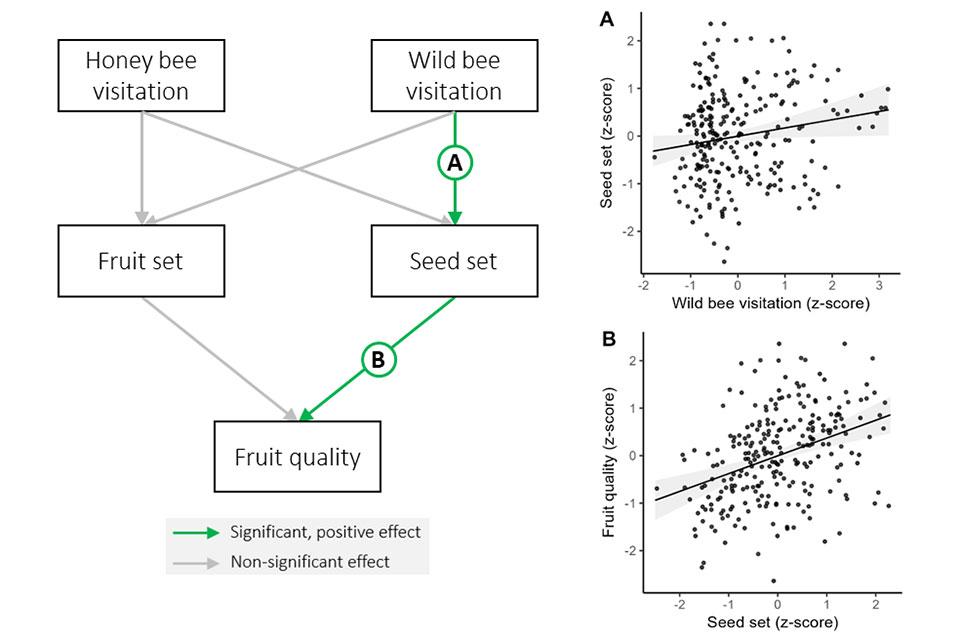
Figure 2: Structural equation model (SEM) on the left of the determinants of fruit quality measured as fruit weight. Green arrows indicate significant, positive relationships (p < 0.05), and the grey arrows indicate non-significant paths. Black double arrows indicate significant, correlated errors and grey dashed arrows indicate a non-unsignificant correlation. On the right the relationship between wild bee visitation and seed set (A) and the relationship between seed set and fruit quality (B) are shown.
Graphic courtesy of Maxime Eeraerts
WHY SEEDS MATTER
The link between seeds and berry size is the following: each seed inside a blueberry releases natural hormones that stimulate surrounding fruit cells to expand. Berries with more seeds develop more uniformly and reach larger sizes. In general, wild bees are known to be better at transferring pollen between flowers compared to honey bees. Wild bees are especially effective pollinators of blueberry because they can perform “buzz pollination,” a technique where they vibrate the flower to release pollen. Many bumble bee and solitary bee species are capable of buzz-pollination. Honey bees are unable to buzz-pollinate, which limits their pollination efficiency. This difference helps explain why fields with more wild bee activity produced heavier, more uniform berries.
IMPLICATIONS FOR FARMERS
For growers, these findings highlight the importance of maintaining diverse pollinator communities in and around their fields. Most blueberry farms are stocked with honey bee hives, but fruit quality still benefits from the presence of wild bees. Even when honey bee numbers are high, wild bees clearly add value by improving seed set and, consequently, berry weight.
Growers can support wild bees in several practical ways. Preserving or planting natural habitats such as hedgerows, forest edges, and flower-meadows provides foraging and nesting sites. Allowing clovers, dandelions, and other flowering plants to bloom between rows helps sustain pollinators throughout the season. Some growers are concerned that adding additional blooming plants could lead to floral competition with blueberries and reduce pollination. However, there is currently no evidence to support this concern. Bee hotels or patches of bare soil can attract solitary species, and planting multiple blueberry cultivars encourages cross-pollination that benefits both bees and quality fruit development.
CONCLUSION
This study makes one point clear: pollination benefits not only yield but also fruit quality. Wild bees play a key role in producing large and uniform blueberries that consumers prefer and that markets increasingly reward. Supporting these pollinators is an investment in better fruit and more sustainable production. Healthy wild bee populations mean healthier, heavier blueberries.
Lisa Wasko DeVetter, Professor of Small Fruit Horticulture at Washington State University, contributed to this article.
Subscribe Today For
