



Blueberry Report: IntoThe Woods
 February 24, 2011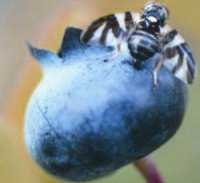
The landscape around your farm can have an impact on the abundance and distribution of certain insect pests. For example, a number of blueberry farms in New Jersey are surrounded by pinelands, which may contain wild blueberry populations. These areas could serve as a nesting ground for both beneficial insects, and those you want to avoid at all costs.
A team of researchers at Rutgers University, with assistance from other Extension scientists as well as local blueberry growers, recently set out to examine how and when pests might move from these native habitats to a commercial farm. They wanted to study the spatial and temporal movement of these pests, determine their distribution within blueberry farms, and identify site-specific management strategies, with the overall goal of helping growers save money on unnecessary chemical applications.
The researchers selected blueberry maggot as their primary pest, as it is a key direct pest in many blueberry growing regions. They hypothesized that populations of blueberry maggot would be higher on fields near wooded areas, thus requiring more intense management.
Important Questions
Cesar Rodriquez-Saona, an Extension specialist in the Department of Ento-mology at Rutgers University, says there are three questions the research team wanted to answer:
– How far do flies move within blueberry farms?
– Does proximity to forest influence fly distribution?
– How do fly movement and distribution affect management practices?
To answer the first question, two studies were conducted: one in an open field, and the other inside a 120-foot tunnel. About 3,500 marked blueberry maggot flies were released at three different points, and flies were captured in eight baited traps and monitored in a period up to 48 hours.
The results indicated that flies have restricted movement once they are inside a field. The further the distance from the release point, the fewer flies that were captured.
Seeing The Forest
When looking at how the proximity to a forest affects fly distribution, the researchers worked with eight New Jersey blueberry growers, half of which used integrated crop management with the help of field mapping. They looked at three different varieties (Duke, Bluecrop, Elliott), and selected farms surrounded by forests, open fields, and other blueberry fields. Variables tested included land cover, farm perimeter, farm interior, and variety.
On a large scale, the trial results indicated that the percent of forest cover best explains maggot distribution across the farms. On a small scale, farms surrounded by forest had higher blueberry maggot populations near the forest edge, while farms with no forest border or open space had low fly populations. It is also worth pointing out that the Duke variety showed little fly populations. In addition, interior fields with a late cultivar tended to have high fly populations, which highlights the importance of field sanitation.
The identification of high blueberry maggot populations in select areas indicates that landscape architecture can be a useful tool to improve pest management strategies. Moving forward, the researchers hope to expand their geographic region, analyze multi-year data, and perhaps study other pests such as fruitworms and Japanese beetle.
For more on “Managing Blueberry Maggot Flies Using Spatially Based Tools,”.
Subscribe Today For
