



Yearning To Learn More About Exciting, New Almond Varieties
 February 3, 2025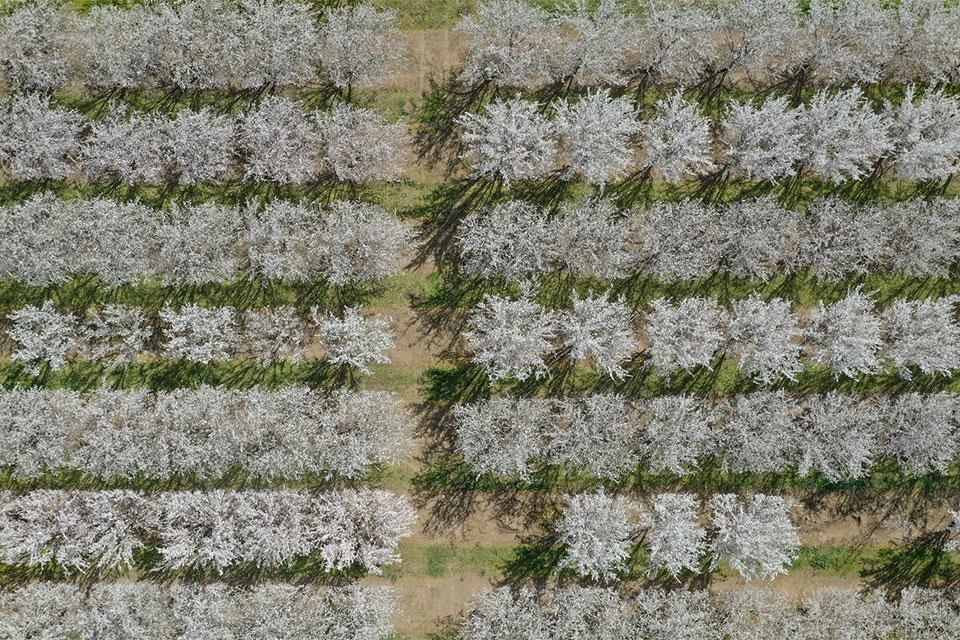
This is a drone photo of the UC Cooperative Extension almond variety trial at the CSU, Chico Farm. In the trial every other row is ‘Nonpareil’, and the other rows are 12 tree replicates of 29 almond varieties.
Image courtesy of Luke Milliron, UC Cooperative Extension
New almond varieties are always coming out from public and private breeding programs around the world. It is tempting to plant the latest and greatest. Unfortunately, many growers in my area of Northern California have been burned by new varieties in recent years — ‘Bennett-Hickman’ bud failure issues and partial incompatibility of ‘Independence’ and ‘Shasta’ on the ‘Krymsk 86’ rootstock.
Witnessing these painful and costly stories leads me to always ask growers to start variety selection with what has worked best for them in the past — although I have written about the new mysterious issues with the ‘Monterey’ variety in my area. For other well-established varieties, we have a good sense for both their advantages and warts. In addition to experienced nursery professionals, your farm advisor and processor are additional great resources for deciding what to plant.
WHAT WE KNOW
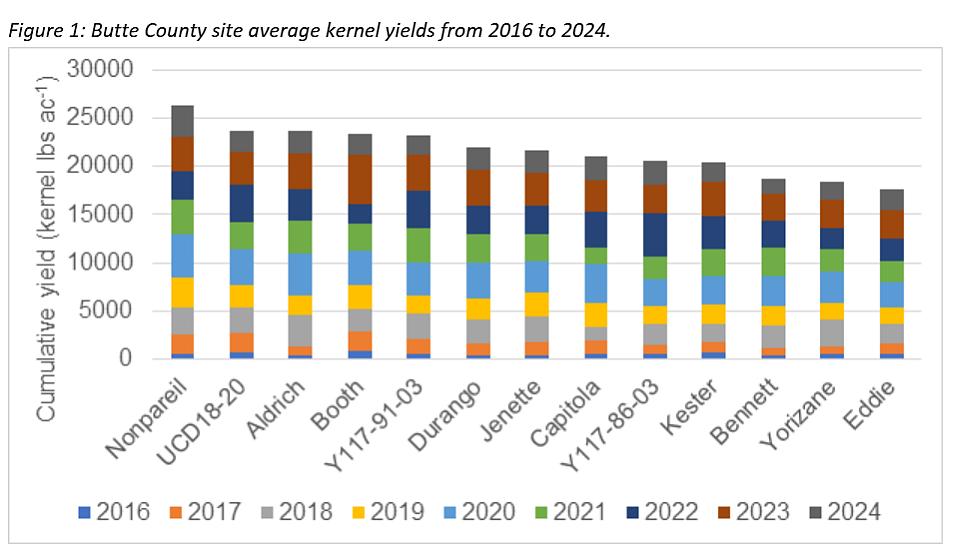
A well-known nurseryman once said, “It takes 20 years to prove a rootstock.” I would add that it can take that long also to prove a variety and a variety-rootstock combination. In the third generation of almond variety trials planted at three locations across the Central Valley in 2014, we do not have 20 years of insights; however, we have learned a great deal in the past 11 years (Figure 1).
Graphic courtesy of Luke Milliron, UC Cooperative Extension
In figure 1, looking at the top five yielding varieties at the Butte site, we see that despite efforts to try and develop superior varieties for nearly 150 years, ‘Nonpareil’ still reigns king not only for kernel quality but also in our trials for yield as well.
‘UCD 18-20′ and ‘Booth’ are high-yielding self-sterile varieties — unfortunately, they can both suffer from very high doubles, and high doubles might help explain their high yields.
‘Y117-91-03′ is a high-yielding self-fertile variety from the USDA. Its kernels consistently have few defects, although they do produce a smaller kernel than ‘Nonpareil’. It is currently under virus clean-up at the Foundation Plant Services facility at UC Davis and could be released to nurseries for propagation as early as fall 2025.
Of the remaining varieties, ‘Y117-86-03′ and ‘Yorizane’, also from the USDA, are self-fertile, while the other varieties above are self-sterile. You can learn more about results from all three trial sites at: fruitsandnuts.ucdavis.edu/resourcesreports and growingthevalleypodcast.com/podcastfeed/rvt3-10.
WHAT WE ARE LEARNING
In the fall of 2022 and spring of 2023, the fourth generation of UC almond variety trials funded by the Almond Board of California was planted in Butte, Stanislaus, and Kern counties. Another 30 varieties are under evaluation — the vast majority of which are self-fertile. New test varieties are from breeding programs at UC Davis, USDA, Australia, Spain, and Burchell Nursery.
This is also the first time we have been allowed to include the popular ‘Independence’ variety in our UC trials, and I have added an ‘Independence’ rootstock trial to my site. Other varieties under evaluation that you may have heard of include ‘Shasta’, ‘Pyrenees’, ‘Lassen’, and ‘Conway’ — all from Burchell nursery. At the Stanislaus site — with tight 10- by 20-foot spacing, minimal pruning, and the high vigor ‘Hansen 536’ rootstock — ‘Yorizane’ yielded just over 1,000 pounds to the acre in the second leaf!
Meanwhile, at the Butte site the planting has had a rocky start, with a late-spring planting out of cold storage resulting in high mortality and extensive replant needs. We will keep you updated in the years to come in articles, podcasts, and field days on what we learn from these three new trial sites.
WHAT WE KNOW THE LEAST ABOUT
Self-fertile ‘Nonpareil’ is an exciting topic of coffee shop talk these days. Both Sierra Gold Nurseries (‘FruitionOne’) and Burchell Nursery (‘Nonpareil SC+’) announced in late 2024 their partnerships with biotech companies to develop a self-fertile ‘Nonpareil’. Both nurseries plan to begin delivering these trees to growers in 2027. However, many questions remain.
My current understanding is that the self-fertile ‘Nonpareil’ trees from both nurseries would not be considered GMOs in the U.S. because of the less invasive genetic modifications made through the CRISPR technique when compared to the earlier generations of biotech modified crops.
However, the EU, our largest export region, currently would consider kernels from these trees as GMOs. Former farm advisor David Doll (aka, The Almond Doctor), who farms in Portugal, thinks there is a “reasonable probability that the EU will loosen the rules that define ‘genetically modified’” in the next five years.
Clearly the road forward for self-fertile ‘Nonpareil’ and potentially other previously self-sterile almond varieties is not yet lit. I hope to be trialing these trees as early as 2026. This is a case where researchers can learn early lessons and mistakes with these new trees so that growers are not in the potentially costly position of finding themselves in the role of experimental researcher.
Subscribe Today For
