


Growers Want Help Against Cherry Leaf Spot Disease
 January 29, 2025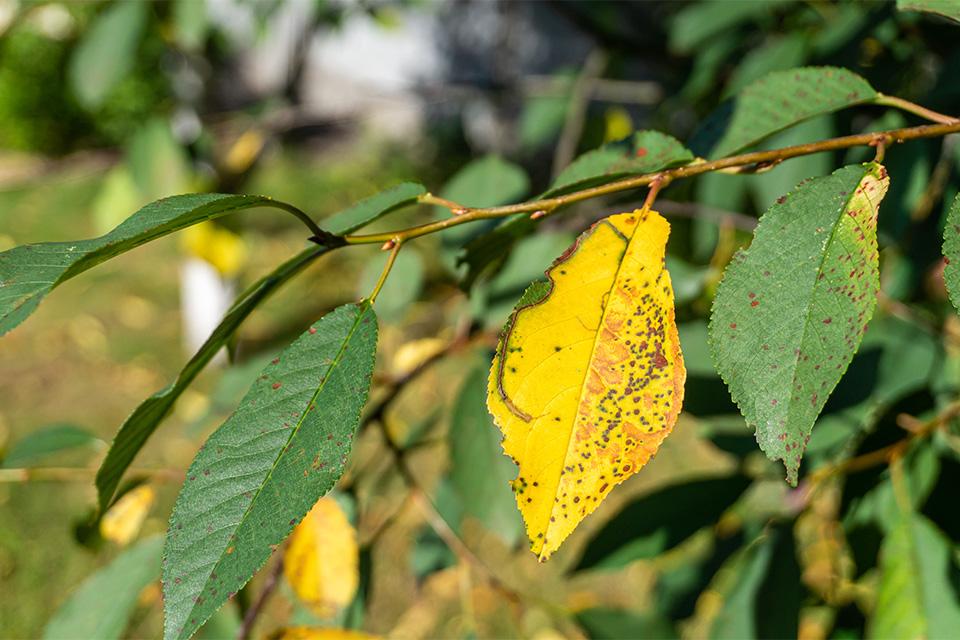
Symptoms of cherry leaf spot are evident on this tree.
Photo courtesy of AdobeStock_salarko
What is going on with cherry leaf spot?
Organizers of the recent Great Lakes Expo in Grand Rapids, MI, posed that question during one of their educational sessions in December. Tasked with answering the query were two Michigan tart cherry growers, a local commercial fruit production consultant, and George Sundin, the tree fruit disease specialist from Michigan State University who has been trying to replace fungicides that have turned obsolete the last 15 years.
The two growers and consultant set the tone for the session upon describing their recent woes with cherry leaf spot, which is considered the most important fungal disease of tart cherry in Michigan.
Jim Nugent (Sunblossom Orchards, Suttons Bay, MI): “As every cherry grower in here knows, it was a crappy year. It simply took a lot of sprays. We’ve really lost so many materials to resistance that we used to depend on. Back in the day we could get up to 120 hours of back action. Today you have to have the material on before you go into the rain. And then we have frequent rains. I looked back at our records, and we ended up with almost 4 inches of rain in May and recorded rainfall on 13 days, and in June it was over 4½ inches on 16 days. And then you have a tough time finding spray windows. It was just a very difficult year for anybody to control leaf spot. Costs were high, and results were poor.”
Gerrit Herrygers (Herrygers Farms, Hart, MI/certified crop advisor, Wilbur-Ellis): “People that did better than others are people that sprayed early and sprayed often. As far as economics went, it was like pulling teeth to (tell) people, ‘You need to reapply, folks. You just washed everything off.’ We’re talking large amounts of rain and heavy infection areas — the whole thing snowballed very quickly. Historically we’re starting our first tart cherry sprays in the middle of May. Our first spray was the 29th or 30th of April. There were people not willing to accept that fact; they were anticipating it was going to be freezing at that point and lack of crop. It was all of the above. It was fighting wind and rain that whole time. The folks who did better are the ones who had more sprayers per acre and could fight the wind and go get ’em.”
Pete Nelson (HortSystems): “Good leaf spot management (last) year came down to excellent coverage, which was difficult because a lot of times when we had these fronts moving through, it was windy for a couple of days afterward. You need a really strong sprayer to get material up into the top of our cherry trees. And timing — you couldn’t wait until Monday to get out there. You had to be on it. 2022 and 2023 were pretty easy years for cherry leaf spot management. A lot of people continued those habits, where half sides provided adequate coverage. It was Memorial Day weekend when we had that first real big infection. We were not prepared. And from there, it was a game of catch-up.”
MSU TO THE RESCUE
As Nugent kiddingly noted, the only person smiling last year in Michigan’s tart cherry orchards was Sundin, whose MSU team picked the perfect year to research treatments of cherry leaf spot.
The problem with the disease, he stressed, is fungicide resistance. The fungus is different from other fungi that his department has dealt with because the populations are so high.
“Each lesion that you see on the leaf might make 100,000 spores,” he said. “We were trying to quantify spores from lesions at one point, and the number was unbelievable. When numbers are that high, there are chances for mutations that lead to fungicide resistance.”
Which is why BASF’s otherwise stellar fungicide, Pristine, became obsolete in 2010. The leaf spot developed resistance to boscalid, the succinate dehydrogenase inhibitor (SDHI) component of the product.
“Pristine was the most amazing fungicide when we got it for leaf spot,” Sundin said. “But we had resistance develop relatively quickly.”
Then, between 2016 and ’19, the same thing happened to fluopyram and fluxapyroxad, the SDHI components of Luna Sensation (Bayer CropScience) and Merivon (BASF), respectively.
“Because of that, there aren’t really these kinds of hammers. They aren’t available to us anymore because we have resistance to leaf spot,” Sundin said. “These were great because these fungicides would internalize within the leaf. And now we can’t do that, so we’re left with fungicides that are protectants, things like captan, things that the EPA doesn’t want us to use. But that’s what we have — captan, coppers, chlorothalonil.”
Captan is best administered at 2.5 pounds per acre, Sundin said, while metallic coppers are ideal at 1.2 pounds per acre.
The fungicides Cabrio (pyraclostrobin, BASF) and Flint Extra (trifloxystrobin, Bayer CropScience) are still working against cherry leaf spot. “They weren’t as good as the SDHIs, but they’re still good. There still is one mode of action. I would mix that with at least 1.25 pound of captan if you’re going to use that.”
The issue with chlorothalonil, according to Sundin, is the 10-day retreatment interval, which can sometimes be a problem, he said, because the fungicide cannot stretch out for 10 days to maintain disease control. “There can be breakthrough infection that occurs,” he added.
2024 COPPER TRIAL
Sundin’s department decided last year to study all coppers — not just fixed coppers, such as Kocide. Included were 11 products that covered copper sulfate pentahydrate (Magnabon, MasterCop), basic copper sulfate (Cuprofix), copper octanoate (Cueva), copper hydroxide (Badge SC) and oxychloride (Badge X2), fixed copper (ChampION, Camp Formula 2, NuCop 50, and Kocide 3000), and captan.
“It was time to put them all out there in a trial,” Sundin said. “The one thing that saves us with cherry leaf spot is that this fungus is highly susceptible to copper, and we hope that doesn’t change. That’s why fixed coppers, like Kocide, work great.”
The first two applications for all treatments (May 10 and 20) was chlorothalonil (Equus 720, Amvac Chemical), followed by four applications of each copper product post shuck split (May 28, June 6, 14, and 24). Before harvest (July 8), ethephon (Ethrel, Bayer CropScience) was applied, followed by a postharvest application (Aug. 5) of the original copper product.
In a comparison of leaf spot defoliation one day before harvest (July 15) and one day postharvest (July 16), there were no significant differences in any of the treatments. “We did not lose leaves due to shaking in this block,” Sundin said.
By Sept. 3, the results had become mixed. While the untreated control was 100% defoliation, three products — Badge X2 (39%), Kocide 3000 (just over 50%), and Badge SC (57%) — worked pretty well, Sundin said, as did captan (36%). “That was great,” Sundin said.
The five next-best products — MasterCop, Cuprofix, ChampION, Champ Formula 2, and NuCop 50 — ranged between 60% and just over 70% defoliation. “They’re at a fringe level in terms of their efficacy. They may work better in an isolated situation, but comparatively they are not as effective,” Sundin said. Magnabon and Cueva ended between 85% and 90% defoliation.
Sundin summarized by saying the best current control materials for cherry leaf spot are Badge X2 and Badge SC (both Gowan), Kocide 3000 (Certis USA), and captan.
“Basically, captan and a few coppers,” Sundin said. “All of the coppers are not equal (to one another) in terms of their efficacy. We need to confirm that this coming season, but that’s the way it’s looking.”
OTHER TRIALS
While that copper trial was conducted with handgun applicators on a small number trees, a separate trial involved three materials — ChampION, Badge SC, and captan — that were air-blasted across 5-acre blocks at MSU’s West Central station. Two results stood out to Sundin.
“One, the ratings were identical for Champ and Badge as to what we had observed at the Northwest station,” Sundin said. “(Also), that speaks to the question I get a lot about, ‘You’re doing handgun; how does that relate to air-blast?’ Well, the results are identical.”
Sundin’s team also evaluated various biologicals, none of which was effective against cherry leaf spot, he said.
Subscribe Today For
