



Which Self-Fertile Almond Variety Is Right for You?
 November 2, 2026
Choosing which almond variety — or varieties — and rootstock to plant is one of the most important almond production decisions you make. There have never been more choices than there are now. Even though we all like having options, additional choices can quickly become overwhelming. If you’re ordering a self-fertile variety in late 2026, you have Independence, Shasta, Pyrenees, Lassen, Yorizane, Earlybird, Parpareil, and the two self-fertile Nonpareil releases, Nonpareil+ and FruitionOne (plus Butte+ in 2027).
I’ll zoom in on the decision between Yorizane and Parpareil. Why? They’re the two self-fertile varieties for which we have the most publicly available information. Both have been in University of California Cooperative Extension regional almond variety trials funded by the Almond Board of California since 2014. I have been evaluating these two varieties in Chico, CA, for nearly 10 years.
THE SIMILARITIES
Yorizane and Parpareil are self-fertile varieties developed by the USDA and released to California nurseries without a royalty in 2020 and 2025, respectively. If you’ve been following the regional almond variety trials for a while, note that Yorizane was listed as Y116-161-99 and Parpareil as Y117-91-03 before they were named.
Yorizane blooms around Nonpareil timing, while Parpareil blooms a couple of days later. Yorizane harvests at roughly Nonpareil timing, while Parpareil harvests four days to two weeks earlier than Nonpareil. Yorizane is considered soft-shelled, while Parpareil is considered semi-hard-shelled. Both have high crackout — 67% for Yorizane and 66% for Parpareil.
THE BIG DIFFERENCES
Yorizane, like most other self-fertile varieties listed above, has lower vigor than Nonpareil. Parpareil may be the first commercially released self-fertile variety in California that is highly vigorous, producing a tree roughly the same size as Nonpareil. Although smaller, Yorizane is more yield-efficient, producing more kernels relative to canopy size than Parpareil.
Overall, after 10 harvests of replicated and randomized trials at three sites — in Butte, Stanislaus, and Madera counties— Parpareil averaged 2,425 pounds per acre, statistically significantly more than the 2,197 pounds per acre for Yorizane, a 10.4% difference. However, that average hides significant site-to-site differences. At Butte and Stanislaus, Parpareil outyielded Yorizane, but the reverse was true at Madera.
ROOTSTOCK AND SPACING MATTER
The choice of rootstock is just as important as the choice of variety. In my northern Sacramento Valley context, Krymsk 86 rootstock reigns king. Although it appears to produce a decent-sized tree in some fields, several grower anecdotes suggest compatibility problems between Yorizane and Krymsk 86.
Currently, Parpareil does not appear to have compatibility issues with Krymsk 86. This is remarkable because most commercial self-fertile varieties — Independence, Shasta, Pyrenees, Lassen, and now Yorizane — have varying levels of evidence suggesting problems when paired with Krymsk 86.
Because the Butte trial was planted on Krymsk 86 at a wide spacing of 18 by 22 feet, both factors help explain Parpareil’s yield advantage at the site and Yorizane’s disadvantage. At Stanislaus, moderate spacing of 16 by 21 feet on a moderate-vigor rootstock, Nemaguard, helps explain why the more vigorous Parpareil outyielded Yorizane. Finally, at Madera, with a tight 12-by-21-foot spacing and the vigorous Hansen 536 rootstock, the highly yield-efficient Yorizane was able to outyield Parpareil.
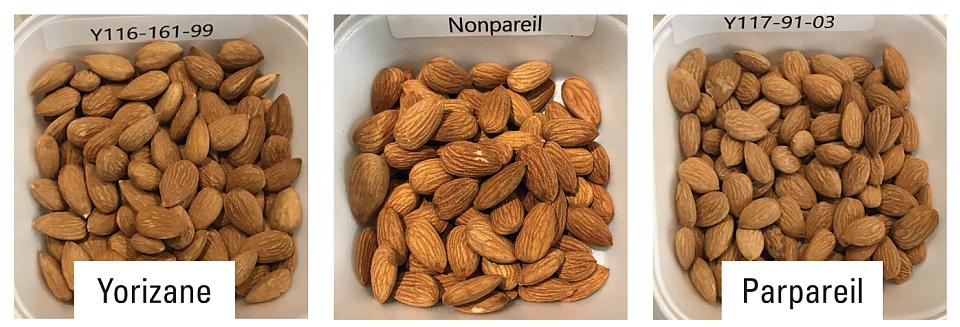
Figure 1: (From left) Kernels of Yorizane, Nonpareil, and Parpareil. Though classification for Yorizane and Parpareil is unknown, these varieties could land in the California classification.
Photos: Luke Milliron, University of California Cooperative Extension
KERNEL CLASSIFICATION REMAINS UNKNOWN
Kernel classification is the biggest unknown for both varieties (Figure 1). Yorizane is the same size as Nonpareil but has a different shape — broader and more oblong. Parpareil is shaped like Nonpareil but is much smaller, similar to Aldrich.
One processor received samples from Butte in 2018 and thought the kernels of both varieties would blend with California types. In a more comprehensive four-handler evaluation conducted by the Almond Board in 2025, Yorizane was deemed an excellent candidate for roasting, but one processor noted problematic blanching because of seam splitting. This processor evaluation is being repeated in 2026 with a refined protocol and will also include Parpareil.
In the quality analysis conducted yearly at each site in the variety trial, both varieties had relatively few defects overall. Parpareil had more brown spot from bug feeding than Yorizane, while the reverse was true for stain.
We will learn much more about kernel quality and classification for these two varieties in the years to come. Kernel classification is ultimately dictated by nut buyers, can differ among handlers, and is subject to change over time. However, my starting assumption is that these are two varieties with relatively low kernel defects that may land in the California classification.
WHICH VARIETY TO CHOOSE?
Given that we don’t know kernel classification, let’s momentarily assume a California classification for both varieties. Which variety performs better then comes down largely to rootstock and spacing.
If using a peach-almond hybrid, such as Hansen 536, SG1, FxA, or Bright’s Hybrid 5, with tight spacing, you may achieve superior yields with Yorizane. However, if you would like to use a more moderate-vigor rootstock, such as Krymsk 86 or Viking, with more moderate spacing, you will likely achieve higher yields with the vigorous Parpareil variety.
In five years, you’ll think it was obvious that you should have instead planted W variety on X rootstock at Y-by-Z spacing. My conclusions here may also appear foolish in five years, but as my understanding evolves, I will continually “tell it like I see it.”
If you’re interested in my unbiased 2 cents on your next almond variety, rootstock, and spacing decision, email me at [email protected].
Subscribe Today For
