



Why Growing More Than Pistachios Matters at Wylie Farms
 February 3, 2026
 When Justin Wylie walks the pistachio orchards his family has tended for more than four decades, he does not just see rows of trees and a season’s worth of work ahead. He sees a living system, one that stretches back through generations and forward into a future that looks nothing like the one his grandparents had imagined.
“There’s a tendency in agriculture to look at the tree as something we fix,” Wylie says. “We’ve focused for so long on resistant rootstocks and chemicals to remove threats. But regenerative farming is about treating the tree as a partner and doing what we can to make it more resilient from the ground up.”
For Wylie, that shift in thinking has reshaped not only how he farms but also how he understands his role in a family story that began long before he ever stepped into an orchard.
THE EARLY PISTACHIO DAYS
The Wylie family’s roots run deep in the early days of California pistachios, back when the crop was still more experiment than enterprise. In the early 1980s, Justin’s father, Craig, and his uncle, twin brother Chris, were part of a generation learning the business from the pioneers themselves.
“They were out here budding some of the very first pistachio trees that were ever planted,” Wylie recalls. Those long days in the field forged an ethic that would define the family’s approach for decades — a belief that farming meant showing up no matter what, solving problems with your hands and doing the work that needed doing even when no one was watching.
Justin grew up inside that culture of grit and responsibility, watching harvest stretch from before sunrise until long after dark. He remembers his father hopping on a forklift when crews ran short and stepping into whatever role was needed to keep things moving. “We came from that world,” he says. “You work any and all hours if there’s an emergency. That’s just farming.”
Still, Justin did not head straight back to the ranch. After college, he found himself in San Diego, working as a drug counselor with Phoenix House, helping families navigate addiction and crisis. “It burned me out fast,” he admits. “I was a kid myself, trying to help parents whose children were in real trouble.” The work mattered, but it took its toll, and eventually a call from home changed the course of his life.
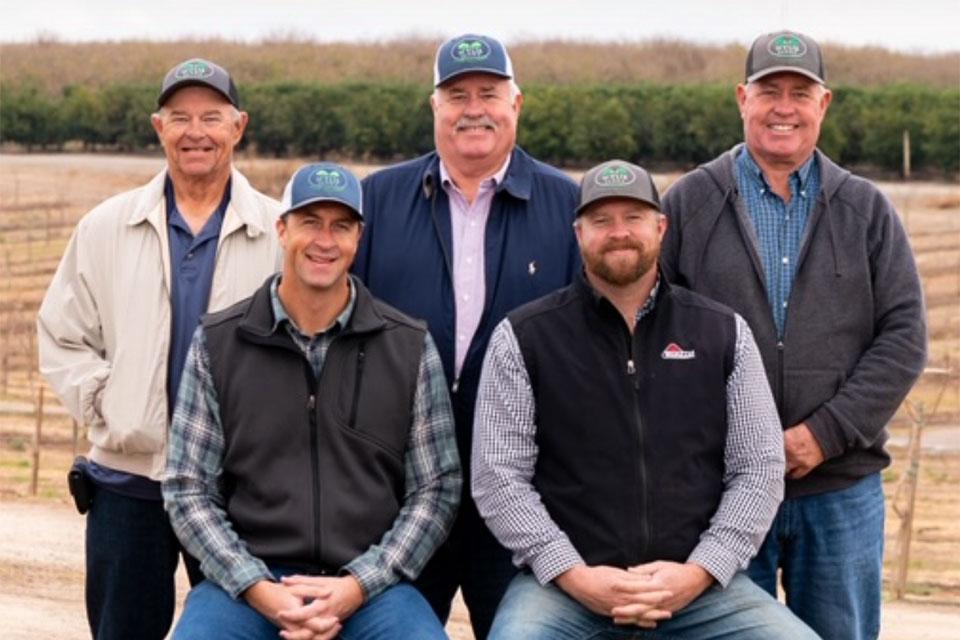
The team at Wylie Farms includes (from top left): Kevin Wylie, Craig Wylie, Chris Wylie; (bottom left to right): Tyler Wylie, Chase Wylie.
Photo: Justin Wylie
COMING HOME
“One day, my Dad called and said, ‘I’ve got all these problems. Can you come help me?’” Wylie recalls. “And I realized — yeah, maybe I can.” Justin returned to the family business not out of obligation but out of a sense that he could make a difference. What he could not have known at the time was that an even bigger transformation was already on its way, one that would reshape how he viewed farming, food, and responsibility itself.
When his son was born, the early joy quickly gave way to worry. “He wasn’t thriving,” Wylie says. “Hospital visits. Oxygen. Antibiotics. Over and over.” By the time his son turned 1, his immune system was compromised, and developmental delays followed close behind.
Doctors eventually offered an autism diagnosis, but for Justin and his wife Tiffany the label did not answer the questions that kept them awake at night. “We were dealing with night terrors, head banging, extreme behaviors,” he says. “And someone looks you in the eye and says, ‘Just practice acceptance.’ When you’ve had two kids before that and you know what normal development looks like, it’s mind-blowing.”
Searching for something — anything — that might help, Justin began reading about the connections between food, health, and the human body. “When you start diving into it, you make the connection between the brain and the gut,” he says. “And then the connection between the gut and the soil.” That realization became the foundation for everything that followed.
A FATHER’S WAKE-UP CALL
The Wylies changed their lives at home first, cutting gluten and artificial dyes from their son’s diet and paying closer attention to what went into their bodies and their environment. The results came faster than they dared hope. “Within three to six months, huge differences,” Wylie says. “He just sort of woke up. His language exploded. The night terrors went away. The asthma went away. He was a totally different child.”
Watching that transformation forced Justin to confront an uncomfortable truth about his own work. “I looked in the mirror and said, ‘Wait — I’m doing one thing at home and another thing at work,’” he says. “If my son is too sensitive for certain foods, then I need to be careful how our food is grown.” That moment became the turning point that pushed him toward regenerative farming.
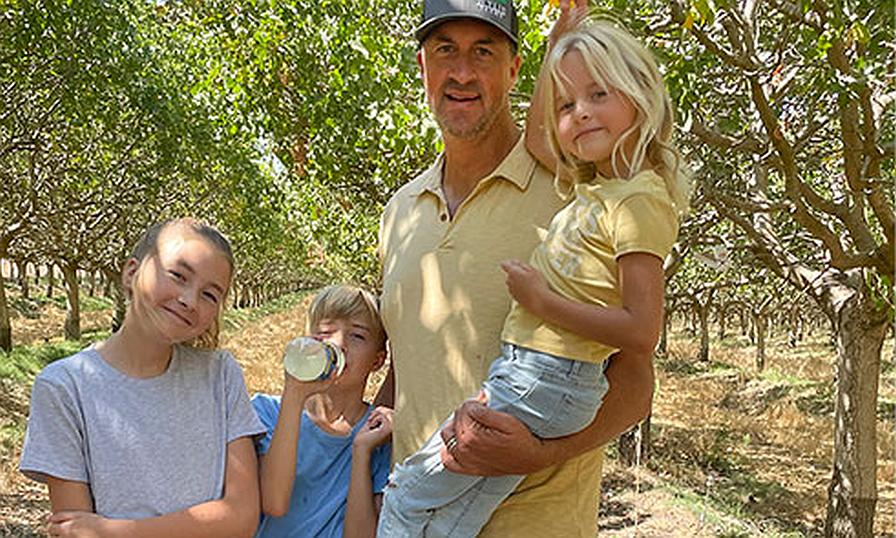
Justin Wylie, with three of his four children, places a strong emphasis on a work/life balance. Photo: Justin Wylie
STARTING SMALL: A 40-ACRE EXPERIMENT
In 2015 Justin carved out a 40-acre block of pistachios and began experimenting, quietly at first, with new ideas and different practices. “At the time, regenerative was just starting to catch on,” he says. “I found John Kempf with Advancing Eco Agriculture, and I listened to every podcast he ever did — twice.” What he discovered was not just a new way of managing crops but a new way of thinking about farming.
“In regenerative ag, everyone is an open book,” he explains. “There’s no roadmap, so we’re all helping each other figure it out.” For a grower accustomed to an industry where information can be guarded and competition fierce, the sense of community felt like a revelation.
The early changes were modest but intentional — fewer blanket sprays, more attention to soil health, and a willingness to question long-held assumptions. “I just started removing treatments to see what I could get away with,” Wylie says. “And I put that money into fertility and long-term soil health.”
Today Wylie Farms still operates both conventional and regenerative acres, but the philosophy guiding decisions has shifted dramatically. “We’re standing on the shoulders of giants,” he says. “Integrated pest management, better chemistry — growers have made huge progress. What we’re trying to add is that missing piece: soil.” For Wylie, regenerative agriculture is not about rejecting the past; it is about building on it.
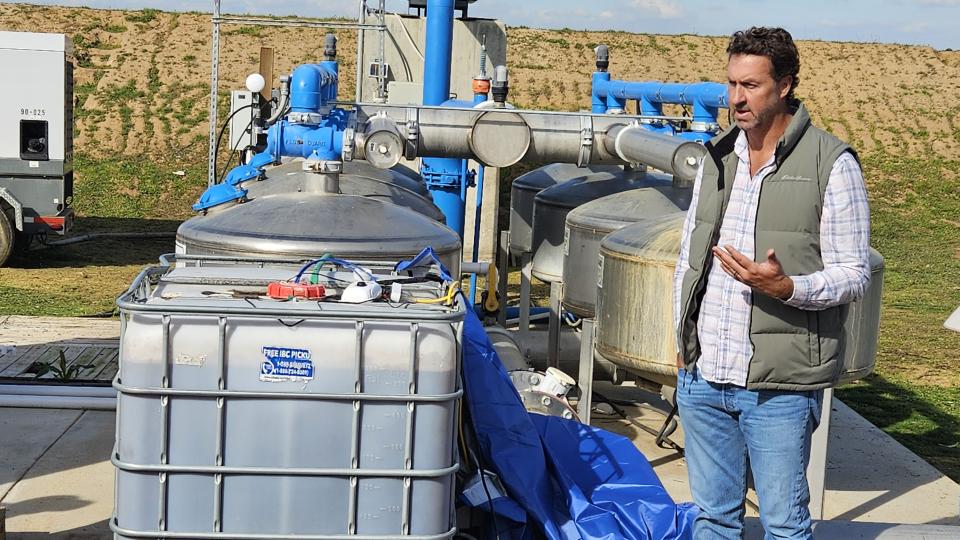
Justin Wylie, owner of Wylie Ranch, shows off his living water system during the BioSolutions Conference and Expo pre-conference tour in February 2025.
Photo by Carol Miller
FARMING A LIVING SYSTEM
At its core, his approach treats the orchard as a living system rather than a collection of problems to solve. “If we’re not taking care of the soil, we’re creating issues long term,” he says. “Most of our soils lack structure. They can’t breathe. That fosters disease.”
Instead of reacting to every new threat, Wylie focuses on prevention — building stronger trees and healthier ecosystems that can weather stress before it turns into a crisis. “Overapplying nitrogen can actually increase pest pressure,” he notes. “That’s controversial, but it’s what I’ve seen.” For him, regenerative farming is about asking better questions.
Practical changes on the ground reflect that philosophy every day at Wylie Farms. Keeping soil covered with compost, mulch, and cover crops has become a cornerstone of the system. “In a 95-degree day, bare soil can hit 140°F,” Wylie explains. “Microbial life dies. Covered soil stays close to ambient temperature. That changes everything.”
He has also worked to restore microbial balance by encouraging beneficial fungi and bacteria. “In old-growth forests, fungi dominate,” he says. “In most farm soils, they’re almost absent. That affects structure, water infiltration, and disease.” The goal is no longer to sanitize orchards but to strengthen them from the inside out.
Those changes carry an economic dimension as well, one that matters deeply in an industry squeezed by rising costs and tightening margins. “In a conventional system, your costs only go up over time,” Wylie says. “With regenerative, the goal is to pull back inputs every year.”
For a crop like pistachios, where global supply continues to grow and prices face constant pressure, efficiency alone is not enough. “We can’t plant our way out of this,” he says. “We’ve got to farm smarter.” For Wylie, sustainability is not a luxury or a public-relations tool. It is a business strategy rooted in long-term survival.
FINDING HOPE IN A CHANGING INDUSTRY
Perhaps the biggest surprise in his regenerative journey has not been the agronomy but the sense of hope it brought back to farming. “I used to feel like every year I was going to lose another tool,” he says. “Something would get banned. Another regulation. It felt threatening.”
Becoming part of the regenerative community changed that perspective. “Once you’re plugged into this world; the future feels hopeful,” he says. “Even the regulators — they want to help. They’re asking, ‘How do we offer carrots instead of sticks?’”
That shift has sparked renewed energy, especially among younger people who once saw agriculture as a dead end. “Kids who were leaving farming are coming back,” Wylie says. “They see this movement and think — maybe there’s a future here after all.”
For him, that possibility hits close to home. “I farm this way because I’d love to see my kids continue to farm,” he says. “And there’s a big question whether they’ll be able to if we don’t change.” Today Justin balances leadership roles in the pistachio industry with the daily rhythms of life on the ranch.
A LEGACY BUILT ON RESILIENCE
“We’re still out there pruning. Still farming,” he says. “We’ve just added another layer of thinking.” In his mind, regenerative agriculture is not a trend or a marketing term; it is a bridge between generations.
“My grandparents focused on survival,” he reflects. “My dad focused on efficiency. I’m focused on resilience.” That mindset, he believes, is what will carry tree nut farming forward in an era defined by climate uncertainty and economic pressure.
As he looks across the orchards today, Wylie sees more than a crop. He sees the possibility of rebuilding soils, conserving water, and strengthening rural communities, one farm at a time. “We can build soil,” he says. “We can hold water. We can improve the climate right where we farm. That’s powerful.”
Then he pauses, thinking not just about the next season but about the next generation. “If we do this right,” he adds, “we’re not just growing pistachios. We’re growing the future.”
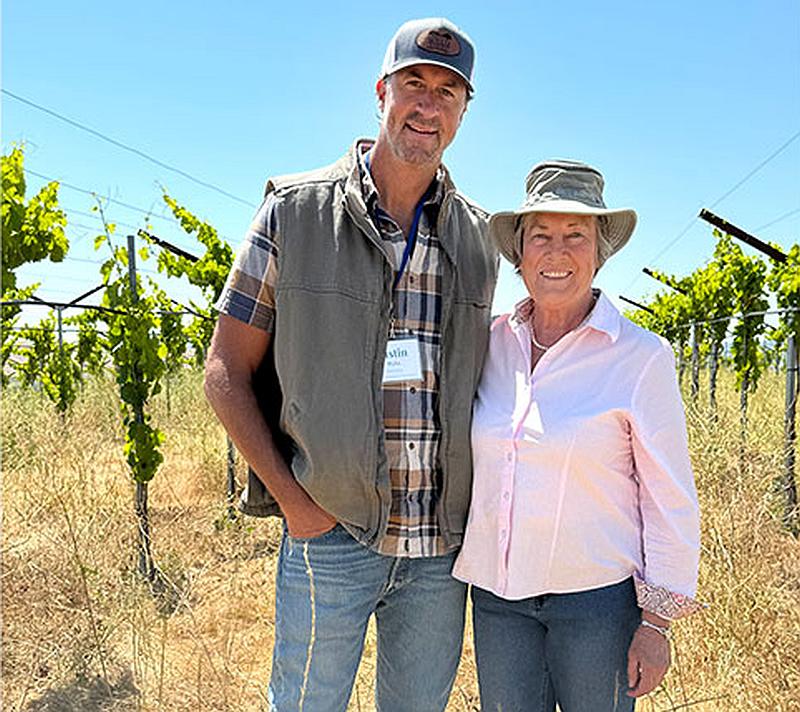
Justin Wylie with renowned soil ecologist Christine Jones, PhD.
Photo: Justin Wylie
Justin Wylie’s Go-To Resources for Regenerative Farming
When Justin Wylie began exploring regenerative agriculture, he immersed himself in the work of educators and practitioners who focus on soil health, plant resilience, and biological systems. These voices helped shape his approach:
- John Kempf — Founder of Advancing Eco Agriculture and host of the AEA Podcast. Kempf emphasizes plant health as the foundation of pest and disease resistance.
- Elaine Ingham, PhD — Pioneering soil microbiologist and founder of Soil Foodweb Inc. whose work helped lay the scientific foundation for regenerative agriculture, showing growers how healthy microbial communities drive plant resilience, nutrient cycling, and long-term soil health.
- Christine Jones, PhD — Soil ecologist known for her work on carbon cycling, soil biology, and building resilient farming systems.
- Graeme Sait — Australian regenerative agriculture educator and speaker focused on mineral nutrition, soil function, and biological balance.
- Gabe Brown — North Dakota farmer, author of From Dirt to Soil, and a leading voice in regenerative agriculture, featured in the documentary Kiss the Ground and its sequel Common Ground.
Subscribe Today For
