



True Drought Tolerance
 January 5, 2011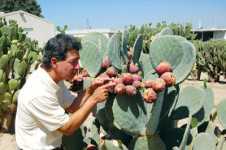

There is potential to produce value-added products from
Indian fig Opuntia, a cactus that can be grown
in adverse conditions.
Photo courtesy of Gary Banuelos
Cactus is a crop that sounds just about ideal for the Western U.S. First, it doesn’t use a lot of water. Second, it appeals to Hispanic consumers, one of the fastest growing population segments in the U.S. Third, it tolerates selenium, an antioxidant so desirable to another fast-growing consumer segment, baby boomers, that they purchase it in pill form. All that, and this particular variety, Indian fig Opuntia, commonly known as prickly pear cactus, doesn’t even possess those painful spines.
No wonder Gary Banuelos, a soil scientist at the USDA Agricultural Research Service Water Management facility near Fresno, CA, is so excited about the crop’s prospects. “I think there’s some real potential,” says Banuelos, who has long researched the ability of certain crops, such as broccoli and canola, to take up selenium from the soil. “We may be able to grow and produce value-added products from Opuntia under adverse growing conditions.”
Banuelos began his study, which is being done in conjunction with Fresno State University and the state Department of Water Resources (DWR), by examining the 50-plus varieties grown at the research station, where scientists are always on the lookout for alternative crops that can survive on little water and/or poor quality water. He settled on the prickly pear because of its ability to tolerate boron and selenium, its low water use, and because it is a spineless variety. “Those with spines are too dangerous for the students to work with,” he explains.
Trying Conditions
After choosing prickly pear for the commercial trial, they are now planting up to 35 acres of the crop on land belonging to John Diener, a large commercial grower in the area. Diener often cooperates with researchers on trials aimed at finding crops to grow on the arid west side of the San Joaquin Valley, which is known for soils with high levels of salt and selenium. Before planting the trial, Banuelos had determined that prickly pear doesn’t just tolerate selenium, it surprisingly takes it up and volatizes much of it, converting it to a non-toxic gas.

The stems, or cladodes, are commonly sold
at stores catering to Hispanic customers,
as well as health food stores.
Banuelos was encouraged by the plant’s ability to accumulate the selenium into both its leaf-like stems and fruit, because selenium is not only healthy for people to eat, it’s an antioxidant. In developing countries like China, people often suffer from selenium deficiency, but because it’s found in meat products like beef, the average American is rarely deficient. Also, because selenium makes many people feel more youthful, it’s become a popular tablet with many aging baby boomers. Opuntia’s health benefits could be the edge that really makes the crop a winner, says Banuelos.
“If I find out — and my research colleagues are testing this now — it has anti-carcinogenic properties, think of the interest,” he says. “If it has additional health benefits, besides selenium, I think we have a potential new crop.”
Some Water Needed
While prickly pear cactus does grow wild, going so far as to absorb water from the atmosphere to survive, Banuelos says it does need irrigation as a commercial crop. Otherwise it would not produce such large, fleshy, leaf-like stems, called cladodes, as well as fruit. He’s studying three main irrigation treatments: good quality water, poor quality water with high levels of salts and selenium, and no water at all. “Yes, it still needs water; at least when we grow it (commercially),” he says. “But it’s good at fighting both high temperatures and the salts.”
Finding that ideal amount of water — the minimum amount of water they can apply and still produce fruit — is a dicey proposition. It’s also quite time consuming. That’s in part, says Banuelos, because they are trying as much as possible to recreate real-life conditions on the San Joaquin Valley’s west side. “We’re growing the crop using poor quality soils,” he says, “so it’s not just battling a lack of irrigation.”
The study, which is funded in part by the DWR and the California State University Research Initiative, will last for another two years. They will not only analyze production data, but in conjunction with CSU-Fresno, look at new product development.
Desert Dessert
While the fruit is usually sold fresh, Banuelos says they are working with Fresno State’s Department of Food Technology on new selenium-enriched products such as marmalade, jam, and even a cereal. The fruit can sometimes be hard to find in retail stores, but the stems, or cladodes, are commonly sold at stores catering to Hispanic consumers, as well as health food stores such as Whole Foods. The cladodes are often chopped up and used in a dish like scrambled eggs. It’s similar in appearance and flavor to a bell pepper, says Banuelos, though milder tasting.
The fruit has a good reputation for its anti-oxidant properties, so you can find it at places like Jamba Juice. It comes in different colors, such as yellow, orange, red, and even purple. At Fresno State they are looking at using the fruit to make a variety of drinks, even wine. “That’s very good,” says Banuelos. “It’s got a wild flavor.”