


Analyzing Labor’s Ripple Effect on the Vegetable Industry
 August 5, 2026
 Labor costs are influencing far more than payroll budgets. For some vegetable growers, they’re shaping decisions about where crops are planted, which crops are grown, and what technologies deserve investment.
“I don’t have a labor shortage problem,” says Bret Erickson, Senior Vice President of Business Affairs for Little Bear Produce in Texas’ Rio Grande Valley. “What I do have is a cost problem.”
Today, roughly 90% to 95% of the company’s workforce comes through H-2A, Erickson says. That has largely solved labor availability challenges, but it has also heightened the need to operate efficiently.
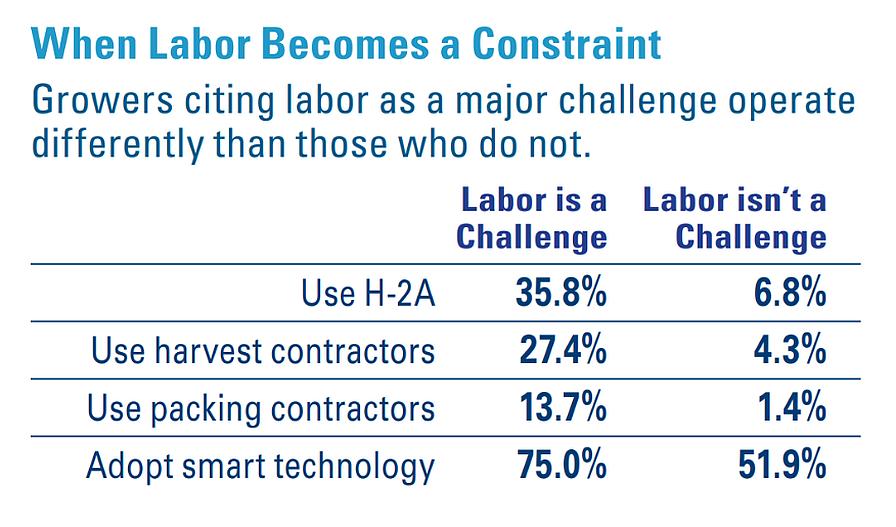
That reality may help explain one of the more intriguing findings from American Vegetable Grower’s 2026 State of the Vegetable Industry survey. Growers citing labor as a major challenge looked noticeably different from those who did not.
Who Feels the Pressure?
To better understand labor’s impact, American Vegetable Grower compared growers who identified labor and labor costs as a major challenge with those who did not.
The labor-challenged group was more likely to operate larger farms, serve supermarkets, foodservice distributors, and processors, and use H-2A workers. Direct-to-consumer growers were the notable exception, showing little difference between the labor-challenged and non-labor-challenged groups.
Scale likely explains part of the pattern. Larger operations naturally require more labor and are often earlier adopters of technology, notes University of Arkansas economist Brandon McFadden.
Customer channels may be part of the story as well. Serving large commercial customers often comes with stricter delivery schedules, volume commitments, and quality expectations, creating additional pressure when labor costs rise.
At Little Bear, those pressures have led to operational changes beyond staffing.
“We’ve tried to focus on fewer items that we are good at, and that we can do efficiently,” Erickson says.
The Efficiency Response
The company has consolidated production into larger, more centralized plantings to reduce the time and expense associated with moving crews and equipment between locations.
“You need to plant more strategically so that you have larger plantings in more centralized locations, so that you’re spending less time moving people and equipment and personnel,” Erickson says.
The survey suggests that many growers are pursuing similar efficiency gains through technology.
Growers citing labor as a major challenge reported higher adoption rates for nearly every technology included in the survey. However, the largest gaps did not appear in robotic harvesters or fully automated equipment. Instead, they appeared in farm management software, GPS guidance systems, remote irrigation controls, precision application technology, weather stations, and soil moisture sensors.
That pattern aligns with observations from North Carolina State University economist Jeffrey Dorfman, who says many of today’s most adopted technologies are managerial and informational rather than direct labor replacements.
Taken together, the findings suggest labor pressure is influencing more than workforce decisions. For many growers, it is prompting a broader examination of efficiency, operational complexity, and how every labor dollar is spent.
The Bigger Decision
For operations heavily dependent on labor, the response increasingly appears to be a series of small decisions rather than a single solution. Some are investing in technology. Others are consolidating fields, simplifying crop mixes, or reevaluating where labor delivers the greatest return.
For growers like Erickson, labor may start as a staffing issue. Increasingly, however, it becomes a factor in decisions that shape the entire operation.
Click here for more findings from the 2026 State of the Vegetable Industry survey.
Subscribe Today For
