


How to Maintain Vegetable Yield Performance Despite Poor Water Quality
 September 29, 2026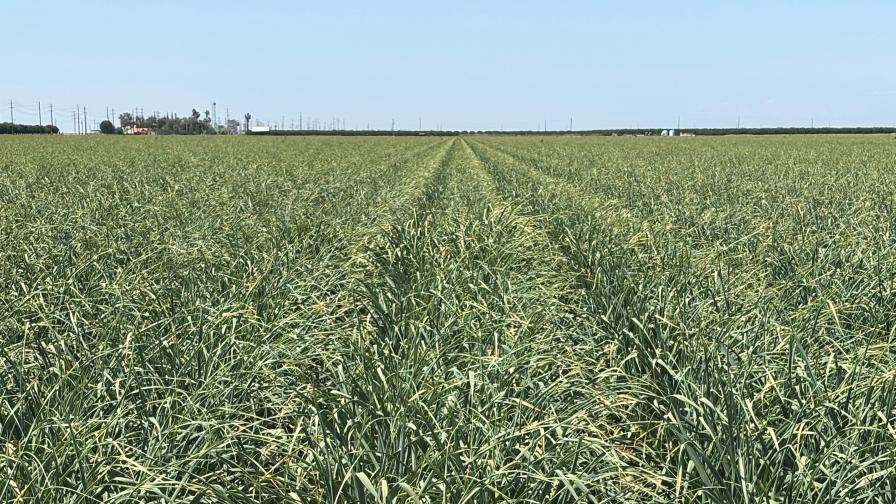
This field of onions are exhibiting symptoms of dehydration. For California growers, finding quality, adequate irrigation resources is becoming a bigger challenge. Photo: Deerpoint Group
Unexpected and record-setting heat in California’s Westland Water District disrupted the onion and garlic season, revealing new challenges for growers. As higher temperatures and intense droughts become more common, farmers are being forced to begin irrigation earlier in the season to compensate. These unfavorable growing conditions are also coming at a time of reduced water allocations. These combined factors are requiring growers to rely more heavily on well water.
In water-constrained regions like California, 40% of the water is being supplied by groundwater. This jumps up to 60% during dry years, according to the California Department of Water Resources. Unfortunately, the well water can contain elevated concentrations of minerals (sodium, sulfates, boron, and other dissolved salts). Water quality is a critical factor as more farmers lean on well water. This dependency comes with greater concentrations of dissolved salts and minerals that disrupt plant health/growth. This has created a “perfect storm” for disrupted nutrient uptake, increased crop stress, and impacted yields.
Long-Term Effects of Sodium From Well Water
Salinity can interfere with nutrient uptake and fertilizer efficiency, and the effects can compound over time. A U.S. Geological survey noted intensive water use can accelerate salinity issues and degrade long-term productivity. Sodium from well water can compete with applied potassium meant to help size a bulb crop. When sodium wins the competition, bulbs don’t size and can tip early. This poor water quality from well-water impacts more than crops; it can influence long-term soil health as well.
Extended exposure to sodium can ultimately lead to soil degradation, decrease water infiltration, and make it challenging for crop roots to access the necessary nutrients. Excessive concentrations of sulfate and boron can further limit nutrient availability if not actively managed. Without addressing these issues, farmers face lower yields and declining soil performance that can affect future seasons and increase production costs.
Testing for Resilience
Farmers who change water sources need to be aware whether additional sodium or other minerals are also being applied with each irrigation cycle. A fertilizer program that performed well with one water source can’t be assumed to work the same with another. Regular water analysis, soil sampling, and plant tissue testing can identify problems early and give growers the information they need to adjust their fertility programs before yield suffers.
On-The-Fly Fertigation
Building resilience under challenging water conditions requires moving beyond traditional nutrition programs toward adaptive strategies. Rather than relying on traditional periodic, high-volume fertilizer applications, continuous fertigation that spoon-feeds smaller amounts with every irrigation application helps maintain a steady supply of nutrients that can address many developing environmental conditions.
This might sound like additional work but once farmers know what’s happening in their fields they can make adjustments to their fertigation mixes so irrigation lines can carry counteractive chemicals directly to each plant. Automated systems can even monitor tanks, pumps and make remote adjustments so no additional labor is required. Simply adding more fertilizer to lines won’t solve poor-water problems. With precise, regular feedings growers can respond easily when testing shows a crop moving out of balance. A nutrition program that can be adjusted incrementally means growers can respond while the crop is actively growing.
Flowing With Water Changes
This past spring’s conditions demonstrated how agricultural challenges can surprise unprepared growers. Heat waves, water allocations, or what minerals are coming out of a well, are all variables that growers need to have the flexibility to respond to without reducing production. Having a view of what is happening with the field, from soil, to water, to plant tissue gives farmers the information they need to stay one step ahead and make nutrient adjustments as needed to preserve their seasons and maximize their yields.
Subscribe Today For
