



Why Almond Growers Need To Watch for Red Leaf Blotch
 February 18, 2026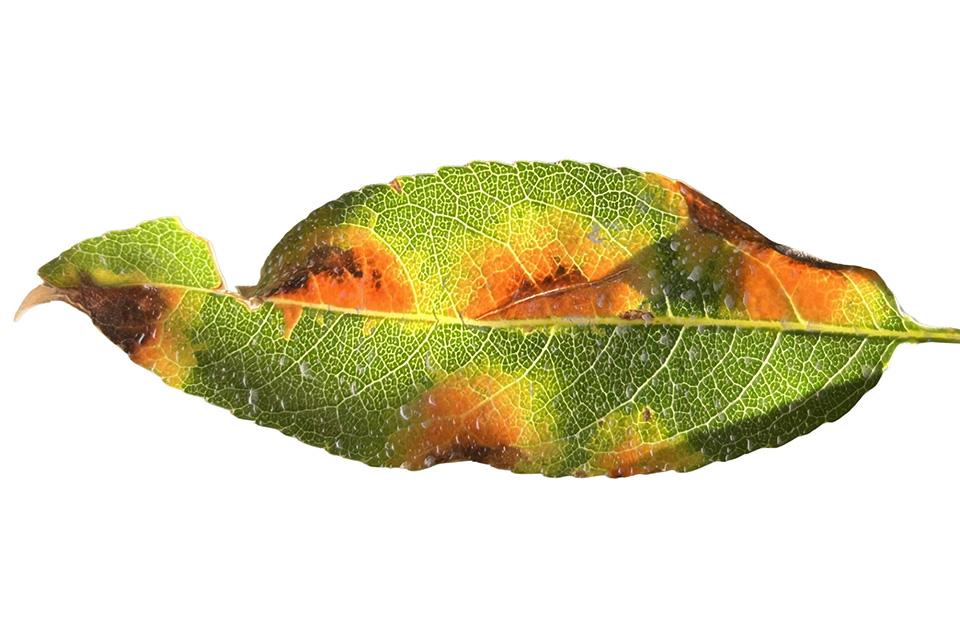
Almond leaf showing red leaf blotch symptoms.
Photo: Syngenta
Red leaf blotch (RLB) is an almond leaf disease spreading swiftly across orchards in California. It was first detected in California in late May 2024, according to a study led by Florent Trouillas, Ph.D., and researchers from the Department of Plant Pathology, University of California, Davis, along with UC Cooperative Extension advisors.
The pathogen that causes red leaf blotch, Polystigma amygdalinum, likely arrived in California through the transfer of infected plant material. The disease spread from the border of Merced and Madera counties throughout all the major almond producing counties in California. If you notice some red leaf blotch pressure this year, you’ll likely see more next year.
History
RLB has existed for years in almond production areas around the Mediterranean and parts of the Middle East. It was recognized in Spanish orchards as early as 1927, and RLB pressure in almonds has increased in recent years. This is likely connected to greater use of late flowering almond cultivars.
Though the first scientific descriptions of P. amygdalinum are more than 150 years old, it has been taxonomically reclassified over time. Research is scarce due to a variety of factors that make laboratory study of RLB challenging.
Life Cycle and Symptoms
RLB transmission occurs when P. amygdalinum infects new almond leaves with sexually reproduced spores (ascospores). P. amygdalinum overwinters in infected leaf litter and produces spores that infect new leaves in the spring. Then, rain at bloom aids in the dispersal of the spores to emerging young leaves.
There is a latency period of 35 to 40 days before the symptoms become visible in April or May. Since new leaf growth is infected before symptoms are visible, managing RLB can be challenging and applications should be made preventatively.
Red leaf blotch symptoms manifest as small yellow blotches on both sides of leaves. As the fungus spreads within leaves, lesions change from yellow to orange and eventually turn reddish-brown. Leaves curl, become necrotic and prematurely detach, serving as inoculum to infect next year’s new foliage growth.
Premature leaf drop reduces the photosynthetic capacity of trees and interrupts carbohydrate production for next year. The most extreme cases in California occurred in orchards that didn’t receive fungicide applications at petal fall. Some of the worst looking trees in these orchards appeared to have shed their leaves for winter. Early defoliation disrupts energy production and storage, which can impact yields in the current season and the following year.
Preventive Management
The pathogen responsible for RLB produces only one infectious generation per season. Due to its prolonged latent period and monocyclic life cycle, initial emergence and symptom development are slow, making preventative practices essential for successful management.
Cultural management practices are used in geographies where the disease is well established. These practices may include removing infected foliage or incorporating it into the soil along with urea to foster the breakdown of inoculum. The effectiveness of these practices hinges on mass employment, and they often prove to be a lot of work with little result. Like many things in agriculture, what happens in neighboring orchards impacts what happens in yours.
The primary tools for RLB management are preventive fungicide applications and spray timing. Applications after symptoms appear are not effective against infection because protection, not treatment, is the goal. Leaves’ cuticle layers provide some natural barrier to the pathogen as they harden throughout the season.
Collaboration between extension and industry has led to 2(ee) label registration for products such as Miravis Prime (Syngenta), as well as Miravis Duo (Syngenta) and Quadris Top (Syngenta) fungicides for control of RLB on almonds in California.
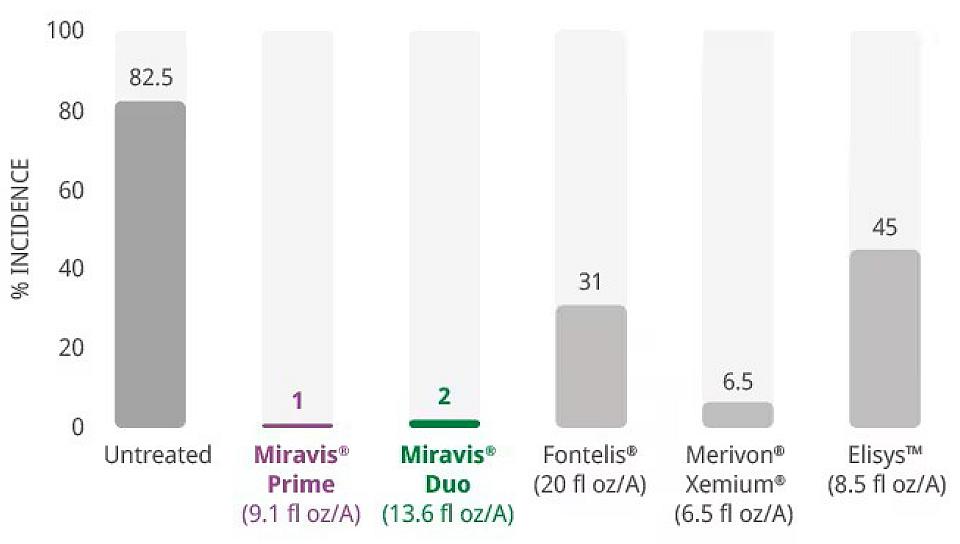
Research shows that a two-spray application program effectively controls the disease: Start with a preventive fungicide application of Miravis Prime (9.1 fl oz/A) at petal fall, followed by an application of Miravis Duo (13.6 fl oz/A) or Quadris Top (14.0 fl oz/A) two to three weeks later. As with any disease program, rotating effective modes of action is recommended to prevent resistance development.
Graphic: Syngenta
Trial Information:
Red leaf blotch almond trial conducted by Florent Trouillas’ Lab UC Davis. Application dates: 2/28, 3/18 and 4/23. SS#826-2025. Merced, CA; 2025.
Subscribe Today For
