



Crop Protection Tools To Fight Blight in Peach Crops
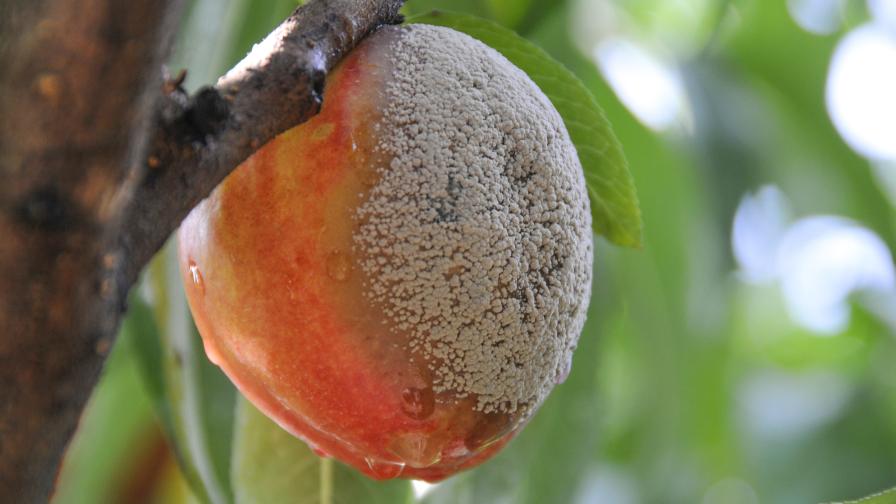
Symptoms of peach brown rot.
Photo: Guido Schnabel
In the world of stone fruit, blossom blight and brown rot are a gut punch for peach growers. These diseases don’t just represent a single event, but a season-long siege that can destroy an entire crop. Caused by the fungal pathogen Monilinia fructicola, blossom blight is an early-season infection of flowers, while brown rot appears during pre-harvest. Ongoing mutations in the fungus create a moving target that is difficult to pin down, said Guido Schnabel, a plant pathologist at Clemson University.
“Because of the fungus’ ability to produce sexual and asexual spores, it can produce genetic diversity and implement mutations,” said Schnabel, speaking at the Southeast Regional Fruit and Vegetable Conference in January. “In addition, you have several infection cycles of the fungus per season, and that contributes to enormous genetic diversity that the fungus exploits to adapt to challenges.”
In the humid southeastern U.S., fungicide resistance remains a primary hurdle for peach production, with the arsenal of effective chemistry shrunk to a vital few.
“Only four classes are actually useful, with some like Rovral not registered after petal-fall,” said Schnabel. “Some are not effective enough during hot season, or are only registered for post-harvest. Others are not effective no matter how high we go with the dose.”
MBCs (like Topsin M, UPL), DMIs (Cevya, BASF) and SDHIs + QoIs (Merivon, BASF) are viable options for growers needing relief, Schnabel said. Products supporting the same FRAC code can be utilized once or twice per season, with single-site fungicides iprodione (Rovral, FMC) and cyprodinil (Vangard, Syngenta) ideal for early protection against blossom blight.
MBCs, or methyl benzimidazole carbamates, were primarily used to sabotage the fungus’s ability to replicate its own DNA. The MBC locks onto the fungus’s internal proteins, paralyzing cell division and stopping infection before it can spread. Yet, mutations within M. fructicola has throttled some of the chemical class’s usefulness, said Schnabel.
“Each of those mutations changes the protein so that the fungicide cannot bind to it anymore, and that makes it resistant,” Schnabel said. “One single mutation can confer complete resistance.”
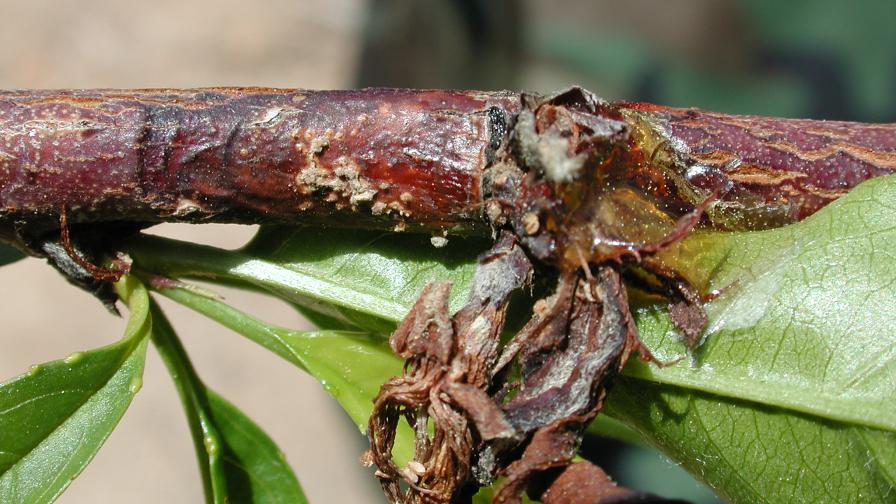
Symptoms of peach blossom blight.
Photo: Guido Schnabel
Schnabel is more confident about FRAC 3 demethylation inhibitors (DMIs) such as tebuconazole (Orius, Makhteshim Agan), fenbuconazole (Indar, Corteva), and mefentrifluconazole (Cevya, BASF). By ramping up dosage, growers can push through the M. fructicola defenses, Schnabel said.
Intensified spray programs are standard in the southeast, where the pathogen is known for evading the DMI chemistries.
“We are in a very unique situation, because we have generated Monilinia that is resistant to the DMIs in a way that nobody else in the world has,” said Schnabel. “More fungicide is necessary to control the disease.”
Meanwhile, QoIs (quinone outside inhibitors) target fungal mitochondrial respiration, leaving the fungus with no room to grow. Even if spores land on a peach, a QoI ensures they die off before tissue is penetrated, Schnabel said.
To this end, farmers can use FRAC 7 (succinate dehydrogenase inhibitor) and 11 (strobilurin) fungicides during pre-harvest. These chemistries encompass premixtures fluxapyroxad/pyraclostrobin (Merivon, BASF), trifloxystrobin/fluopyram (Luna Sensation, Bayer), and boscalid/pyraclostrobin (Pristine, BASF).
Mutations require strategic fungicide applications, especially in vulnerable warm regions where a pathogen can thrive. While farmers battle strains that can shrug off combinations of FRAC 1, 3, and 7, the pairing of FRAC 1 and 7 remains a reliable defense, Schnabel said.
Farmers with low disease pressure and no resistance can spray Pristine (7 and 11) or Orius and Indar (3). Schnabel also has advice for navigating high-pressure situations where resistance to SDHIs and DMIs has taken hold.
“My best guess would be to spray Merivon or Luna Sensation, and add Topsin M,” Schnabel said. “You’re combining 7, 11 and 1 fungicides into your spray mixture. They key is to spray this 14 days before harvest, then follow up with either Cevya or a high dose of Indar or Orius. If you need a third application, you can spray Merivon one more time. Though I’d spray Topsin M only one time per year, and only in combination with a 7 and 11 fungicide.”
Subscribe Today For
