



Smart Tech
Precision Irrigation in the Orchard: Where Fertilizer Value Is Won or Lost
 June 29, 2026
In fruit production, fertilizer value is reflected in root activity, canopy growth, fruit size, crop load, plant health, and the long-term strength of orchards, vineyards, berry crops, citrus, and nut crops. When fertilizer prices rise, the question is not only what growers pay. It is how much of that investment becomes usable crop nutrition.
The World Bank projects fertilizer prices will rise 31% in 2026, driven largely by higher urea prices, with affordability weakening to its lowest level since 2022. For fruit growers, that price pressure makes every block-level decision more consequential, from fertigation timing and irrigation uniformity to how well nutrients reach the root zone during active uptake periods.
FOLLOW THE NUTRIENT PATH
Before changing rates or switching products, fruit growers should first look at the route nutrients take through the irrigation system, into the soil or substrate, and ultimately to the active root zone. Fertilizer value is too easily lost through runoff, leaching, poor timing, uneven water distribution, clogged emitters, pressure variation, or applications made when the crop is not quite ready to take up nutrients efficiently. Overapplication of nitrogen and phosphorus also poses environmental risks when excess nutrients flow into waterways. For the grower, though, the immediate issue is practical. Fertilizer that does not support the crop is money down the proverbial drain.
Precision irrigation and fertigation are the foundations for fruit growers to smooth that pathway. Fertigation places nutrient delivery inside the irrigation schedule, where timing, water movement, and root-zone access can be managed together. Through drip systems, nutrients can be applied in smaller, optimally timed doses, paced to crop demand. The goal is not simply to reduce fertilizer use but rather to feed the crop when uptake is active, carry nutrients into the root zone rather than past it, and avoid paying for applications that the system cannot deliver evenly.
The healthiest fertigation programs are when the grower is clear on what the crop needs and when, and whether the irrigation system can deliver water and nutrients uniformly enough to meet these needs. Before switching up a fertilizer program, growers should run through a checklist of questions:
- Are pressure and flow rates being checked often enough? Are emitters clogged or partially restricted?
- Is fertilizer being applied during active uptake periods, after leaf-out and through key fruit development stages, or according to historical schedules that might no longer match current field conditions?
- Is the block showing uneven canopy growth, fruit sizing, or crop response that might reflect underlying distribution problems?
- Has the fertilizer plan been adjusted for actual crop load, not just last year’s schedule?
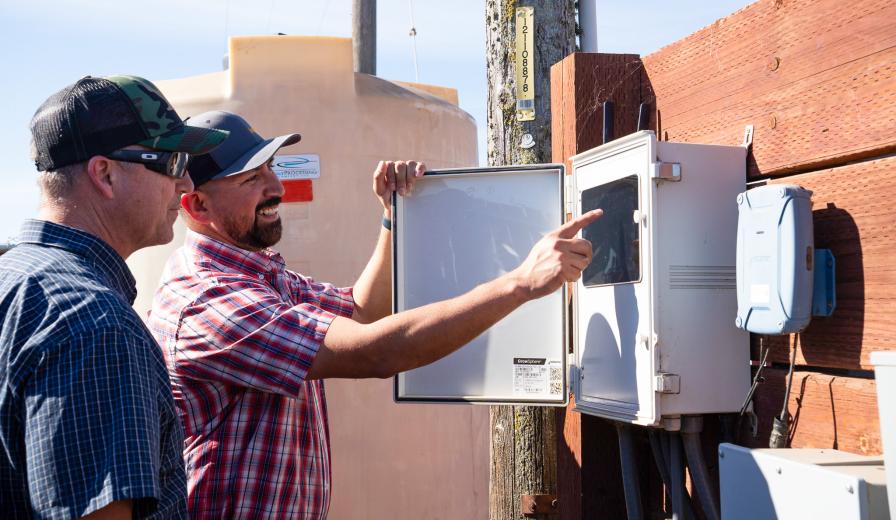
Focusing on improved timing, placement, and uniformity helps fruit growers to better manage fertilizer costs without sacrificing crop quality, productivity, or long-term orchard and vineyard health.
Photo: Netafim
START WITH SYSTEM PERFORMANCE
The quality of water also requires more attention than is often considered. Fertilizer materials can behave very differently depending on the water source. A nutrient ratio that looks on-target on paper can still react negatively with certain water sources, resulting in more precipitates that strain emitters, reduce uniformity, and add extra crew time for maintenance during the season. When growers start thinking about changing fertilizer sources or mixes, it’s a good idea to test compatibility to learn whether the system can handle any new concentration and injection rates.
Also, the cheapest fertilizer program is not always the one with the lowest price tag per ton. A lower-quality input can quickly put a hole in your budget if it performs poorly, clogs the system, or requires extra crew time. A comprehensive program looks at the full path: source, timing, application method, water movement, root-zone access, and crop response.
In some blocks, the most profitable change might not be a new fertilizer source at all. It could involve fixing pressure variation, cleaning filters, flushing lines, checking emitter performance, or adjusting fertigation timing more closely tied to crop stages and water availability.
PROTECTING CROP VALUE
Paying more attention to the gap between purchased fertilizer and applied crop nutrition can make a substantial difference in costs and results. Focusing on improved timing, placement, and uniformity helps fruit growers to better manage fertilizer costs without sacrificing crop quality, productivity, or long-term orchard and vineyard health.
Fertilizer price spikes are unlikely to level out soon. Fruit growers will always be facing market price and supply chain pressures that originate far from their orchards but land squarely on their businesses. Precision irrigation and fertigation will not change today’s reality in the fertilizer market, but these tools can help fruit growers protect crop value from the resources already budgeted. In perennial systems, the goal is always about fruit quality, crop consistency, and the long-term performance of the block.

For more Smart Tech topics, click here.
Subscribe Today For
