



To Mechanize or Not? Fruit Growers Should Weigh Options Now
 December 26, 2024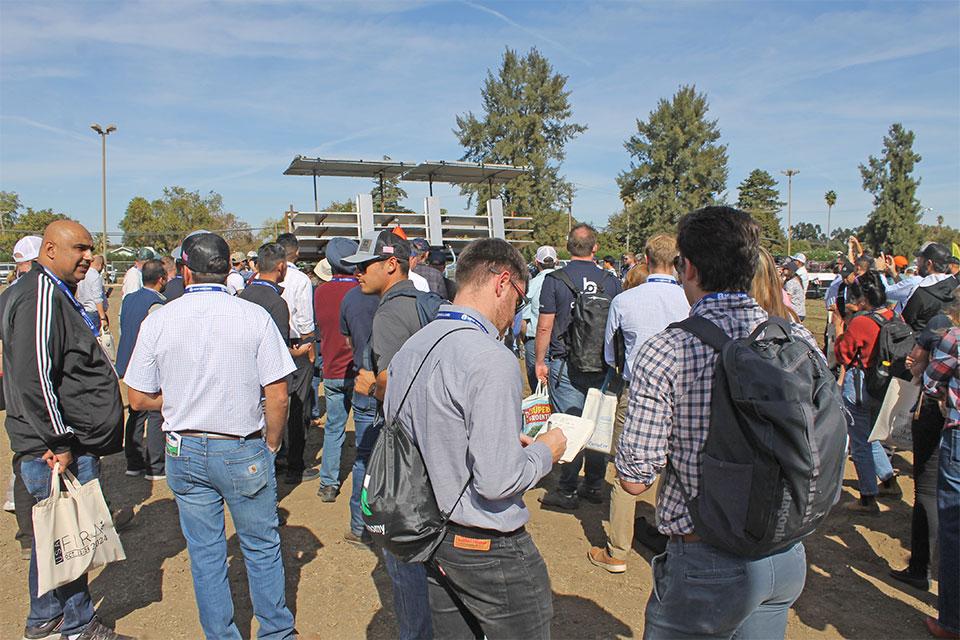
The need for mechanization in fruit is on the grow. Industry events like FIRA USA give growers an opportunity to see for themselves what these modern machines can and cannot do for them.
Photo by David Eddy

About two decades ago, there was a popular saying, “Go big or go home.” It made perfect sense, as if you’re not going to give it everything you have, don’t bother. It still makes sense for today’s growers.
A little over a half-dozen years ago, I wrote an editorial with the headline “Moving to Orchard Mechanization Is Tough, But Necessary.”
It was in part due to the paper: “Alternatives to Immigrant Labor?” It was published by The Center for Immigration Studies. Its introduction began with a statement from the California Farm Bureau Federation: “Without an adequate supply of workers to fill seasonal labor-intensive tasks such as harvesting, U.S. growers will become uncompetitive and be forced to reduce production of labor-intensive crops.”
Nothing new there, I thought, and then I looked at the top of the page for the year it was published: 2000. Oh, great, it was worse than I thought, bringing one of my Sunday School Bible quotes to the fore: “There is nothing new under the sun.”
About the only surprise in the piece was that the authors noted that, in 1979, then-USDA Secretary Bob Bergland stated: “I will not put federal money into any project that reduces the need for farm labor.”
The important thing to keep in mind about the mechanization of such farming tasks as harvest is that it’s not a matter of whether growers will no longer have enough people to pick their crops but when. Growers around the country say there are good years and bad years attracting labor, but there’s no doubt the number of available laborers is decreasing.
However, in recent years, some major agricultural states have begun amending their employment statutes for agricultural employers. California, Washington (2021), and Colorado (2022) created statutes to phase in overtime requirements for agricultural employees after a certain number of weekly hours. With the cost of farm labor on the rise, producers of labor-intensive crops have been using three main strategies for coping.
Average hourly earnings of U.S. field and livestock workers, adjusted for inflation, increased 16% between 2001 and 2019. In 2022 minimum wages in 29 states were higher than the Federal minimum wage of $7.25. California and Washington, two major employers of hired agricultural labor, had some of the highest minimum wages at $15 an hour and $14.49 an hour, respectively.
Mechanization — the use of machinery to complete tasks previously completed by hand — has a long history in U.S. agriculture. Most field crops are exclusively planted, tended, harvested, and processed by machines. However, it is more difficult to mechanize many tasks in fruit and vegetable farming. Specialty crops are vulnerable to changes in weather, topography, and plant conditions. Many fruits and vegetables are soft, so machines can damage them. Finally, some markets have relatively few producers, which means engineering firms must develop new and expensive technologies for a small market of potential users.
But though difficult, there doesn’t seem to be any alternative to mechanization for large growers. Even better is to have the machines take on more tasks, as in autonomous machines, or robots.
Even if you cannot picture yourself ever using a robot, it’s important to learn what they can and can’t do. We gave you a taste of the largest robotics meeting in the country, FIRA USA, which was held in California in late October. There is no better place for specialty crop growers to see for themselves how robots work on fruit and vegetable crops.
The conference is free to growers, but only 500 attended this year. If you’re going to be farming fruits and vegetables in the future, you have to know what all your options are. How you’re going to get all the necessary work done should be at the top of the list. See you there next year.
Subscribe Today For
