



Powdery Mildew: A Crop Protection Problem That Needs Attention
 May 27, 2026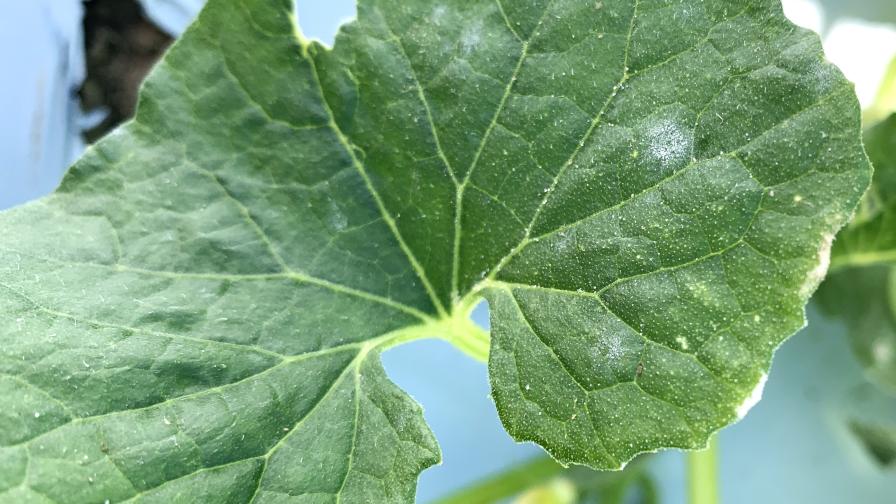
Powdery mildew symptoms on cucumber.
Photo: Anthony Keinath
For the last four years, powdery mildew was voted the top disease in the annual State of the Vegetable Industry survey. Each year, more growers selected powdery mildew as a “particularly problematic disease” than all other diseases except downy mildew. The results of this “unpopularity contest” puzzled me so much that American Vegetable Grower Editor Carol Miller agreed to add a follow-up question in 2026: On which crops did you observe symptoms you associate with powdery mildew?
Not surprisingly, squash/pumpkin was the most susceptible crop, listed by 71% of respondents, statistically more often than any other crop. Although many cultivars have intermediate resistance, as plants age, they become more susceptible to powdery mildew. Yield losses, in the form of smaller fruits, are most common in pumpkins and winter squashes. Powdery mildew also weakens pumpkin handles, a serious shortcoming on Jack-o-lanterns.
Cucumber was the second most likely crop to get powdery mildew, more often than melon, tomato and all other crops. Field-grown hybrid cultivars of slicing and pickling cucumbers have excellent resistance to powdery mildew. Sixty-one respondents, however, grew cucurbits in protected cultures. Cucumber is, by far, the main cucurbit produced indoors, so it’s likely most respondents who observed powdery mildew on cucumber grew it in protected culture.
Powdery mildew has long been a problem in greenhouses, because the environment favors this unique pathogen. The UV radiation and lack of free moisture on leaves in greenhouses reduce development of, and competition from, other fungal leaf pathogens. Greenhouses without proper or sufficient venting also trap humidity. Powdery mildew can develop at lower humidity levels than most other fungi, as low as 25% RH.
The frequency of powdery mildew isn’t quite a crisis, but it is a call to action. I have often said that powdery mildew is the easiest vegetable disease to diagnose and manage, because the fungus grows mostly on the outside of the plant where fungicides, including biofungicides, can be sprayed directly on it. This direct contact between biofungicides and powdery mildew explains why biofungicides are somewhat more effective against powdery mildew than against other diseases.
What to Spray
In my study on managing powdery mildew on cucurbit seedlings, sulfur and Organocide (Organic Laboratories), a fish oil-sesame oil product, which is OMRI-listed, were the most effective biofungicides in repeated greenhouse tests. The conventional fungicides penthiopyrad (Fontelis) or cyprodinil plus fludioxonil (Switch) also may be applied in greenhouses.
In the field, the list of conventional fungicide options against powdery mildew is longer. My preferred products are Gatten (Nichino) and Vivando (BASF), because no one has reported resistance developing to these active ingredients. Note, however, that fungicide resistance in powdery mildew varies by region. For example, powdery mildew in New Jersey and Long Island is resistant to Torino (Gowan) and Quintec (Gowan), while these fungicides are usually still effective at the highest labeled rate in my tests in South Carolina. Growers should double-check local Extension recommendations.
Partially Resistant Cultivars
The Southeastern U.S. Vegetable Crop Handbook lists four English and five Beit Alpha cucumber cultivars with powdery mildew resistance that are widely recommended for greenhouse production. In a project at Purdue University, the horticulturist Dr. Wenjing Guan noted, however, that powdery mildew resistance is intermediate in some greenhouse cultivars. For example, ‘Jawell’ was more susceptible than five other Beit Alpha cultivars tested. Comparing three long English cultivars, Camaro was relatively resistant. American slicer cultivars developed for greenhouse production were relatively more resistant.
Pruning
In protected culture, removing senescing lower cucumber leaves reduces the spore load. These leaves aren’t contributing to plant productivity, but as long as they are pale green or yellow, that is, alive, they support growth of the powdery mildew fungus.
Scouting
In both greenhouse and field cultivation, the scouting threshold developed by a retired colleague, Dr. Meg McGrath at Cornell, is one spot of powdery mildew per 50 old leaves checked. Both the top and bottom of leaves leaves should be examined.
If crops are scouted weekly, this threshold can be used to decide when to start spraying conventional fungicides. Note that the threshold has not been verified with biofungicides, so I recommend they be applied preventatively. Growers should estimate which approach is more economical: spending money on fungicides or scouting?
Subscribe Today For
