



Four Most Destructive Vegetable Diseases
 April 26, 2011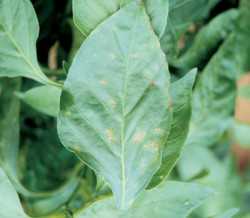
It’s an understatement to say that growers have quite a few unpredictable variables they have to deal with every year. One of the biggest variables, the weather, constantly wreaks havoc on growers’ plans for their crops. It is often too wet, too cold, too hot, too dry, or too windy. You get the picture.
In spite of the fact that growers have no control over the weather, they are constantly trying to stay one step ahead of Mother Nature, so to speak, in order to bring their crops to harvest.
Because the weather often plays a critical role in the spread of various diseases each growing season, American Vegetable Grower spoke with several researchers from across the country to find out which ones have been a major threat to crops recently. The four that follow — bacterial spot, tomato spotted wilt virus, late blight, and sclerotinia — were deemed some of the most problematic. On a positive note, the researchers provided control strategies to help growers minimize crop losses and potentially avert a disaster dished out by Mother Nature.
Bacterial Spot: Have A Good Offense
The first line of defense against bacterial spot is a good offense. Really, it is. According to David Langston, a plant pathologist at the University of Georgia, growers shouldn’t wait for the disease to show up before they do something. They need to take preventative measures.
This disease is typically a problem in the south on peppers and tomatoes, most notably Florida and Georgia, but it has shown up in the Midwest and along the East Coast. Langston says the disease typically rears its head in fall production in the south, thanks to the heat. It is also present in the spring but is generally less severe.
“Growers often see bacterial spot first on transplants as dark, almost black water-soaked spots on the leaves of both peppers and tomatoes,” he explains. “Those spots grow and coalesce and form larger spots, and a lot of times leaves will fall out. The leaves tend to fall off more on peppers than they do on tomatoes.”
Even though this is a disease that is best controlled via prevention measures, scouting is important in the greenhouse before the transplants are moved to the field, says Langston.
How do growers prevent the disease? For tomato growers, Actigard (acibenzolar-S-methyl, Syngenta Crop Protection) is available as well as copper and mancozeb-type products. No resistant tomato varieties are currently available.
With peppers, on the other hand, growers have access to several resistant varieties. “So the first line of defense for pepper growers is to use resistant varieties,” says Langston. “Then they rely on copper. We don’t have maneb labeled on pepper anymore but growers can use Quintec (quinoxyfen, Dow AgroSciences), which does have some antibacterial properties.”
To date, Langston says the copper tolerance situation with the bacteria has gotten worse on both pepper and tomato. The outlook, however, isn’t bleak. Actigard is being studied by the IR-4 Project for a label on pepper. The product does suppress bacterial spot on pepper the same way it does on tomato, but there are some crop safety issues that have to be worked through, he explains.
Langston’s advice to growers can be summed up in two words: preventative schedule. “I think it is a mistake to wait until you see the disease and then try to react to it,” he says. “You need to have a preventative program in place before the disease shows up. That would be a big plus for anyone trying to grow peppers or tomatoes.”
Tomato Spotted Wilt Virus: Doesn’t Just Impact Tomatoes
Although the name would suggest that only tomatoes are affected, tomato spotted wilt virus (TSWV) can impact many minor crops. This thrips-vectored virus can infect pepper, potato, radicchio, spinach, beans, celery, cilantro, eggplant, and recently lettuce. Many weeds are also infected.
Last summer in central California, there was a substantial amount of TSWV at the end of the season, which wasn’t unusual. What was unusual was that the virus reached levels in lettuce that caused noticeable losses. According to Steve Koike, plant pathology farm advisor in Monterey County, University of California Cooperative Extension, because of the cool temperatures in the summer, the tomato crop took longer to mature and, as a result, was late to harvest.
“That meant the tomatoes were left in the field longer, so what resulted was an inadvertent overlap with lettuce crops,” he explains. “Usually in this region by the time the tomatoes are harvested and gone, that is when the lettuce starts to come in. This year there was a month or more in which the two crops were side by side. And TSWV via the thrips jumped to the lettuce and caused a lot of problems on the lettuce.”
TSWV has shown up on lettuce before, he says, but usually not to this degree. Like in tomatoes, however, the only way to control the virus is to control the vector of the virus: thrips.
On top of that, the first symptoms of the virus are difficult to detect, adds Thomas Turini, University of California Cooperative Extension farm advisor. In tomatoes, TSWV can appear as a light green or yellow discoloration on part of a leaf. Another symptom is leaf bronzing.
According to Turini, insecticides can be used to limit the spread of the virus in the field, but there are limitations to what chemicals can do. For instance, thrips are typically in an area of a plant where they can find shelter, such as the flower or bud tissue. Also, populations can increase quickly, sometimes in as little as one week. In addition, he says if the virus is largely being introduced by thrips from outside the field, it is likely that the application within the field will not have as great, if any, effect.
In trials conducted in Fresno from 2007 to 2010, Turini says some insect control products have proven effective against the pest: dimethoate, Lannate (methomyl, DuPont Crop Protection), and Radiant (spinetoram, Dow AgroSciences). In addition, he says resistant varieties for both fresh market and processing tomatoes are available that will help keep the virus at bay.
Turini advises growers to avoid planting near weedy or crop fields that may serve as a source of thrips and the virus. He also tells growers to disk under the crop residue immediately after harvest. Sanitation will help to keep thrips populations and TSWV levels down.
Late Blight: Sometimes Unpredictable
In the summer of 2009, this well-known potato disease caused by Phytophthora infestans took to tomato transplants in the Northeast in an unprecedented fashion. Until 2009, there was no record of the disease being so widespread in the Eastern U.S. so early in the season, explains Meg McGrath, associate professor in the Department of Plant Pathology and Plant-Microbe Biology at Cornell University.
Growers, however, have lost crops to unpredicted occurrences before. McGrath describes an outbreak on Long Island, NY, in August 2007 when conditions seemed too hot and dry for late blight, plus the pathogen seemed to be too far away as the nearest reported occurrence was in Lancaster, PA. “It made a pretty big jump over New
York city,” she explains. “Late blight is a predictable disease that is sometimes unpredictable.”
Staying true to its unpredictable nature, in 2010, there were some isolated outbreaks on tomato, but the source of the pathogen for several of the outbreaks was never determined. “Potatoes nearby could have been the source, but affected potato plants were not always found,” she explains. “This may be because symptoms caused by a ‘tomato’ genotype would be harder to find on potato, and the size of many potato crops precludes examining each plant.”
The biggest problem with late blight is it is very difficult to control with fungicides once you see symptoms, McGrath explains. “Way too often if there is no protective fungicide like chlorothalonil on the crop before the pathogen arrives, the first time you see it, the disease is too severe to stop. And since it is so destructive and contagious, growers have to apply fungicides to save their crop and minimize impact to other growers.”
Since the disease is usually out of control once the grower recognizes it in his fields, the best way for growers to defend their crops is to apply fungicides preventively and take measures to ensure the pathogen doesn’t survive the winter, says McGrath. Potato tubers provide the pathogen the living host tissue it needs to survive between crops, she says, and so it is critical to destroy potato cull piles and any infected tubers left in the field.
In spite of the occurrences on tomato in 2010, grower fears were allayed because the disease was significantly less common in 2010 than in 2009. Although McGrath predicts that another year like 2009 is unlikely, the disease will continue to appear sporadically on tomatoes and potatoes.
“It used to be that late blight was almost exclusively a disease of potatoes and those were the only growers who really had to worry about it,” she says. “That’s not the case anymore. The pathogen has changed. There are now genotypes present in the U.S. that are more aggressive on tomato and that tolerate warm temperatures, thus it has been developing in Florida later in the spring when tomatoes are growing to the north, creating the potential for a ‘green bridge’ up the East Coast.”
Another big concern is the pathogen being able to reproduce sexually, she says. “We have both mating types in the U.S. now, but fortunately no evidence of sexual reproduction. If it becomes established as a sexually reproducing pathogen, particularly here in the North, that will change the situation entirely because the spore produced in the process survives without living plant tissue,” McGrath explains.
“It has happened in Europe,” she continues. “There are parts of Europe where they now see late blight every year, where in the past it was occurring sporadically as here. The late blight pathogen has become like those causing early blight and Septor-ia leaf spot. It is able to survive in the soil and overwinter without being in a potato.”
Sclerotinia: Timing Is Everything
The two types of Sclerotinia — Sclerotinia sclerotiorum, known as white mold, and Sclerotinia minor, which is common on lettuce — caused horrendous problems this year in the desert in Yuma, AZ, on a variety of crops. This pest was also an issue on cruciferous crops on the coast of California.
Just ask Koike of the University of California Cooperative Extension. The problem in Yuma, however, was quite unusual. Cool, wet, and windy weather was the recipe needed to spread Sclerotinia spores, causing infection.
“What occurred is an example of what can happen when the right environment occurs and the pathogen is present,” he says. “You can really have a fire on your hands, and that is what happened this year.”
The first symptoms on most vegetable crop hosts are small, irregularly shaped, water-soaked areas on stems, leaves, pods, or flower heads, explains Koike. “These infections quickly develop into soft, watery, pale brown to gray rots. Rotted areas can expand rapidly and affect a large portion of the plant,” he says. “In the desert regions, white mold was causing damage on broccoli, cauliflower, celery, lettuce, and other vegetables. For lettuce this disease, Sclerotinia minor, is commonly called lettuce drop.”
Koike says the products Rovral (iprodione, Bayer CropScience), Endura (boscalid, BASF Corp.), and Switch (cyprodinil, Syngenta Crop Protection) are registered for control of both types of sclerotinia. The tools, however, aren’t the issue; the issue is timing the sprays.
In essence, growers are trying to protect the foliage and the plants from the pathogen’s airborne spore stage, and “no one can predict exactly when the spores are going to be flying,” he explains. “Materials work pretty well, but if you can only spray twice or three times and you have two months worth of growth, you have to deploy those products and say, ‘Well, it has been raining and I’m going to guess the spores are going to fly, so I’ll spray next week.'”
As there are no varieties for any crop that are resistant to Sclerotinia, Koike says it is important to rotate crops. In addition to being airborne, the inoculum also is soilborne, particularly for S. minor.
“The fungicides available to fight this pest do a good job,” he says, “but there is always the ‘guesswork’ in determining when to apply the fungicide, and if it wasn’t applied correctly, growers may have a problem on their hands.”
Photos provided by: Gene McAvoy, University of Florida; David Langston, University of Georgia; Meg McGrath, Cornell University; Tom Turini, University of California Cooperative Extension; and Steve Koike, University of California Cooperative Extension
Subscribe Today For
