



Same Name, Different Plant Disease — Why You Need To Know the Differences
 April 2, 2026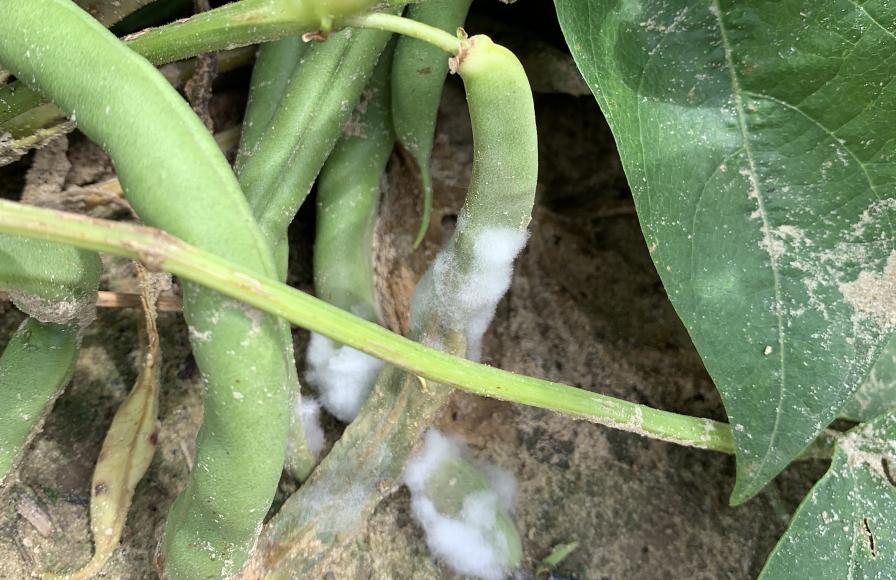
This bean planting is showing symptoms of Pythium pod rot (aka, cottony leak), which could easily be confused with white mold.
Photo: Clemson University
I provided incorrect fungicide recommendations for a bean disease for several years because of a name. Growers called the problem “white mold.” In plant pathology training, I learned that term referred to Sclerotinia, a cool-weather disease. Yet growers in South Carolina were seeing it in June, when temperatures were well above 82°F.
That disconnect didn’t make sense until I saw it in the field.
What growers were calling white mold was actually Pythium pod rot, also known as a cottony leak. Growers called it white mold based on the symptoms, the most common source of common names for plant diseases.
True white mold is caused by a fungus (Sclerotinia), while Pythium pod rot is caused by a water mold (oomycete). These organisms respond to different fungicides with different FRAC codes, and few products are effective against both. Misidentifying the disease can lead to ineffective control.
Other Confusing Common Names
White mold isn’t the only case where familiar names create confusion. Several widely used disease names are applied to completely different problems.
“Black rot” can refer to four different vegetable diseases. Most commonly, it’s applied to black rot on leafy, head, and stem brassicas, because this “black rot” is the one most commonly seen. The bacterium is notoriously difficult to control.
On three other vegetables, “black rot” is one of three different fungal rots that cause postharvest losses. On sweet potato, black rot shows large, dark spots on roots. On carrots, black rot is also a root rot, but it’s caused by a different fungus. On pumpkins and other cucurbit fruits, black rot is the fruit rot phase of gummy stem blight. (Thankfully, this case is one of the few diseases with two common names.)
“Early blight” and “late blight” are common names used on multiple crops that suffer from relatively severe diseases (blights) that typically appear at different times during the growing season. Be aware, however, that “late” blights can appear before “early” blights, depending on the weather or nearby outbreaks that release airborne spores.
Celery is a crop with diseases called early blight and late blight. One classic reference book gets around the confusion associated with these overused common names by using pathogen names for these two diseases. Early blight is listed as Cercospora blight, while late blight is listed as Septoria blight.
Tomatoes and potatoes also get early blight and late blight that are different than celery diseases. Because both hosts are Solanum species, the diseases on the two crops are the same. Early blight is a disease caused by several species of the Alternaria fungus, while late blight is the famous disease that caused the Irish potato famine in the 1850s. The names early blight and late blight are associated mostly with the diseases on tomato and potato, because these crops are grown more widely than celery.
How to Get Through the Haze of Common Names
The ease of sending photos now helps clarify which symptoms are present in the field. A trained eye may be able to distinguish between different causes of generic “white mold” growing vegetables. For example, white mold growth of Pythium is fluffy like a cotton ball, whereas white mold growth of Sclerotinia includes the black sclerotia, survival structures formed from condensed fungal growth.
The common name of the disease is the key to accessing accurate information about the disease. All management guides and fungicide labels are organized by disease common names, not the more specific pathogen names, which typically are familiar only to specialists.
Consider these points when you communicate with advisors:
- The most common disease is usually what people mean when they use a familiar name.
- If the crops are botanically related, then diseases with the same common name are probably caused by the same pathogen, and the same control measures are used.
- On unrelated crops, the same name often signals different diseases that require different management, especially different fungicides.
- Always include the crop when describing a disease. Cultivar names can also help narrow identification.
List of Common Names Frequently Confused
- *White mold and cottony leak on snap bean
- *Early blight on tomato and celery foliage
- *Late blight on tomato and celery foliage
- Black mold on tomato fruit and onion bulbs
- *Black rot on brassicas, sweet potato roots, carrot roots, cucurbit fruits
- Black dot, black spot, and black rot are all different diseases on potato, brassicas, and the four crops mentioned above, respectively
*Mentioned in the article
Subscribe Today For
