


Rodent Control the Right Way in Your Fruit and Nut Orchards
 August 15, 2026
 Rodent problems in an orchard can behave a little like a slow leak in a tire. At first, the problem may seem manageable: A few ground squirrels appear. Some vole activity shows up. A pocket gopher leaves a mound or two. Then the damage begins to accumulate.
“By the time people pull the trigger, you’re kind of behind the eight ball,” said Jared Hajik, Northern California Territory Sales Manager for ORCAL, during a rodent control webinar hosted by American Pistachio Growers.
Avoiding that predicament starts with knowing which rodent is causing the problem. Hajik identified five major rodent pests growers may encounter — ground squirrels, pocket gophers, voles, roof rats, and deer mice. All can damage irrigation lines, but their feeding habits, movement, reproduction, and potential crop and tree damage vary considerably.
So should the response.
SET A REALISTIC GOAL
Unlike some insect pests, rodents do not necessarily come with a clear economic threshold that tells growers exactly when to act. Damage to irrigation lines or nuts may be relatively easy to calculate. The cost of root feeding or tree girdling can be harder to recognize until the damage becomes significant.
Hajik recommended establishing a threshold appropriate to the operation and setting realistic goals. Complete elimination generally should not be one of them.
Rodents may continually move into orchards from neighboring properties, ditch banks, fields, and other habitat. The more realistic objective is to keep populations — and economic damage — at acceptable levels.
That means monitoring even after a control program appears successful.
MATCH TOOL AND TIMING
Ground squirrels illustrate why both the control method and its timing matter.
The animals feed heavily on green vegetation after emerging from hibernation, making bait less attractive while that food is plentiful. Burrow fumigation is better suited to early spring, while bait becomes more effective as green vegetation dries and the squirrels’ diet shifts toward seeds. Trapping is another option when squirrels are active above ground.
Growers can also make orchards less inviting. Hajik recommended mowing or discing cover crops and weeds, removing brush piles and old structures, and eliminating food sources, such as nuts left after harvest. He also advised disrupting old burrows, which squirrels may otherwise reoccupy. When growers are unsure whether a burrow is active, they can fill its entrance and see whether a squirrel clears it.
Bait stations bring their own management requirements. Hajik identified two common problems: not having enough stations and allowing them to run dry. Placement matters, too.
“You have to think like a rodent,” Hajik said.
Stations should be close to active burrows rather than requiring squirrels to cross exposed ground. Pre-baiting with untreated oats can help familiarize squirrels with the stations before treated bait is introduced.
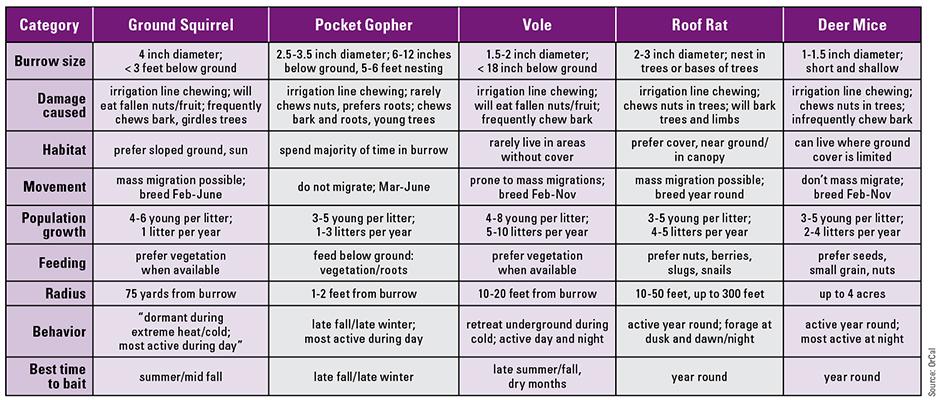
Graphic: OrCal
GO UNDERGROUND FOR GOPHERS
Pocket gophers require an entirely different approach. They spend most of their lives underground, feed on roots, and generally remain within their own burrow systems.
Growers using a probe must locate the active main run rather than simply treat a visible mound. Another option is a tractor-mounted burrow builder, which creates an artificial underground tunnel containing bait. The objective is for that artificial run to intersect natural gopher tunnels.
Soil conditions matter. Hajik said sufficient moisture is necessary for the artificial burrow to hold together.
Cover crops can even become part of the strategy. Hajik said they can help draw voles and gophers away from berms and tree rows toward row middles, where growers can concentrate baiting, burrow building, or discing.
The approach illustrates a broader principle: Equipment can be used not only for direct control but also to manipulate the environment in ways that make rodents easier to manage.
MORE RODENT CONTROL TOOLS IN THE BOX
Roof rats add still another equipment option. Hajik discussed both bait stations and snap traps, with station and trap placement based on how the rats move through the orchard. Regardless of the device, monitoring and maintenance remain important.
Natural predators can contribute as well. Owl boxes can encourage predators of gophers and voles, while elevated wooden hawk perches can provide raptors with open views for hunting ground squirrels.
Rodenticides remain another control option. Hajik discussed anticoagulants, such as diphacinone, as well as acute toxicants, such as zinc phosphide. Their characteristics and uses differ, making product selection, timing, placement, and adherence to label directions important.
But chemical control is only one component.
“Bait’s not the only thing you should be doing,” Hajik said. “It’s just one of the things to do.”
Ultimately, Hajik’s approach follows the IPM cycle: identify the pest, prevent where possible, monitor, choose appropriate options, act, and evaluate.
There is no single piece of equipment, bait, or practice for every orchard rodent.
The goal is to know what is causing the damage, match the tools to the pest, and act before that slow leak becomes a flat tire.
Subscribe Today For
