



How Revival of Public Plant Breeding Benefits Veggie Growers
 December 30, 2025
 Over the past five years, southeastern U. S. universities hired seven vegetable breeders who work on butter (lima) bean, broccoli, mustard greens, turnip greens, cantaloupe, cucumber, watermelon, pepper, and tomato.
Some of these positions were newly created because of the growing demand for tasty, nutritious vegetables that improve human health. In the 1990’s, university administrators assumed that plant breeding could be outsourced to private companies, and funds allocated to pay plant breeding faculty could be used for more “modern” disciplines, like biochemistry and molecular genetics.
The shortcoming of this market-driven approach is that large seed companies focus on major vegetable crops, like lettuce, tomato, and broccoli, and overlook leafy brassica greens and butter beans, crops of major importance in the Southeast.
Regional production of tomato and broccoli for national consumption means that firmness and shipping ability are emphasized, while to small growers who market locally, flavor is more important. Plant breeders working at land-grant universities are better positioned to address local concerns.
Cost Savings
Resistant cultivars (a.k.a., varieties) are often the cheapest and easiest way to manage vegetable diseases. Even if the seed of a new resistant, hybrid cultivar costs a bit more per acre, the returns in yield improvement make up for the increased seed cost..
For example, seed of ‘Speedway,’ a slicing cucumber susceptible to downy mildew, currently sells for $16 per 1,000 seeds, while seed of partially resistant ‘Bristol’ costs $21 per 1,000. The difference translates to an increased seed cost of $124/acre @1.5 lb seed/acre. In my tests, ‘Bristol’ outyielded ‘Speedway’ by 90 cartons/acre or $1,350/acre @$15.00/carton, ten times the extra cost of the seed.
Note that resistant cultivars still need to be sprayed for most foliar diseases, because resistance is not effective enough to forgo fungicides. In the cucumber study above, both cultivars were treated with chlorothalonil and cyazofamid (Ranman). The extra yield from ‘Bristol’ is the contribution of resistance.
Vegetable Quality vs. Resistance
A major hurdle to breeding disease-resistant vegetables is the strict requirements for sizes of fruit vegetables. After a resistant line is selected, further breeding or selection is needed to refine the characteristics of the fruit. For example, sliced cucumbers must be 6 inches long to be marketable. Seedless watermelons should weigh 15 pounds, which apparently is the maximum-size fruit that customers choose. Mountain tomatoes must be extra-large with a diameter greater than 2 ¾ inches. Produce not meeting these standards is graded out, donated, or composted, contributing to the 40% of food waste in the U.S.
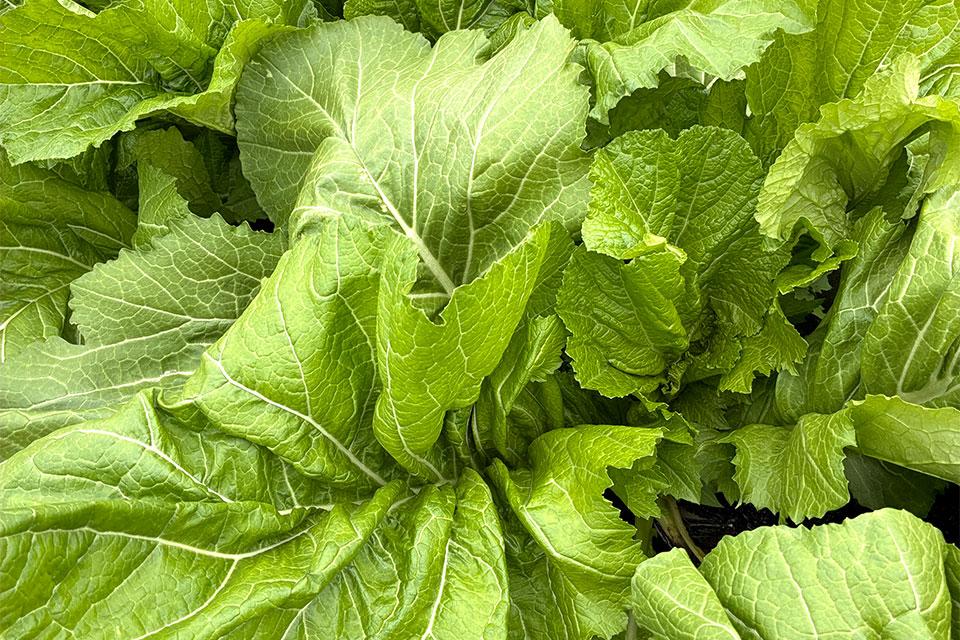
‘Charleston Broadleaf’ mustard resistant to bacterial blight.
Photo by Anthony Keinath
Some vegetable cultivars need to be tailored specifically to processing or fresh markets. Mustard greens for the fresh market are primarily curly leafed. Mustard greens for canning should have large, flat leaves with smooth margins and be slow to bolt. The resistant cultivar ‘Carolina Broadleaf” released in 2015 is grown for processing but is less desirable for fresh markets than the susceptible commercial cultivar ‘Florida Broadleaf.’ It has taken 10 years of additional part-time breeding to produce resistant ‘Charleston Broadleaf’ with leaf shape and delayed bolting more like ‘Florida Broadleaf.’
Expanding the Public Breeding Toolbox
Fortunately, creative plant breeders are finding ways to address these challenges.
Participatory plant breeding is catching on in multiple states. Growers walk through plots and select their favorite breeding lines, which are then retested the following year. Input from the end users early in the breeding process ensures that the new resistant cultivars also have the horticultural characteristics that growers need.
Advanced lines of processing pumpkin with improved resistance to powdery mildew developed at Cornell University were canned in a simulated processing facility. These tests confirmed that their purees matched the industry standard ‘Dickinson’ before releasing one as a cultivar.
Historical data on 73 collard lines were re-analyzed at Clemson University with current genomic techniques to identify two genes regulating bolting. This information can be used to breed collard cultivars less likely to bolt prematurely.
Field Book (https://breedinginsight.org/learning-hub/field-book/) is an app that enables efficient, accurate, electronic data collection in the field on thousands of breeding lines.
The Culinary Breeding Network (culinarybreedingnetwork.com), headquartered at Oregon State University, brings together plant breeders, chefs, farmers, and consumers to evaluate new cultivars for sustainability and taste.
Subscribe Today For
