



Using Propane For Weed Control
 January 1, 2010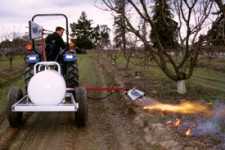
For growers looking for new ways to control weeds, a propane torch might be just the tool to add to your arsenal. Thermal weed control — or eliminating weeds with a propane flamer — can be a viable option for controlling weeds in orchards and vineyards. Flame weeders are typically placed on tractors, and the flames shoot toward the base of the crop, burning just the weeds.
Flaming, which is often used in organic production, is less labor-intensive than hand weeding, according to Doug Doohan, professor, department of horticulture and crop science at The Ohio State University. In a study Doohan and his colleagues conducted of flaming in cabbage and tomato crops, they found that morning flaming was more effective. The extra moisture early in the day helps to transfer the flame’s heat. The ideal temperature to reach was between 140°F and 160°F.
Overall, flaming can work quite well under the right conditions, Doohan says. “It is weather dependent. In a wetter year, there are going to be more weeds that come up,” he notes.
While the majority of the work Doohan has done has been with vegetable crops, he thinks flaming might actually be better suited to orchards and vineyards. “It can damage some vegetable crops. They recover from it, slowly or relatively fast, and there are probably some vegetable crops that can’t tolerate it at all,” Doohan says. “But we think that in an orchard or vineyard, the woody nature — the bark — is probably going to make tree and vine crops more resistant than vegetable crops would be.”
Best Uses
Flaming works best on broadleaf weeds, Doohan adds. Grasses and perennial weeds tend to be harder to control with flaming. “With perennial weeds, it’s going to basically work like a lawn mower,” he says. “It’s going to burn them back to the soil level.”
He adds that the more vegetation you have, the less effective flaming will be. “You’re working with units of heat and interacting with units of biological plant material that’s usually got a lot of water in it. So the more plant material you have, the more heat you’ll need.”
The smaller the weed seedling, the better, too, notes Doohan. “If you had a seedling that’s two inches high, like a pigweed seedling, I’m not certain that flaming would kill it.” He adds the main concern here is ensuring the flame is hot enough to kill the weeds while not harming the crop.
Doohan says he’d like to see some research on the use of flaming during an orchard’s or vineyard’s establishment period. Because the bark of young trees is still green and photosynthetic, it is much more sensitive to chemicals. The green bark absorbs the herbicides and can be easily damaged. “That would be a really great way to use a flamer, especially for organic producers,” he says.
Subscribe Today For
